READ · DISCOVER · ENJOYClassic literature · Always free
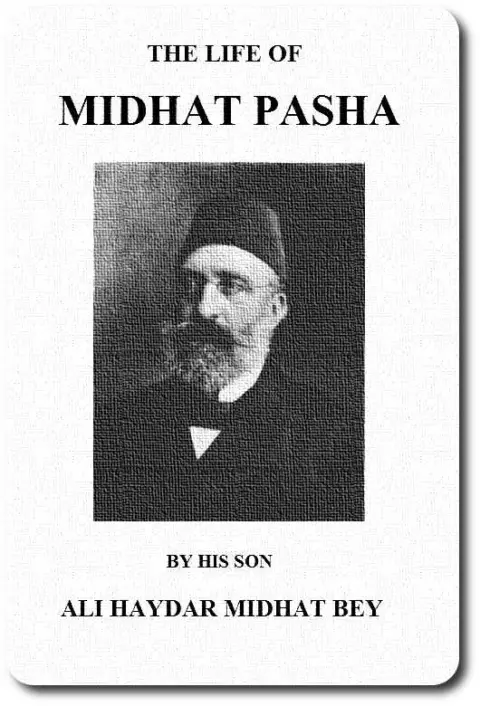
The life of Midhat Pasha; a record of his services, political reforms, banishment, and judicial murder — digital edition cover

THE CLASSIC COLLECTION · 1903

The life of Midhat Pasha; a record of his services, political reforms, banishment, and judicial murder

"The Life of Midhat Pasha: A Record of His Services, Political Reforms, Banishment, and Judicial Murder" by Ali Haydar Midhat Bey is a historical account written in the early 20th century. The book presents a detailed examination of the life and political reforms implemented by Midhat Pasha, a significant figure in the Ottoman Empire, emphasizing his contributions and eventual downfall amidst the turbulent dynamics of Turkish politics during his time. The opening of the book provides a preface by Midhat's son, Ali Haydar, explaining the impetus behind writing this account. He shares his personal experiences as Midhat Pasha's son, detailing the hardships he faced in exile and his desire to reveal the true story of his father's career and death. Midhat's influence in reforming the Ottoman political structure during a period marked by despotism is highlighted, indicating that his initiatives were often met with resistance from established powers. Ali Haydar underscores the oppressive environment of Sultan Abdul Hamid II's regime that ultimately led to his father's banishment and execution, setting the stage for an exploration of the broader historical context surrounding Midhat Pasha's legacy in the subsequent chapters.

Introduction adapted from the source catalogue; source summaries may be automatically generated.

Start reading ↓

Free to read · English · 99,680 words · No account needed

MAKE TIME FOR A GOOD BOOK

The life of Midhat Pasha; a record of his services, political reforms, banishment, and judicial murder

On by default. Untick to stop anonymous reading totals. Each page counts after 10 seconds in view. How this works.

Anonymous counting is on unless you have switched it off.

The life of Midhat Pasha; a record of his services, political reforms, banishment, and judicial murder

On the right of the throne stood the Ministers and high functionaries, the Chiefs of the Christian communities, and members of the Council of State; on the left, the Ulema, and Cadi, and Heads of the High Courts of Justice, with the Generals of Division; behind these the pages of the Court. Behind the throne were the Foreign Representatives, and interspersed between the groups on the right and left of the throne were the Senators and Representatives in the Parliament. The Sultan entered, dressed in black, and stood by the throne with his hand on his sword, whilst his First Secretary read the following Opening Speech:—

The Sultan’s Speech.

“SENATORS AND DEPUTIES,—GENTLEMEN,—The difficulties and dangers which our general situation presents cannot be compared to any of the crises through which the Empire has hitherto passed. I was obliged, first of all, in order to guard the rights of the Empire, to augment the effective force of our armies at various points, and to call under arms 700,000 combatants. Next I considered it a duty to try, by means of essential reforms, to put an end, with God’s help, to the disorder of the situation, and thus to insure our future in a permanent fashion. It is evident that, thanks to the resources with which Providence has endowed our country, and the aptitudes of our subjects, a good administration would enable us in a short time to make considerable progress. If we have not reached the level of progress of other parts of the civilised world, the cause of this must be traced to the instability of the institutions necessary to the State, and of the laws and regulations issuing therefrom. This instability proceeded from everything, being in the hands of an absolute Government, which disregarded the salutary principle of common deliberation. The progress effected by civilised States, the security and wealth they enjoy, are the fruit of the participation of all in the enactment of laws and in the administration of public affairs. This is why we thought it necessary to seek in that course the means of arriving at progress, and of enacting and enforcing laws adopted by the common consent of the population. For this purpose I have granted and promulgated the Constitution. By the promulgation of the Constitution, I have not simply designed to invite the population to share in the direction of public affairs; I have had the firm resolution of employing the deliberative system as an effective means for the amelioration of the administrative system of the country, to preserve it from maladministration and absolutism. Irrespective of these fundamental advantages, the Constitution guarantees the unity of the governed, and confirms the principle of the welfare and fraternal solidarity of the population; for our illustrious ancestors, having, by God’s grace, extended their possessions and aggrandised the Empire, have combined under their rule a large number of peoples. These peoples being of various nationalities and religions, it was desirable that a uniform law should unite and protect them all. I give thanks to Divine Providence for this legitimate aspiration being at length realised. Henceforth all my subjects will be considered children of the same country, and will be placed under the protection of one law. They will be designated by the name borne by the illustrious race of the Founders of the Empire—a name associated with the glorious annals of a history of 600 years. I have a firm conviction that from this moment all my subjects will unite their efforts to make the name Osmanli retain the force and power hitherto surrounding it. I am therefore resolved, in view of this ideal and these reasons, not to deviate from the course which I have just adopted, and ever to adhere closely to it. I expect from you a real and intelligent co‐operation, in order to derive legitimate benefit from the Constitution, which is based on justice and the public security. I have deemed it necessary to insure to all the advantages of liberty and equality, to abolish the system of arbitrariness, to enact and execute laws adopted in common accord with the population, and, lastly, to found our administrative system on constitutional and liberal principles. It is in order to realise this sincere desire that I have created and convoked your body, composed of the Senate and Chamber of Deputies. It now devolves on you faithfully and honestly to fulfil the legislative duties intrusted to your patriotism. In this task you should not be influenced by any personal considerations, but have in view only the faithful maintenance of the safety and welfare of the State and country. The improvements which we now need, and the reforms in all the public services, are of the highest importance. The gradual application of these measures depends on the accord which shall prevail among you. The Council of State is engaged in framing Bills which will be submitted to you. In the present Session you will have before you Bills on the Standing Orders of the Chamber, the Electoral Law, the General Law respecting the Vilayets and the Government of the Communes, the Municipal Law, the Civil Code of Procedure; the laws relative to the re‐organisation of the Tribunal and the mode of promoting and superannuating Judges, the Law concerning the functions and retiring pensions of all public functionaries in general, the Law of the Press, that respecting the Court of Accounts, and, lastly, the Budget Law. I desire that these different Bills be successively studied and discussed. You will have especially to occupy yourselves with the re‐organisation of the Tribunals, the only safeguard for the rights of everyone, and with the formation of the gendarmerie. In order to attain this end, it will be necessary to augment the amount of special grants for these two branches of the Service. As you will see from the Budget which will be submitted to the Chamber, our finances are in an extremely difficult situation. I recommend you, above all, to adopt common measures adapted to meet the difficulties of the situation and to restore our credit. You will have moreover, to take measures to insure the supply of funds required for urgent reforms. One of the greatest wants of our Empire and of our subjects is the development of agriculture and industry, and the progress of civilisation and of public wealth. This result can only be obtained by means of the development of public instruction. Measures with the object of improving educational establishments, and of fixing the programme of studies, will be submitted to the Chambers in the Session of next year. The Imperial Government attaches the greatest importance to the choice and appointment of the functionaries who will be called upon to apply and execute the above‐mentioned laws and those which will be ultimately promulgated for the working of the Constitution. Since my accession to the Throne I have given particular attention to this question. It is for this reason that I have decided on instituting, at my own expense, a special school for the education of administrative officials. As stated by the published organic regulations of that school, they will be admitted to the highest administrative and political posts. The pupils will be selected without distinction of religion, from all classes of my subjects. Their promotion will be according to the degree of their capacity. For nearly two years we have had to face internal complications. During this period, especially during the hostilities with Servia and Montenegro, our faithful subjects have given proofs of patriotism, and our troops have done, at the price of great suffering, acts of courage and bravery which I profoundly appreciate. In all questions we have only had the defence of our rights in view. The efforts we have made for this purpose have had the result of restoring peace with Servia. As to the decision we shall take in the negotiations with Montenegro, it will be referred to your deliberations at their first sitting. I advise you to be prompt in deciding. Our relations with friendly Powers are still marked by that courtesy and deference which are among the most precious rules for our State. Several months ago the Government of England proposed the meeting of a Conference in our capital for the consideration of the present questions. The bases proposed being also supported by the other Great Powers, our Sublime Porte consented to the meeting of the Conference. Though a definite understanding was not obtained in that Conference, we have given proofs of our sincere desire to defer to the wishes and counsels of friendly Powers. As to the causes of the non‐agreement of the Conference, these lay rather in the form and the mode of execution than in the substance. I thoroughly appreciate the imperative necessity of continuing the efforts for progress, by which so much has already been achieved, from the origin of the Tanzimat till this time, in all branches of the administration, and in the general condition of my Empire. All our efforts still tend towards that object. But on this occasion I considered it my duty to preserve the country from all attacks on its honour and independence. Time will prove the sincerity of our intentions. Our desire being in all cases to maintain our rights and independence, we adopt also for the future the same line of conduct. I rejoice to think that the proofs of moderation and sincerity furnished by our State, before and after the Conference, will have served to strengthen the bonds of friendship and sympathy which unite my Empire to the Concert of European Powers. May the Almighty deign to grant success to our common efforts!”

Your reading position is saved on this browser. Take it to another device with a library code. Reading pages adapt to text, rather than matching a printed edition.

BEHIND THE WORDS

About Ali Haydar Mithat

Ali Haydar Mithat (1872–1950). Explore The life of Midhat Pasha; a record of his services, political reforms, banishment, and judicial murder in this collection. These books span biography & memoir, history.

Explore this author’s books →

THE READERS’ VERDICT

How did this story stay with you?

Not rated yet
Your rating for The life of Midhat Pasha; a record of his services, political reforms, banishment, and judicial murder

Be the first to share your verdict.

One rating per browser, which you can change or remove. A necessary browser identifier remembers your vote. How ratings work

A GOOD STORY DESERVES COMPANY

Pass this book along.

A great read is even better when it’s shared.

SEND A LITTLE INSPIRATION

Share this book

BEHIND THE BOOK

Edition & source details.

Title
The life of Midhat Pasha; a record of his services, political reforms, banishment, and judicial murder
Author
Ali Haydar Mithat
First publication (Open Library catalogue match)
1903
Digital edition publisher
Project Gutenberg
Gutenberg release date
2016-02-17
Language
English
Source edition imprint
Not stated in source catalogue
Source identifier
Project Gutenberg #51243
Contributors
No additional named contributors in source metadata

Public-domain source & licence

This eBook is for the use of anyone anywhere in the United States and most other parts of the world at no cost and with almost no restrictions whatsoever. You may copy it, give it away or re-use it under the terms of the Project Gutenberg License included with this eBook or online at www.gutenberg.org. If you are not located in the United States, you will have to check the laws of the country where you are located before using this eBook. Read the source licence.

Full source licence and obtaining an original copy

The original source file, including credits and licence, is retained by this library. Request an original-format copy at no charge. Please include the book title and Project Gutenberg identifier #51243.

the full Project Gutenberg License must appear
prominently whenever any copy of a Project Gutenberg work (any work
on which the phrase “Project Gutenberg” appears, or with which the
phrase “Project Gutenberg” is associated) is accessed, displayed,
performed, viewed, copied or distributed:

This eBook is for the use of anyone anywhere in the United States and most
other parts of the world at no cost and with almost no restrictions
whatsoever. You may copy it, give it away or re-use it under the terms
of the Project Gutenberg™ License included with this eBook or online
at www.gutenberg.org. If you
are not located in the United States, you will have to check the laws
of the country where you are located before using this eBook.

1.E.2. If an individual Project Gutenberg electronic work is
derived from texts not protected by U.S. copyright law (does not
contain a notice indicating that it is posted with permission of the
copyright holder), the work can be copied and distributed to anyone in
the United States without paying any fees or charges. If you are
redistributing or providing access to a work with the phrase “Project
Gutenberg” associated with or appearing on the work, you must comply
either with the requirements of paragraphs 1.E.1 through 1.E.7 or
obtain permission for the use of the work and the Project Gutenberg
trademark as set forth in paragraphs 1.E.8 or 1.E.9.

1.E.3. If an individual Project Gutenberg electronic work is posted
with the permission of the copyright holder, your use and distribution
must comply with both paragraphs 1.E.1 through 1.E.7 and any
additional terms imposed by the copyright holder. Additional terms
will be linked to the Project Gutenberg License for all works
posted with the permission of the copyright holder found at the
beginning of this work.

1.E.4. Do not unlink or detach or remove the full Project Gutenberg
License terms from this work, or any files containing a part of this
work or any other work associated with Project Gutenberg.

1.E.5. Do not copy, display, perform, distribute or redistribute this
electronic work, or any part of this electronic work, without
prominently displaying the sentence set forth in paragraph 1.E.1 with
active links or immediate access to the full terms of the Project
Gutenberg License.

1.E.6. You may convert to and distribute this work in any binary,
compressed, marked up, nonproprietary or proprietary form, including
any word processing or hypertext form. However, if you provide access
to or distribute copies of a Project Gutenberg work in a format
other than “Plain Vanilla ASCII” or other format used in the official
version posted on the official Project Gutenberg website
(www.gutenberg.org), you must, at no additional cost, fee or expense
to the user, provide a copy, a means of exporting a copy, or a means
of obtaining a copy upon request, of the work in its original “Plain
Vanilla ASCII” or other form. Any alternate format must include the
full Project Gutenberg License as specified in paragraph 1.E.1.

1.E.7. Do not charge a fee for access to, viewing, displaying,
performing, copying or distributing any Project Gutenberg works
unless you comply with paragraph 1.E.8 or 1.E.9.

1.E.8. You may charge a reasonable fee for copies of or providing
access to or distributing Project Gutenberg electronic works
provided that:

• You pay a royalty fee of 20% of the gross profits you derive from
the use of Project Gutenberg works calculated using the method
you already use to calculate your applicable taxes. The fee is owed
to the owner of the Project Gutenberg trademark, but he has
agreed to donate royalties under this paragraph to the Project
Gutenberg Literary Archive Foundation. Royalty payments must be paid
within 60 days following each date on which you prepare (or are
legally required to prepare) your periodic tax returns. Royalty
payments should be clearly marked as such and sent to the Project
Gutenberg Literary Archive Foundation at the address specified in
Section 4, “Information about donations to the Project Gutenberg
Literary Archive Foundation.”

• You provide a full refund of any money paid by a user who notifies
you in writing (or by e-mail) within 30 days of receipt that s/he
does not agree to the terms of the full Project Gutenberg™
License. You must require such a user to return or destroy all
copies of the works possessed in a physical medium and discontinue
all use of and all access to other copies of Project Gutenberg™
works.

• You provide, in accordance with paragraph 1.F.3, a full refund of
any money paid for a work or a replacement copy, if a defect in the
electronic work is discovered and reported to you within 90 days of
receipt of the work.

• You comply with all other terms of this agreement for free
distribution of Project Gutenberg™ works.


1.E.9. If you wish to charge a fee or distribute a Project
Gutenberg™ electronic work or group of works on different terms than
are set forth in this agreement, you must obtain permission in writing
from the Project Gutenberg Literary Archive Foundation, the manager of
the Project Gutenberg™ trademark. Contact the Foundation as set
forth in Section 3 below.

1.F.

1.F.1. Project Gutenberg volunteers and employees expend considerable
effort to identify, do copyright research on, transcribe and proofread
works not protected by U.S. copyright law in creating the Project
Gutenberg™ collection. Despite these efforts, Project Gutenberg™
electronic works, and the medium on which they may be stored, may
contain “Defects,” such as, but not limited to, incomplete, inaccurate
or corrupt data, transcription errors, a copyright or other
intellectual property infringement, a defective or damaged disk or
other medium, a computer virus, or computer codes that damage or
cannot be read by your equipment.

1.F.2. LIMITED WARRANTY, DISCLAIMER OF DAMAGES - Except for the “Right
of Replacement or Refund” described in paragraph 1.F.3, the Project
Gutenberg Literary Archive Foundation, the owner of the Project
Gutenberg™ trademark, and any other party distributing a Project
Gutenberg™ electronic work under this agreement, disclaim all
liability to you for damages, costs and expenses, including legal
fees. YOU AGREE THAT YOU HAVE NO REMEDIES FOR NEGLIGENCE, STRICT
LIABILITY, BREACH OF WARRANTY OR BREACH OF CONTRACT EXCEPT THOSE
PROVIDED IN PARAGRAPH 1.F.3. YOU AGREE THAT THE FOUNDATION, THE
TRADEMARK OWNER, AND ANY DISTRIBUTOR UNDER THIS AGREEMENT WILL NOT BE
LIABLE TO YOU FOR ACTUAL, DIRECT, INDIRECT, CONSEQUENTIAL, PUNITIVE OR
INCIDENTAL DAMAGES EVEN IF YOU GIVE NOTICE OF THE POSSIBILITY OF SUCH
DAMAGE.

1.F.3. LIMITED RIGHT OF REPLACEMENT OR REFUND - If you discover a
defect in this electronic work within 90 days of receiving it, you can
receive a refund of the money (if any) you paid for it by sending a
written explanation to the person you received the work from. If you
received the work on a physical medium, you must return the medium
with your written explanation. The person or entity that provided you
with the defective work may elect to provide a replacement copy in
lieu of a refund. If you received the work electronically, the person
or entity providing it to you may choose to give you a second
opportunity to receive the work electronically in lieu of a refund. If
the second copy is also defective, you may demand a refund in writing
without further opportunities to fix the problem.

1.F.4. Except for the limited right of replacement or refund set forth
in paragraph 1.F.3, this work is provided to you ‘AS-IS’, WITH NO
OTHER WARRANTIES OF ANY KIND, EXPRESS OR IMPLIED, INCLUDING BUT NOT
LIMITED TO WARRANTIES OF MERCHANTABILITY OR FITNESS FOR ANY PURPOSE.

1.F.5. Some states do not allow disclaimers of certain implied
warranties or the exclusion or limitation of certain types of
damages. If any disclaimer or limitation set forth in this agreement
violates the law of the state applicable to this agreement, the
agreement shall be interpreted to make the maximum disclaimer or
limitation permitted by the applicable state law. The invalidity or
unenforceability of any provision of this agreement shall not void the
remaining provisions.

1.F.6. INDEMNITY - You agree to indemnify and hold the Foundation, the
trademark owner, any agent or employee of the Foundation, anyone
providing copies of Project Gutenberg™ electronic works in
accordance with this agreement, and any volunteers associated with the
production, promotion and distribution of Project Gutenberg™
electronic works, harmless from all liability, costs and expenses,
including legal fees, that arise directly or indirectly from any of
the following which you do or cause to occur: (a) distribution of this
or any Project Gutenberg work, (b) alteration, modification, or
additions or deletions to any Project Gutenberg work, and (c) any
Defect you cause.

Section 2. Information about the Mission of Project Gutenberg

Project Gutenberg is synonymous with the free distribution of
electronic works in formats readable by the widest variety of
computers including obsolete, old, middle-aged and new computers. It
exists because of the efforts of hundreds of volunteers and donations
from people in all walks of life.

Volunteers and financial support to provide volunteers with the
assistance they need are critical to reaching Project Gutenberg’s
goals and ensuring that the Project Gutenberg collection will
remain freely available for generations to come. In 2001, the Project
Gutenberg Literary Archive Foundation was created to provide a secure
and permanent future for Project Gutenberg and future
generations. To learn more about the Project Gutenberg Literary
Archive Foundation and how your efforts and donations can help, see
Sections 3 and 4 and the Foundation information page at www.gutenberg.org.

Section 3. Information about the Project Gutenberg Literary Archive Foundation

The Project Gutenberg Literary Archive Foundation is a non-profit
501(c)(3) educational corporation organized under the laws of the
state of Mississippi and granted tax exempt status by the Internal
Revenue Service. The Foundation’s EIN or federal tax identification
number is 64-6221541. Contributions to the Project Gutenberg Literary
Archive Foundation are tax deductible to the full extent permitted by
U.S. federal laws and your state’s laws.

The Foundation’s business office is located at 41 Watchung Plaza #516,
Montclair NJ 07042, USA, +1 (862) 621-9288. Email contact links and up
to date contact information can be found at the Foundation’s website
and official page at www.gutenberg.org/contact

Section 4. Information about Donations to the Project Gutenberg
Literary Archive Foundation

Project Gutenberg™ depends upon and cannot survive without widespread
public support and donations to carry out its mission of
increasing the number of public domain and licensed works that can be
freely distributed in machine-readable form accessible by the widest
array of equipment including outdated equipment. Many small donations
($1 to $5,000) are particularly important to maintaining tax exempt
status with the IRS.

The Foundation is committed to complying with the laws regulating
charities and charitable donations in all 50 states of the United
States. Compliance requirements are not uniform and it takes a
considerable effort, much paperwork and many fees to meet and keep up
with these requirements. We do not solicit donations in locations
where we have not received written confirmation of compliance. To SEND
DONATIONS or determine the status of compliance for any particular state
visit www.gutenberg.org/donate.

While we cannot and do not solicit contributions from states where we
have not met the solicitation requirements, we know of no prohibition
against accepting unsolicited donations from donors in such states who
approach us with offers to donate.

International donations are gratefully accepted, but we cannot make
any statements concerning tax treatment of donations received from
outside the United States. U.S. laws alone swamp our small staff.

Please check the Project Gutenberg web pages for current donation
methods and addresses. Donations are accepted in a number of other
ways including checks, online payments and credit card donations. To
donate, please visit: www.gutenberg.org/donate.

Section 5. General Information About Project Gutenberg electronic works

Professor Michael S. Hart was the originator of the Project
Gutenberg concept of a library of electronic works that could be
freely shared with anyone. For forty years, he produced and
distributed Project Gutenberg eBooks with only a loose network of
volunteer support.

Project Gutenberg eBooks are often created from several printed
editions, all of which are confirmed as not protected by copyright in
the U.S. unless a copyright notice is included. Thus, we do not
necessarily keep eBooks in compliance with any particular paper
edition.

Most people start at our website which has the main PG search
facility: www.gutenberg.org.

This website includes information about Project Gutenberg,
including how to make donations to the Project Gutenberg Literary
Archive Foundation, how to help produce our new eBooks, and how to
subscribe to our email newsletter to hear about new eBooks.


KEEP YOUR CURIOSITY GOING

Your next chapter awaits.

Your privacy choices

Reading is always free. You can change these settings at any time.

Book banners link to our books on simonward.net. They do not use advertising cookies or tracking.

Privacy & cookie policy · Reading data and privacy controls