THE CLASSIC COLLECTION✦An outlaw’s diary: the CommuneCLASSIC FREE BOOKS
An outlaw’s diary: the Commune
Cécile Tormay
THE CLASSIC COLLECTION · 1870
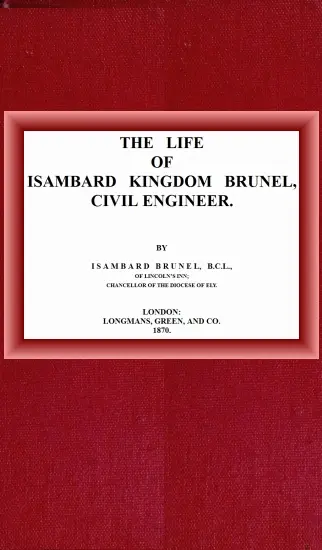
"The Life of Isambard Kingdom Brunel, Civil Engineer" by Isambard Brunel is a historical account written in the late 19th century. This work narrates the life and achievements of the renowned civil engineer Isambard Kingdom Brunel, detailing his influential contributions to engineering projects such as the Great Western Railway and the Thames Tunnel. The book serves as both a biography and a technical record of Brunel's revolutionary work that shaped the landscape of 19th-century engineering. The opening of the narrative introduces Isambard Kingdom Brunel, born in 1806, as the son of Sir Marc Isambard Brunel, outlining his early life and education. It emphasizes his father's engineering prowess and the profound influence he had on Isambard's formative years. The manuscript sets the stage for a detailed chronicle of Brunel's significant engineering projects, beginning with his involvement in the Thames Tunnel and the innovative techniques employed during its construction. The narrative reveals Brunel's early insights and precocious talent, establishing a foundation for understanding his later accomplishments in civil engineering.
Introduction adapted from the source catalogue; source summaries may be automatically generated.
Free to read · English · 205,064 words · No account needed
MAKE TIME FOR A GOOD BOOK
On by default. Untick to stop anonymous reading totals. Each page counts after 10 seconds in view. How this works.
Anonymous counting is on unless you have switched it off.
[149] The power of blowing off the steam without noise is of great importance, and Mr. Brunel made many experiments on the point. The noise of the steam blowing off, when the engines of a ship are stopped for fear of an impending collision or other accident, is so great, that it is almost impossible to hear any orders that may be given.
[150] The screw propeller of ‘Agamemnon’ was broken in a trial trip outside Plymouth Sound, on November 9, 1853; and the result was that, from not having efficient governors, the engines flew round at an alarming speed.
[151] Mr. Russell’s works. The ship was built in a yard immediately
adjoining them.
[152] See, for example, an article in the Quarterly Review of March 1856, entitled ‘The Triton and the Minnows.’
[153] It must be remembered that this report describes the ship as she was at that time designed by Mr. Brunel.
[154] Extract from memoranda of October 5, 1855:--
‘By constant observation, to lay down position and course of ship, and
correct compasses.
‘To record speed of ship through water by logs.
‘Revolution of engines.
‘Force and direction of wind.
‘Draught and trim of ship, sails carried, &c.
‘Temperature and peculiarities of sea water.
‘As the result of these observations, to plot down hour by hour the position of the ship, to compute the speed, variations of compass, the direction and force of current, and true direction and force of the wind.’
[155] Mr. Brunel also proposed to have charts prepared for the route of the great ship to Australia and Calcutta, similar in character to some which were made under his directions for the route of the ‘Great Western’ to New York, which he described as follows:--
‘When we started the “Great Western” to New York, I had a chart drawn and engraved of the sea (that is, the lines of latitude and longitude, and the bearings of the compass, and the coast and soundings) on a cylindrical projection of a great circle from Bristol to New York; and we found it very useful for the captain to see his great circle sailing, and to see how much he was deviating from it.’
[156] Captain Harrison’s command of the ‘Great Eastern’ after she left the river was unhappily of but short duration, as he was drowned by the accidental upsetting of his boat in Southampton Water on January 21, 1860, four months after Mr. Brunel’s death.
[157] With this paper Mr. Brunel enclosed a letter, in which he points out with great earnestness the responsibility of his own position.
After calling the Directors’ attention to the important step they were about to take, he proceeds:--
Your reading position is saved on this browser. Take it to another device with a library code. Reading pages adapt to text, rather than matching a printed edition.
BEHIND THE BOOK
This eBook is for the use of anyone anywhere in the United States and most other parts of the world at no cost and with almost no restrictions whatsoever. You may copy it, give it away or re-use it under the terms of the Project Gutenberg License included with this eBook or online at www.gutenberg.org. If you are not located in the United States, you will have to check the laws of the country where you are located before using this eBook. Read the source licence.
The original source file, including credits and licence, is retained by this library. Request an original-format copy at no charge. Please include the book title and Project Gutenberg identifier #41210.
KEEP YOUR CURIOSITY GOING
Cécile Tormay

Moritz Busch
John L. Ransom
Frances Wright
Cécile Tormay

Mabel Potter Daggett