THE CLASSIC COLLECTION✦An outlaw’s diary: the CommuneCLASSIC FREE BOOKS
An outlaw’s diary: the Commune
Cécile Tormay
THE CLASSIC COLLECTION · 1870
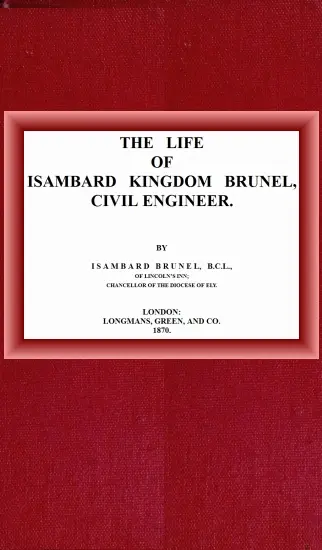
"The Life of Isambard Kingdom Brunel, Civil Engineer" by Isambard Brunel is a historical account written in the late 19th century. This work narrates the life and achievements of the renowned civil engineer Isambard Kingdom Brunel, detailing his influential contributions to engineering projects such as the Great Western Railway and the Thames Tunnel. The book serves as both a biography and a technical record of Brunel's revolutionary work that shaped the landscape of 19th-century engineering. The opening of the narrative introduces Isambard Kingdom Brunel, born in 1806, as the son of Sir Marc Isambard Brunel, outlining his early life and education. It emphasizes his father's engineering prowess and the profound influence he had on Isambard's formative years. The manuscript sets the stage for a detailed chronicle of Brunel's significant engineering projects, beginning with his involvement in the Thames Tunnel and the innovative techniques employed during its construction. The narrative reveals Brunel's early insights and precocious talent, establishing a foundation for understanding his later accomplishments in civil engineering.
Introduction adapted from the source catalogue; source summaries may be automatically generated.
Free to read · English · 205,064 words · No account needed
MAKE TIME FOR A GOOD BOOK
On by default. Untick to stop anonymous reading totals. Each page counts after 10 seconds in view. How this works.
Anonymous counting is on unless you have switched it off.
Great Western Railway, origin of the, 63.
Mr. Brunel appointed engineer, 64.
Survey of the country, 65.
Bill for a line from London to Reading, and Bath to Bristol, read a second time, and referred to a committee, 66.
Opposition to the Bill, 67.
Plan of entering London, 68.
Mr. Brunel’s cross-examination, 69.
The Bill passed by the Commons, but thrown out in the Lords, 70.
A Bill for the whole line introduced, read a second time, and committed, 71.
Evidence taken before the Commons’ Committee, 72.
Evidence before the Lords’ Committee, 73.
The Bill receives the Royal Assent, 74.
Construction of the line, 80.
Opening from London to Bristol, 80.
Levels and inclines, 80, 104.
The Box Tunnel, 81.
The Bath and Bristol stations, 84.
Paddington station, 84.
Branches and extensions of the railway, 86, 88, 90.
Adoption of the broad gauge, 106.
The permanent way, 108, 111.
Meeting of shareholders on broad gauge, 111.
Extension of the Great Western system, 116
‘Great Western’ steam-ship, formation of the company, 233.
Details of the construction of the vessel, 234 note^{2}.
Report on the selection of the builders of the engines, 235.
Controversy with Dr. Lardner, 237.
Launch of the vessel, and voyage to London, 241.
Return to Bristol, 242.
Fire on board, and accident to Mr. Brunel, 242.
First voyage to New York, 243.
Subsequent history, 244.
Dimensions of ship and engines, 245
Gunnery experiments, 452
Guppy, T. R., 148, 233, 234, 247, 253, 254.
Letter to, on iron-ship building, 259
Hammond, J. W., 65, 92
Hanwell, bridge at, destroyed by fire, 190
Hanwell viaduct, 172
Harrison, Captain, 223.
Appointed commander of the ‘Great Eastern,’ 323.
Letter to, on the river tackle, 354.
At the launch, 362, 370, 382, 392
Haverfordwest, opening bridge at, 198
Hawkshaw, J., 57.
Report on broad gauge and permanent way, 107
Henley branch of the Great Western Railway, 86
Hungerford Suspension Bridge, 57, 59
India, railway works in, 91
Indian Cable expedition of the ‘Great Eastern,’ 414
Institution of Civil Engineers, 516 note^{2}, 521
Inventors, communications with, 485
Ireland, railway works in, 90
Italy, Mr. Brunel’s railway works in, 91, 510
Ivybridge viaduct, 182
Kennet, bridge over the river, 175
Kidwelly, opening bridge at, 198
Kyanising process, 189, 421
Landore, viaduct at, 183
Lane, Michael, 29
Lardner, Dr., 114 note^{1}.
Opinions respecting ocean steam navigation, 237
Llansamlet, flying arches near, 176
Llynvi Valley Railway, 89
Locke, Joseph, 62, 74.
His address on the death of Mr. Brunel, 521
Locomotive power, comparison of, with stationary power, 142, 166
Loughor, opening bridge at, 197
Maidenhead bridge, 96, 173
Masonry, bridges in, 172
Maudslay and Field, 15, 148, 236, 284
Milford Haven, 88, 443
Monkwearmouth, docks at, 417, 418
Moulsford, bridge at, 174
Nasmyth, James, his steam hammer designed, 252 note^{1}. Letter to, on gunnery experiments, 452
Neath, improvement of river, 438 note^{1}
Newport viaduct, 185, 199
Neyland, pier at, 443
Ocean steam navigation, Mr. Brunel’s connection with, 231, 313
Opening bridges, 195
Oxford, Mr. Brunel created a Doctor in Civil Law at, 516
Oxford and Rugby extension of the Great Western Railway, 90, 116
Oxford branch of the Great Western Railway, 86
Oxford, Worcester, and Wolverhampton Railway, 90, 116
Paddington station, 84
Paris Exhibition of 1855, letter on decorations conferred at, 489
Parkes, Dr., medical superintendent of Renkioi Hospital, 468. Report of, on hospital buildings, 468
Your reading position is saved on this browser. Take it to another device with a library code. Reading pages adapt to text, rather than matching a printed edition.
BEHIND THE BOOK
This eBook is for the use of anyone anywhere in the United States and most other parts of the world at no cost and with almost no restrictions whatsoever. You may copy it, give it away or re-use it under the terms of the Project Gutenberg License included with this eBook or online at www.gutenberg.org. If you are not located in the United States, you will have to check the laws of the country where you are located before using this eBook. Read the source licence.
The original source file, including credits and licence, is retained by this library. Request an original-format copy at no charge. Please include the book title and Project Gutenberg identifier #41210.
KEEP YOUR CURIOSITY GOING
Cécile Tormay

Moritz Busch
John L. Ransom
Frances Wright
Cécile Tormay

Mabel Potter Daggett