THE CLASSIC COLLECTION✦An outlaw’s diary: the CommuneCLASSIC FREE BOOKS
An outlaw’s diary: the Commune
Cécile Tormay
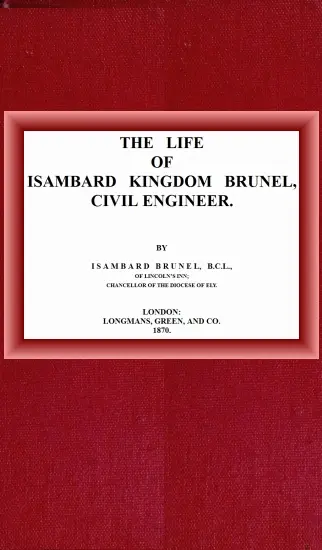
THE CLASSIC COLLECTION · 1870
"The Life of Isambard Kingdom Brunel, Civil Engineer" by Isambard Brunel is a historical account written in the late 19th century. This work narrates the life and achievements of the renowned civil engineer Isambard Kingdom Brunel, detailing his influential contributions to engineering projects such as the Great Western Railway and the Thames Tunnel. The book serves as both a biography and a technical record of Brunel's revolutionary work that shaped the landscape of 19th-century engineering. The opening of the narrative introduces Isambard Kingdom Brunel, born in 1806, as the son of Sir Marc Isambard Brunel, outlining his early life and education. It emphasizes his father's engineering prowess and the profound influence he had on Isambard's formative years. The manuscript sets the stage for a detailed chronicle of Brunel's significant engineering projects, beginning with his involvement in the Thames Tunnel and the innovative techniques employed during its construction. The narrative reveals Brunel's early insights and precocious talent, establishing a foundation for understanding his later accomplishments in civil engineering.
Introduction adapted from the source catalogue; source summaries may be automatically generated.
Free to read · English · 205,064 words · No account needed
MAKE TIME FOR A GOOD BOOK
On by default. Untick to stop anonymous reading totals. Each page counts after 10 seconds in view. How this works.
Anonymous counting is on unless you have switched it off.
Dublin, railway to Wicklow from, 91
Dundrum Bay, stranding of the ‘Great Britain’ in, 263
Early life of Mr. Brunel.
He goes to school at Chelsea, 4; at Brighton, 4; at Paris, 5.
Employed in his father’s office, 5.
Engaged at the Thames Tunnel, 6.
References by Sir I. Brunel to his exertions, 17, 19, 21, 22, 25, 33.
Appointed resident engineer, 25 note^{1}.
First irruption of the river, 29.
Second irruption, 35.
Accident, 36.
Visit to Plymouth, 46
Eastern Bengal Railway, 91, 195, 517
Eastern Counties Railway, gauge adopted on the, 105
Eastern Steam Navigation Company, formation of the, 291.
See ‘Great Eastern’
Egypt, visit to, 517
Electric telegraph, application of the, in connection with railways, 155
Engineer, Mr. Brunel’s view of the position of, 475.
Of joint-engineer, 476.
Of consulting engineer, 477.
Of the position of the engineer in relation to the contractors, 477.
To the Directors, 478.
Remarks on interference of Directors with assistant engineers, 481.
On State control over engineering works, 486
Experiments:
Strength of timber, 182, 227.
Cast-iron girders, 190, 191.
Wrought-iron girder, 193.
Riveting, 194, 228.
Continuous beams, 209, 229.
Bridge construction, 227.
Ropes and chains, 228.
Friction, 348, 368, 385
Faraday, M., his experiments on the liquefaction of gases, 42. Consulted by Mr. Brunel on the Kyanising process, 189
Field, Cyrus, 411, 414
Field, J., consulted by Mr. Brunel on the ‘Great Eastern,’ 297
Floating gun-carriage, 454
Floating harbour at Bristol, 422
Floating pier, proposed at Portishead, 426.
In Mill Bay, 436
Florence and Pistoja Railway, 91
Flying bridges, 176
Ford, Captain Robert, consulted by Mr. Brunel on the ‘Great Eastern,’ 297
Friction, experiments and observations on, 348, 368, 385
Froude, W., letter to, describing floating of the ‘Great Eastern,’ 389
Gathampton, bridge at, 174
Genoa, Novi, and Alessandria Railway, 91
Gauge of railways, difference between the broad and narrow, 99.
Origin of the ordinary gauge, 99.
Adoption of the broad gauge on the Great Western Railway, 101, 106.
Reasons for its adoption, 102.
Attacks on, 106.
Reports of Mr. Wood and Mr. Hawkshaw on, 107.
Report by Mr. Brunel on, 107.
Northern extension, 116.
Inconveniences of a break of gauge, 116.
Royal Commission on the gauge question, 117.
Report of the Commissioners, 117.
‘Observations on the Report,’ 119.
Report of the Board of Trade, 122.
Act for regulating gauge, 122.
The mixed gauge, 124.
Summary of the advantages of the broad gauge, 127.
Partial abandonment of the broad gauge, 127, 129.
Report on the broad gauge, 525
Gilbert, Davies, appointed referee in the second competition for the Clifton Suspension Bridge, 52. Recommends Mr. Brunel’s design, 53
Girder bridges, 193
Glennie, W., 215 note^{1}
Gloucester, opening bridges near, 196
Gloucester and Dean Forest Railway, 88
Gooch, Sir Daniel, 117, 119.
Experiments by, 125
Gravatt, William, an assistant engineer at the Thames Tunnel, 26
‘Great Britain’ steam-ship, commencement of the, 247.
Report on the engines, 249.
Adoption of the screw propeller, 254.
Principal features of her design, 255.
Arrives in the Thames, 261.
Her voyages, 262.
Stranded in Dundrum Bay, 263.
Letter from Mr. Brunel on the subject, 264.
His reports to the Directors, 267, 273.
Construction of breakwater, 274.
Floating of the ship, 280.
Her subsequent history, 282.
Dimensions of ship and engines, 282
Your reading position is saved on this browser. Take it to another device with a library code. Reading pages adapt to text, rather than matching a printed edition.
BEHIND THE BOOK
This eBook is for the use of anyone anywhere in the United States and most other parts of the world at no cost and with almost no restrictions whatsoever. You may copy it, give it away or re-use it under the terms of the Project Gutenberg License included with this eBook or online at www.gutenberg.org. If you are not located in the United States, you will have to check the laws of the country where you are located before using this eBook. Read the source licence.
The original source file, including credits and licence, is retained by this library. Request an original-format copy at no charge. Please include the book title and Project Gutenberg identifier #41210.
KEEP YOUR CURIOSITY GOING
Cécile Tormay

Moritz Busch
John L. Ransom
Frances Wright
Cécile Tormay

Mabel Potter Daggett