THE CLASSIC COLLECTION✦An outlaw’s diary: the CommuneCLASSIC FREE BOOKS
An outlaw’s diary: the Commune
Cécile Tormay
THE CLASSIC COLLECTION · 1870
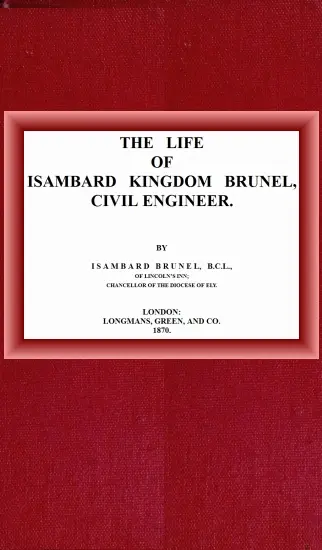
"The Life of Isambard Kingdom Brunel, Civil Engineer" by Isambard Brunel is a historical account written in the late 19th century. This work narrates the life and achievements of the renowned civil engineer Isambard Kingdom Brunel, detailing his influential contributions to engineering projects such as the Great Western Railway and the Thames Tunnel. The book serves as both a biography and a technical record of Brunel's revolutionary work that shaped the landscape of 19th-century engineering. The opening of the narrative introduces Isambard Kingdom Brunel, born in 1806, as the son of Sir Marc Isambard Brunel, outlining his early life and education. It emphasizes his father's engineering prowess and the profound influence he had on Isambard's formative years. The manuscript sets the stage for a detailed chronicle of Brunel's significant engineering projects, beginning with his involvement in the Thames Tunnel and the innovative techniques employed during its construction. The narrative reveals Brunel's early insights and precocious talent, establishing a foundation for understanding his later accomplishments in civil engineering.
Introduction adapted from the source catalogue; source summaries may be automatically generated.
Free to read · English · 205,064 words · No account needed
MAKE TIME FOR A GOOD BOOK
On by default. Untick to stop anonymous reading totals. Each page counts after 10 seconds in view. How this works.
Anonymous counting is on unless you have switched it off.
The mode of laying the rails is the next point which I shall consider. It may appear strange that I should again in this case disclaim having attempted anything perfectly new; yet regard to truth compels me to do so. I have recommended, in the case of the Great Western, the principle of a continuous bearing of timber under the rail, instead of isolated supports--an old system recently revived, and as such I described it in my Report of January 1836; the result of many hundred miles laid in this manner in America, and of some detached portions of railways in England, was quite sufficient to prove that the system was attended with many advantages; but since we first adopted it these proofs have been multiplied--there need now be no apprehension. There are railways in full work, upon which the experiment has been tried sufficiently to prove beyond doubt, to those willing to be convinced, that a permanent way in continuous bearings of wood may be constructed, in which the motion will be much smoother, the noise less, and consequently--for they are effects produced by the same cause--the wear and tear of the machinery much less. Such a plan is certainly best adapted for high speeds, and this is the system recommended by me and adopted on our road. There are, no doubt, different modes of construction, and that which I have adopted as an improvement upon others may, on the contrary, be attended with disadvantages. For the system I will strenuously contend.
But I should be sorry to enter with any such determined feeling into a discussion of the merits of the particular mode of construction. I would refer to my last Report for the reasons which influenced me, and the objects I had in view in introducing the piling; that part which had been made under my own eye answered fully all my expectations. Here the piles did answer their purpose, and no inconvenience resulted from their use. The difficulties which we have since encountered, the bad state in which the line was for a considerable time, and which is only recently improved, have undoubtedly been aggravated, if not caused, by these piles; but not, as I believe, from a defect in the principle as applied in our case, where the line is mostly in cutting, or on the surface, but from defective execution; for, notwithstanding the determination to allow sufficient time for this most important operation, yet, to make up for previous delays and loss of time, it became necessary at last to force forward the work more rapidly than was at all consistent with due care in the execution; and during the whole of this period I was most unfortunately prevented by a serious accident from even seeing the work almost until the day of opening, when I ought to have personally superintended the whole. I do not mean that the work was neglected by those whose duty it was to supply my place--far from it; but in such a case, a new work cannot be properly directed except under the eye of the master. Following exactly the plan which had succeeded on the first piece completed, several serious faults were committed. A much greater density and firmness of packing is required than was previously supposed; the mode of packing adopted, and the material selected, in the first instance, have proved defective elsewhere; and over a great extent in the line, particularly in the clay cuttings, and where the work was at last most hurried, it has been badly executed. But many parts have stood well from the commencement; others are fast improving; and I have the satisfaction, although a very painful one, of seeing that if, in the first instance, a foundation of coarse gravel had been everywhere well rammed in before the timbers had been laid, and the packing formed upon this, we should, from the outset, have obtained as solid a road as we have now over a great part of the line. What we have been able to effect since the opening of the line has necessarily been a slow, expensive, and laborious operation. We have been compelled to open the ground, and excavate it to a depth of 18 inches under the longitudinal timbers, and this without interrupting the traffic: to remove the whole of the material thus obtained from off the line, and to replace it by coarse ballast; and not having the means of sufficiently consolidating this ballast by ramming while the timber is in its place, the packing has to be repeated once or twice after it has been compressed by the passing of the trains. This new packing, however, does stand, and in a few weeks I expect the line will be in a very different state from that in which it has been, or indeed now is. From what I have described as the result which can now be, and might have been, obtained from the commencement, it will be inferred that I am disposed still to defend the system of piling. I certainly could not abandon it from conviction of its inefficiency, for I see proofs of the contrary; and I feel that under similar circumstances I could now prevent the mischief which has occurred. Upon that portion of the line where the permanent way must next be formed, piling could not be resorted to, the ground being a solid hard chalk for many miles. I had intended, however, recommending the same principle, but in a different form, holding down the longitudinals by small iron rods driven into the chalk; but the same objection could not exist, because the chalk cannot yield under the timbers like clay, or even gravel. But I should wish most anxiously to avoid anything like an obstinate adherence to a plan, if the object which I believe essential can be obtained by other means, particularly when, that plan being my own, I may be somewhat prejudiced in its favour. I find that the system of piling involves considerable expenses in the first construction, and requires perhaps too great a perfection in the whole work, and that if the whole or a part of this cost were expended in increased scantling of timber and weight of metal, that a very solid continuous rail would be formed.
Your reading position is saved on this browser. Take it to another device with a library code. Reading pages adapt to text, rather than matching a printed edition.
BEHIND THE BOOK
This eBook is for the use of anyone anywhere in the United States and most other parts of the world at no cost and with almost no restrictions whatsoever. You may copy it, give it away or re-use it under the terms of the Project Gutenberg License included with this eBook or online at www.gutenberg.org. If you are not located in the United States, you will have to check the laws of the country where you are located before using this eBook. Read the source licence.
The original source file, including credits and licence, is retained by this library. Request an original-format copy at no charge. Please include the book title and Project Gutenberg identifier #41210.
KEEP YOUR CURIOSITY GOING
Cécile Tormay

Moritz Busch
John L. Ransom
Frances Wright
Cécile Tormay

Mabel Potter Daggett