THE CLASSIC COLLECTION✦An outlaw’s diary: the CommuneCLASSIC FREE BOOKS
An outlaw’s diary: the Commune
Cécile Tormay
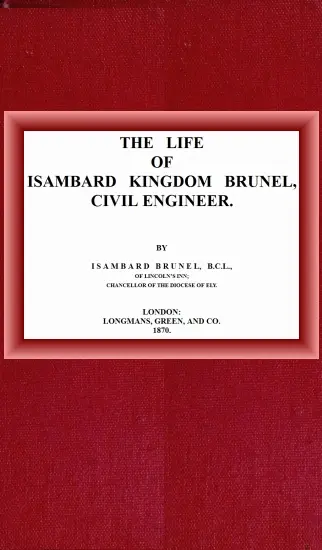
THE CLASSIC COLLECTION · 1870
"The Life of Isambard Kingdom Brunel, Civil Engineer" by Isambard Brunel is a historical account written in the late 19th century. This work narrates the life and achievements of the renowned civil engineer Isambard Kingdom Brunel, detailing his influential contributions to engineering projects such as the Great Western Railway and the Thames Tunnel. The book serves as both a biography and a technical record of Brunel's revolutionary work that shaped the landscape of 19th-century engineering. The opening of the narrative introduces Isambard Kingdom Brunel, born in 1806, as the son of Sir Marc Isambard Brunel, outlining his early life and education. It emphasizes his father's engineering prowess and the profound influence he had on Isambard's formative years. The manuscript sets the stage for a detailed chronicle of Brunel's significant engineering projects, beginning with his involvement in the Thames Tunnel and the innovative techniques employed during its construction. The narrative reveals Brunel's early insights and precocious talent, establishing a foundation for understanding his later accomplishments in civil engineering.
Introduction adapted from the source catalogue; source summaries may be automatically generated.
Free to read · English · 205,064 words · No account needed
MAKE TIME FOR A GOOD BOOK
On by default. Untick to stop anonymous reading totals. Each page counts after 10 seconds in view. How this works.
Anonymous counting is on unless you have switched it off.
There is another very serious evil produced by the system. In taking out a patent, the necessity for avoiding all claim to anything that can be shown to have been patented or in common use before compels you in most cases to seek rather what part of it can best be patented than what it is that is good in the invention. Comparatively trivial points are frequently patented in order to secure the monopoly of that which, although it constitutes the merit of the invention, may not happen to be so new in every respect as to admit of a patent. When the patent is taken, other modes of carrying out the real invention are discovered; these modes are patented and the original patentee is obliged to lose the benefit of his invention or to buy up these new patents. There are instances where enormous sums have been spent in this manner to protect an original invention.
And, lastly, there is an evil which acts like a numbing disease on all improvements; a patentee frequently dares not himself introduce improvements in any apparatus or process which he has patented, for fear of thus injuring his patent; and I have seen numerous cases of very important inventions where all improvement has been thus checked and resisted by the very parties most capable of effecting them, and who would have brought great talent and zeal to the work if they had been free.
Extract from Observations on the Patent Laws made by Mr. Brunel at a Meeting of the Society of Arts.
March 28, 1856.
He did not agree at all as to the advantages of patents. He quite agreed as to the desirability of protecting, as far as possible, a man’s property, whether it was in the power of invention, or any other good thing that was within him, and still more would he protect in every possible way the property in inventions of those who possessed but little other property--the powers of the inventor and the ingenuity of the workman; but, having had some considerable experience with patentees, manufacturers, and workmen, he was of opinion that any practical benefits derived from the patent laws did not compensate for the injury inflicted. He believed, on the contrary, that both the inventors and the public greatly suffered from the attempt to protect inventions. He had had great experience on this subject, being compelled daily to examine inventions of various kinds, and having himself constantly to invent in the occupations in which he was engaged. Having, then, all his life, been connected with inventors and workmen, he had witnessed the injury, the waste of mind, the waste of time, the excitement of false hopes, the vast waste of money, caused by the patent laws, in fact, all the evils which generally resulted from the attempt to protect that which did not naturally admit of protection. He agreed as to the abstract desirability of protecting inventors in some way, provided it did not foster unhealthy invention, as he thought it desirable to protect every species of property that existed. He was disposed to encourage every step towards facilitating the obtaining patents; he hoped they would be made dirt cheap, as he thought that would be the most effectual way of destroying them altogether. Therefore, whenever he had been consulted on the subject of the patent laws, he had always advocated the rendering of patents as open and free and cheap as possible; in the first place, because he saw no reason for attaching a price to them, and next, because they would sooner arrive where the principle would be fully tested. We were already nearly arrived at that state of things when engineers were almost brought to a dead stand in their attempt to introduce improvements, from the excess of protection. He found that he could hardly introduce the slightest improvement in his own machinery without being stopped by a patent. He could mention a striking instance, in which, a few months ago, wishing to introduce an improvement that he thought would have been valuable to the public in a large work on which he was engaged, he had no sooner entered upon it, with a willingness to incur considerable expense in the preliminary requirements and in the trial of it, than he was stopped by a patentee; but he was fortunate enough to find that another patent existed of the same thing, and a week after a third appeared. There was thus, fortunately, a probability that, by the destruction of all value in any of the patents, he might be able to continue the improvements he was desirous of introducing.
Your reading position is saved on this browser. Take it to another device with a library code. Reading pages adapt to text, rather than matching a printed edition.
BEHIND THE BOOK
This eBook is for the use of anyone anywhere in the United States and most other parts of the world at no cost and with almost no restrictions whatsoever. You may copy it, give it away or re-use it under the terms of the Project Gutenberg License included with this eBook or online at www.gutenberg.org. If you are not located in the United States, you will have to check the laws of the country where you are located before using this eBook. Read the source licence.
The original source file, including credits and licence, is retained by this library. Request an original-format copy at no charge. Please include the book title and Project Gutenberg identifier #41210.
KEEP YOUR CURIOSITY GOING
Cécile Tormay

Moritz Busch
John L. Ransom
Frances Wright
Cécile Tormay

Mabel Potter Daggett