THE CLASSIC COLLECTION✦An outlaw’s diary: the CommuneCLASSIC FREE BOOKS
An outlaw’s diary: the Commune
Cécile Tormay
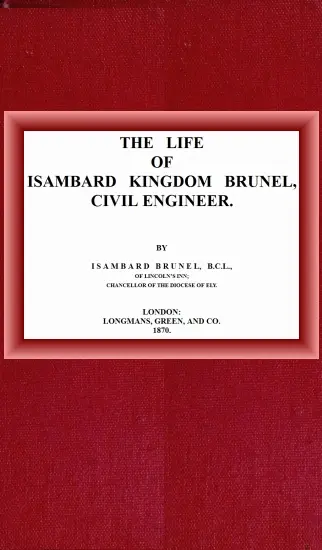
THE CLASSIC COLLECTION · 1870
"The Life of Isambard Kingdom Brunel, Civil Engineer" by Isambard Brunel is a historical account written in the late 19th century. This work narrates the life and achievements of the renowned civil engineer Isambard Kingdom Brunel, detailing his influential contributions to engineering projects such as the Great Western Railway and the Thames Tunnel. The book serves as both a biography and a technical record of Brunel's revolutionary work that shaped the landscape of 19th-century engineering. The opening of the narrative introduces Isambard Kingdom Brunel, born in 1806, as the son of Sir Marc Isambard Brunel, outlining his early life and education. It emphasizes his father's engineering prowess and the profound influence he had on Isambard's formative years. The manuscript sets the stage for a detailed chronicle of Brunel's significant engineering projects, beginning with his involvement in the Thames Tunnel and the innovative techniques employed during its construction. The narrative reveals Brunel's early insights and precocious talent, establishing a foundation for understanding his later accomplishments in civil engineering.
Introduction adapted from the source catalogue; source summaries may be automatically generated.
Free to read · English · 205,064 words · No account needed
MAKE TIME FOR A GOOD BOOK
On by default. Untick to stop anonymous reading totals. Each page counts after 10 seconds in view. How this works.
Anonymous counting is on unless you have switched it off.
In addition to this will be the freight and insurance, which we are to pay, and also the unloading at Bristol and placing in the vessel, which I take at Captain Claxton’s estimate, 2,000
Making a total of 43,150
It is to be observed that this includes Mr. Field’s apparatus for changing water, Kingston’s cocks, casing the cylinders, and all those extras which were applied to the ‘Great Western,’ and also the paddle-beams and paddle-wheels. Without these latter the nett cost of the engine, fixed in place, and including all other extras, would appear to be about 40,000l. or 40,500l. If the cylinders be increased to 77¾, which would be equivalent to the pair of 110 inch, and supposing the cost of the engines to increase in the same ratio as the power resulting from this increase, but which ought not to be the case, the total cost, according to Messrs. Maudslay’s estimate, will be 46,500l., and deducting the paddle-beams or framework for carrying the paddles, which do not, I think, form part of Mr. Humphrys’ estimate, probably about 45,500l. as compared with Mr. Humphrys’ estimate of 30,700l. With respect to this latter estimate, I cannot help expressing the fears I entertain that Mr. Humphrys is over-sanguine, and that the cost would greatly exceed the sum named. The items seem to me to be moderate prices only for each article named, and I see no allowance for those alterations, damages, and waste of parts, and a variety of other contingencies, which in a piece of machinery of this magnitude and novelty is certain to amount to a very large sum.
In his estimate of the fittings and smaller parts, I think also he has greatly underrated them.
The outlay for tools and tackle would, I think, also be greater than he seems to anticipate, and on the whole I cannot but come to the conclusion in my own mind, and I should not act rightly if I did not communicate that opinion to you, that the first outlay will be fully as large and probably larger by adopting the plan of making our own engines than by employing a manufacturer. It is true we shall have some valuable and costly tools and shops included in this outlay, and a fine establishment formed, which may be rendered fully competent in point of means to continue the manufacture of engines for others, and to keep up the repairs of any number of engines which the Company are likely to have at work. My only fear would be that of the risk of the undertaking being too great for a newly-formed establishment. The making of the vessel itself is no mean effort, and to superadd the construction of the largest pair of engines and boilers yet made, and upon a new plan, is calculating very much upon every effort being successful, and particularly upon the continued assistance of those who have hitherto attended to the subject; as it must be well known to the Directors that if Mr. Guppy, for instance, should be prevented from giving his time as he has hitherto done, or if Mr. Humphrys should, from illness or other causes, leave us, the manufactory would be brought to a stand, and the loss would be serious. I have no wish to deter the Company from becoming their own manufacturers--I think it a course which must ultimately be adopted if the Company thrive--but I should have much preferred that it had been adopted gradually, that we had commenced with a vessel, and then proceeded with boilers and repairs; and, as our establishment became formed and matured, and when we might no longer depend entirely upon the engineering talents and assistance of one Director, who may be unable to attend to it, or upon the health of one superintendent who, as yet, is alone in possession of all our plans and ideas, and at present is alone capable of carrying them out, we might then have ventured upon making the engines perhaps for the third vessel. Circumstances may, however, render it necessary that we should proceed more expeditiously, and I am only anxious that the Directors should be aware of the difficulties that we may have to encounter, and that they should not form expectations as regards economy in which they may be disappointed. The result of the best consideration I have been able to give to it is, that the question does not seem to be one of cost. In that respect, according to my view, the two modes of proceeding would be nearly balanced, but it resolves itself into the following question:--Is it better in our present position to enter at once upon the manufacture of the engines and boilers, in doing which we shall in part repay the cost of tools and shops, which must eventually be required, and by which we shall be more independent, and more capable of expediting the works, should it become desirable to incur any additional expense for that purpose, or to throw all the responsibility and risk on another party or contractor--the vessel, for which we could not easily contract, being still made in the Company’s yard?
Your reading position is saved on this browser. Take it to another device with a library code. Reading pages adapt to text, rather than matching a printed edition.
BEHIND THE BOOK
This eBook is for the use of anyone anywhere in the United States and most other parts of the world at no cost and with almost no restrictions whatsoever. You may copy it, give it away or re-use it under the terms of the Project Gutenberg License included with this eBook or online at www.gutenberg.org. If you are not located in the United States, you will have to check the laws of the country where you are located before using this eBook. Read the source licence.
The original source file, including credits and licence, is retained by this library. Request an original-format copy at no charge. Please include the book title and Project Gutenberg identifier #41210.
KEEP YOUR CURIOSITY GOING
Cécile Tormay

Moritz Busch
John L. Ransom
Frances Wright
Cécile Tormay

Mabel Potter Daggett