THE CLASSIC COLLECTION✦An outlaw’s diary: the CommuneCLASSIC FREE BOOKS
An outlaw’s diary: the Commune
Cécile Tormay
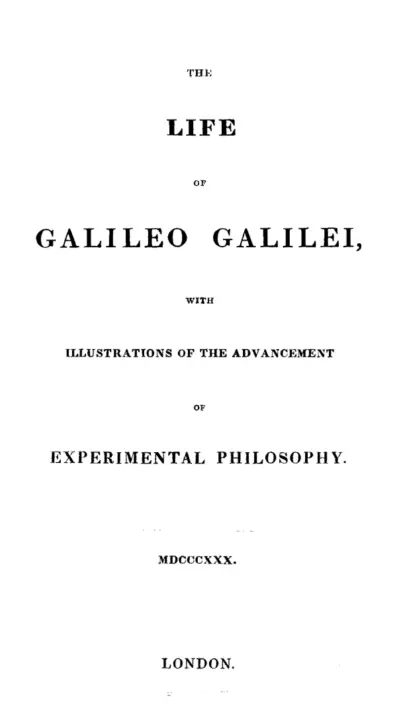
THE CLASSIC COLLECTION · 1830
"The Life of Galileo Galilei, with Illustrations of the Advancement of Experimental Philosophy" is a historical account likely written in the early 19th century. The text presents the life and contributions of the renowned scientist Galileo Galilei, placing significant emphasis on the evolution of philosophical thought and experimental science. It details not just Galileo's personal journey but also the progress of natural philosophy during his time, illustrating the shift from traditional Aristotelian principles to a more experimental and evidence-based approach. The opening portion explores the context of scientific knowledge prior to Galileo's contributions, detailing both the stagnation of natural philosophy and the emergence of a more empirical scientific method. It introduces Galileo's background and early intellectual influences, mentioning how he was motivated to challenge the old paradigms of thought, particularly those of Aristotelian philosophy. The narrative outlines Galileo's initial observations and experiments, emphasizing his pioneering role in advocating for experimental philosophy—a significant turn away from mere observation toward a hands-on methodology, thus setting the stage for the profound impact of his later discoveries.
Introduction adapted from the source catalogue; source summaries may be automatically generated.
Free to read · English · 126,968 words · No account needed
MAKE TIME FOR A GOOD BOOK
On by default. Untick to stop anonymous reading totals. Each page counts after 10 seconds in view. How this works.
Anonymous counting is on unless you have switched it off.
The whole value and interest of experimental processes generally depends on a variety of minute circumstances, the detail of which would be particularly unsuited to a sketch like the present one. For those who are desirous of becoming more familiar with Galileo's mode of conducting an argument, it is fortunate that such a series of experiments exists as that contained in this essay; experiments which, from their simplicity, admit of being for the most part concisely enumerated, and at the same time possess so much intrinsic beauty and characteristic power of forcing conviction. They also present an admirable specimen of the talent for which Galileo was so deservedly famous, of inventing ingenious arguments in favour of his adversaries' absurd opinions before he condescended to crush them, shewing that nothing but his love of truth stood in the way of his being a more subtle sophist than any amongst them. In addition to these reasons for giving these experiments somewhat in detail, is the fact that all explanation of one of the principal phenomena to which they allude is omitted in many more modern treatises on Hydrostatics; and in some it is referred precisely to the false doctrines here confuted.
The marrow of the dispute is included in Galileo's assertion, that "The diversity of figure given to any solid cannot be in any way the cause of its absolutely sinking or floating; so that if a solid, when formed for example into a spherical figure, sinks or floats in the water, the same body will sink or float in the same water, when put into any other form. The breadth of the figure may indeed retard its velocity, as well of ascent as descent, and more and more according as the said figure is reduced to a greater breadth and thinness; but that it may be reduced to such a form as absolutely to put an end to its motion in the same fluid, I hold to be impossible. In this I have met with great contradictors who, producing some experiments, and in particular a thin board of ebony, and a ball of the same wood, and shewing that the ball in water sinks to the bottom[71], and that the board if put lightly on the surface floats, have held and confirmed themselves in their opinion with the authority of Aristotle, that the cause of that rest is the breadth of the figure, unable by its small weight to pierce and penetrate the resistance of the water's thickness, which is readily overcome by the other spherical figure."—For the purpose of these experiments, Galileo recommends a substance such as wax, which may be easily moulded into any shape, and with which, by the addition of a few filings of lead, a substance may be readily made of any required specific gravity. He then declares that if a ball of wax of the size of an orange, or bigger, be made in this manner heavy enough to sink to the bottom, but so lightly that if we take from it only one grain of lead it returns to the top; and if the same wax be afterwards moulded into a broad and thin cake, or into any other figure, regular or irregular, the addition of the same grain of lead will always make it sink, and it will again rise when we remove the lead from it.—"But methinks I hear some of the adversaries raise a doubt upon my produced experiment: and, first, they offer to my consideration that the figure, as a figure simply, and disjunct from the matter, works no effect, but requires to be conjoined with the matter; and, moreover, not with every matter, but with those only wherewith it may be able to execute the desired operation. Just as we see by experience that an acute and sharp angle is more apt to cut than an obtuse; yet always provided that both one and the other are joined with a matter fit to cut, as for instance, steel. Therefore a knife with a fine and sharp edge cuts bread or wood with much ease, which it will not do if the edge be blunt and thick; but if, instead of steel, any one will take wax and mould it into a knife, undoubtedly he will never learn the effects of sharp and blunt edges, because neither of them will cut; the wax being unable, by reason of its flexibility, to overcome the hardness of the wood and bread. And therefore, applying the like discourse to our argument, they say that the difference of figure will shew different effects with regard to floating and sinking, but not conjoined with any kind of matter, but only with those matters which by their weight are able to overcome the viscosity of the water (like the ebony which they have selected); and he that will select cork or other light wood to form solids of different figures, would in vain seek to find out what operation figure has in sinking or floating, because all would swim, and that not through any property of this or that figure, but through the debility of the matter.
Your reading position is saved on this browser. Take it to another device with a library code. Reading pages adapt to text, rather than matching a printed edition.
BEHIND THE BOOK
This eBook is for the use of anyone anywhere in the United States and most other parts of the world at no cost and with almost no restrictions whatsoever. You may copy it, give it away or re-use it under the terms of the Project Gutenberg License included with this eBook or online at www.gutenberg.org. If you are not located in the United States, you will have to check the laws of the country where you are located before using this eBook. Read the source licence.
The original source file, including credits and licence, is retained by this library. Request an original-format copy at no charge. Please include the book title and Project Gutenberg identifier #43877.
KEEP YOUR CURIOSITY GOING
Cécile Tormay

Moritz Busch
John L. Ransom
Frances Wright
Cécile Tormay

Mabel Potter Daggett