THE CLASSIC COLLECTION✦An outlaw’s diary: the CommuneCLASSIC FREE BOOKS
An outlaw’s diary: the Commune
Cécile Tormay
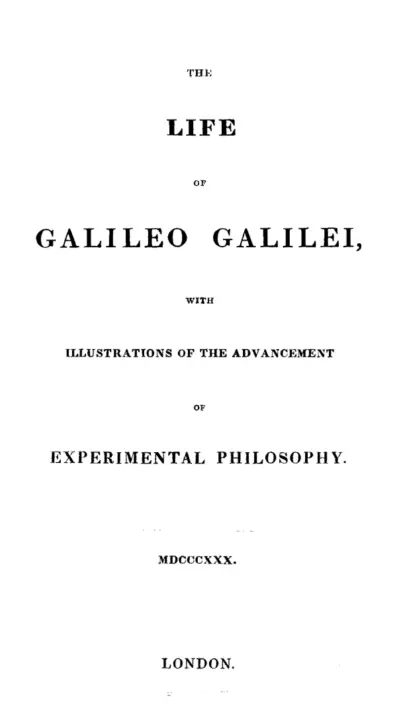
THE CLASSIC COLLECTION · 1830
"The Life of Galileo Galilei, with Illustrations of the Advancement of Experimental Philosophy" is a historical account likely written in the early 19th century. The text presents the life and contributions of the renowned scientist Galileo Galilei, placing significant emphasis on the evolution of philosophical thought and experimental science. It details not just Galileo's personal journey but also the progress of natural philosophy during his time, illustrating the shift from traditional Aristotelian principles to a more experimental and evidence-based approach. The opening portion explores the context of scientific knowledge prior to Galileo's contributions, detailing both the stagnation of natural philosophy and the emergence of a more empirical scientific method. It introduces Galileo's background and early intellectual influences, mentioning how he was motivated to challenge the old paradigms of thought, particularly those of Aristotelian philosophy. The narrative outlines Galileo's initial observations and experiments, emphasizing his pioneering role in advocating for experimental philosophy—a significant turn away from mere observation toward a hands-on methodology, thus setting the stage for the profound impact of his later discoveries.
Introduction adapted from the source catalogue; source summaries may be automatically generated.
Free to read · English · 126,968 words · No account needed
MAKE TIME FOR A GOOD BOOK
On by default. Untick to stop anonymous reading totals. Each page counts after 10 seconds in view. How this works.
Anonymous counting is on unless you have switched it off.
Nearly at the same time, 1607, or immediately after, he first turned his attention towards the loadstone, on which our countryman Gilbert had already published his researches, conducted in the true spirit of the inductive method. Very little that is original is to be found in Galileo's works on this subject, except some allusions to his method of arming magnets, in which, as in most of his practical and mechanical operations, he appears to have been singularly successful. Sir Kenelm Digby[30] asserts, that the magnets armed by Galileo would support twice as great a weight as one of Gilbert's of the same size. Galileo was well acquainted, as appears from his frequent allusions in different parts of his works, with what Gilbert had done, of whom he says, "I extremely praise, admire, and envy this author;—I think him, moreover, worthy of the greatest praise for the many new and true observations that he has made to the disgrace of so many vain and fabling authors, who write, not from their own knowledge only, but repeat every thing they hear from the foolish vulgar, without attempting to satisfy themselves of the same by experience, perhaps that they may not diminish the size of their books."
Galileo's reputation being now greatly increased, proposals were made to him, in 1609, to return to his original situation at Pisa. He had been in the habit of passing over to Florence during the academic vacation, for the purpose of giving mathematical instruction to the younger members of Ferdinand's family; and Cosmo, who had now succeeded his father as duke of Tuscany, regretted that so masterly a genius had been allowed to leave the university which he naturally should have graced. A few extracts from Galileo's answers to these overtures will serve to show the nature of his situation at Padua, and the manner in which his time was there occupied. "I will not hesitate to say, having now laboured during twenty years, and those the best of my life, in dealing out, as one may say, in detail, at the request of any body, the little talent which God has granted to my assiduity in my profession, that my wish certainly would be to have sufficient rest and leisure to enable me, before my life comes to its close, to conclude three great works which I have in hand, and to publish them; which might perhaps bring some credit to me, and to those who had favoured me in this undertaking, and possibly may be of greater and more frequent service to students than in the rest of my life I could personally afford them. Greater leisure than I have here I doubt if I could meet with elsewhere, so long as I am compelled to support my family from my public and private lectures, (nor would I willingly lecture in any other city than this, for several reasons which would be long to mention) nevertheless not even the liberty I have here is sufficient, where I am obliged to spend many, and often the best hours of the day at the request of this and that man.—My public salary here is 520 florins, which I am almost certain will be advanced to as many crowns upon my re-election, and these I can greatly increase by receiving pupils, and from private lectures, to any extent that I please. My public duty does not confine me during more than 60 half hours in the year, and even that not so strictly but that I may, on occasion of any business, contrive to get some vacant days; the rest of my time is absolutely at my own disposal; but because my private lectures and domestic pupils are a great hindrance and interruption of my studies, I wish to live entirely exempt from the former, and in great measure from the latter: for if I am to return to my native country, I should wish the first object of his Serene Highness to be, that leisure and opportunity should be given me to complete my works without employing myself in lecturing.—And, in short, I should wish to gain my bread from my writings, which I would always dedicate to my Serene Master.—The works which I have to finish are principally—two books on the system or structure of the Universe, an immense work, full of philosophy, astronomy, and geometry; three books on Local Motion, a science entirely new, no one, either ancient or modern, having discovered any of the very many admirable accidents which I demonstrate in natural and violent motions, so that I may with very great reason call it a new science, and invented by me from its very first principles; three books of Mechanics, two on the demonstration of principles and one of problems; and although others have treated this same matter, yet all that has been hitherto written, neither in quantity, nor otherwise, is the quarter of what I am writing on it. I have also different treatises on natural subjects; On sound and speech; On light and colours; On the tide; On the composition of continuous quantity; On the motions of animals;—And others besides. I have also an idea of writing some books relating to the military art, giving not only a model of a soldier, but teaching with very exact rules every thing which it is his duty to know that depends upon mathematics; as the knowledge of castrametation, drawing up battalions, fortifications, assaults, planning, surveying, the knowledge of artillery, the use of instruments, &c. I also wish to reprint the 'Use of my Geometrical Compass,' which is dedicated to his highness, and which is no longer to be met with; for this instrument has experienced such favour from the public, that in fact no other instruments of this kind are now made, and I know that up to this time several thousands of mine have been made.—I say nothing as to the amount of my salary, feeling convinced that as I am to live upon it, the graciousness of his highness would not deprive me of any of those comforts, which, however, I feel the want of less than many others; and therefore I say nothing more on the subject. Finally, on the title and profession of my service, I should wish that to the name of Mathematician, his highness would add that of Philosopher, as I profess to have studied a greater number of years in philosophy than months in pure mathematics; and how I have profited by it, and if I can or ought to deserve this title, I may let their highnesses see as often as it shall please them to give me an opportunity of discussing such subjects in their presence with those who are most esteemed in this knowledge." It may perhaps be seen in the expressions of this letter, that Galileo was not inclined to undervalue his own merits, but the peculiar nature of the correspondence should be taken into account, which might justify his indulging a little more than usual in self-praise, and it would have been perhaps almost impossible for him to have remained entirely blind to his vast superiority over his contemporaries.
Your reading position is saved on this browser. Take it to another device with a library code. Reading pages adapt to text, rather than matching a printed edition.
BEHIND THE BOOK
This eBook is for the use of anyone anywhere in the United States and most other parts of the world at no cost and with almost no restrictions whatsoever. You may copy it, give it away or re-use it under the terms of the Project Gutenberg License included with this eBook or online at www.gutenberg.org. If you are not located in the United States, you will have to check the laws of the country where you are located before using this eBook. Read the source licence.
The original source file, including credits and licence, is retained by this library. Request an original-format copy at no charge. Please include the book title and Project Gutenberg identifier #43877.
KEEP YOUR CURIOSITY GOING
Cécile Tormay

Moritz Busch
John L. Ransom
Frances Wright
Cécile Tormay

Mabel Potter Daggett