THE CLASSIC COLLECTION✦An outlaw’s diary: the CommuneCLASSIC FREE BOOKS
An outlaw’s diary: the Commune
Cécile Tormay
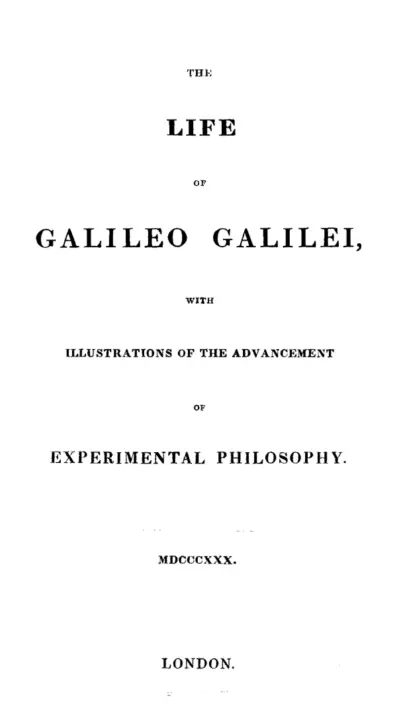
THE CLASSIC COLLECTION · 1830
"The Life of Galileo Galilei, with Illustrations of the Advancement of Experimental Philosophy" is a historical account likely written in the early 19th century. The text presents the life and contributions of the renowned scientist Galileo Galilei, placing significant emphasis on the evolution of philosophical thought and experimental science. It details not just Galileo's personal journey but also the progress of natural philosophy during his time, illustrating the shift from traditional Aristotelian principles to a more experimental and evidence-based approach. The opening portion explores the context of scientific knowledge prior to Galileo's contributions, detailing both the stagnation of natural philosophy and the emergence of a more empirical scientific method. It introduces Galileo's background and early intellectual influences, mentioning how he was motivated to challenge the old paradigms of thought, particularly those of Aristotelian philosophy. The narrative outlines Galileo's initial observations and experiments, emphasizing his pioneering role in advocating for experimental philosophy—a significant turn away from mere observation toward a hands-on methodology, thus setting the stage for the profound impact of his later discoveries.
Introduction adapted from the source catalogue; source summaries may be automatically generated.
Free to read · English · 126,968 words · No account needed
MAKE TIME FOR A GOOD BOOK
On by default. Untick to stop anonymous reading totals. Each page counts after 10 seconds in view. How this works.
Anonymous counting is on unless you have switched it off.
Besides this trifle, Kepler left behind him a vast mass of unpublished writings, which came at last into the hands of his biographer, Hantsch. In 1714, Hantsch issued a prospectus for publishing them by subscription, in twenty-two folio volumes. The plan met no encouragement, and nothing was published but a single folio volume of letters to and from Kepler, which seem to have furnished the principal materials for the memoir prefixed to them. After various unavailing attempts to interest different learned bodies in their appearance, the manuscripts were purchased for the library at St. Petersburg, where Euler, Lexell, and Kraft, undertook to examine them, and select the most interesting parts for publication. The result of this examination does not appear.
Kepler's body was buried in St. Peter's churchyard at Ratisbon, and a simple inscription was placed on his tombstone. This appears to have been destroyed not long after, in the course of the wars which still desolated the country. In 1786, a proposal was made to erect a marble monument to his memory, but nothing was done. Kästner, on whose authority it is mentioned, says upon this, rather bitterly, that it matters little whether or not Germany, having almost refused him bread during his life, should, a century and a half after his death, offer him a stone.
Delambre mentions, in his History of Astronomy, that this design was resumed in 1803 by the Prince Bishop of Constance, and that a monument has been erected in the Botanical Garden at Ratisbon, near the place of his interment. It is built in the form of a temple, surmounted by a sphere; in the centre is placed a bust of Kepler, in Carrara marble. Delambre does not mention the original of the bust; but says it is not unlike the figure engraved in the frontispiece of the Rudolphine Tables. That frontispiece consists of a portico of ten pillars, supporting a cupola covered with astronomical emblems. Copernicus, Tycho Brahe, Ptolemy, Hipparchus, and other astronomers, are seen among them. In one of the compartments of the common pedestal is a plan of the observatory at Uraniburg; in another, a printing press; in a third is the figure of a man, meant for Kepler, seated at a table. He is identified by the titles of his works, which are round him; but the whole is so small as to convey very little idea of his figure or countenance. The only portrait known of Kepler was given by him to his assistant Gringallet, who presented it to Bernegger; and it was placed by the latter in the library at Strasburg. Hantsch had a copy taken for the purpose of engraving it, but died before it was completed. A portrait of Kepler is engraved in the seventh part of Boissard's Bibliotheca Chalcographica. It is not known whence this was taken, but it may, perhaps, be a copy of that which was engraved by desire of Bernegger in 1620. The likeness is said not to have been well preserved. "His heart and genius," says Kästner, "are faithfully depicted in his writings; and that may console us, if we cannot entirely trust his portrait." In the preceding pages, it has been endeavoured to select such passages from his writings as might throw the greatest light on his character, with a subordinate reference only to the importance of the subjects treated. In conclusion, it may be well to support the opinion which has been ventured on the real nature of his triumphs, and on the danger of attempting to follow his method in the pursuit of truth, by the judgment pronounced by Delambre, as well on his failures as on his success. "Considering these matters in another point of view, it is not impossible to convince ourselves that Kepler may have been always the same. Ardent, restless, burning to distinguish himself by his discoveries, he attempted everything; and having once obtained a glimpse of one, no labour was too hard for him in following or verifying it. All his attempts had not the same success, and, in fact, that was impossible. Those which have failed seem to us only fanciful; those which have been more fortunate appear sublime. When in search of that which really existed, he has sometimes found it; when he devoted himself to the pursuit of a chimera, he could not but fail; but even there he unfolded the same qualities, and that obstinate perseverance that must triumph over all difficulties but those which are insurmountable."[201]
Your reading position is saved on this browser. Take it to another device with a library code. Reading pages adapt to text, rather than matching a printed edition.
BEHIND THE BOOK
This eBook is for the use of anyone anywhere in the United States and most other parts of the world at no cost and with almost no restrictions whatsoever. You may copy it, give it away or re-use it under the terms of the Project Gutenberg License included with this eBook or online at www.gutenberg.org. If you are not located in the United States, you will have to check the laws of the country where you are located before using this eBook. Read the source licence.
The original source file, including credits and licence, is retained by this library. Request an original-format copy at no charge. Please include the book title and Project Gutenberg identifier #43877.
KEEP YOUR CURIOSITY GOING
Cécile Tormay

Moritz Busch
John L. Ransom
Frances Wright
Cécile Tormay

Mabel Potter Daggett