THE CLASSIC COLLECTION✦An outlaw’s diary: the CommuneCLASSIC FREE BOOKS
An outlaw’s diary: the Commune
Cécile Tormay
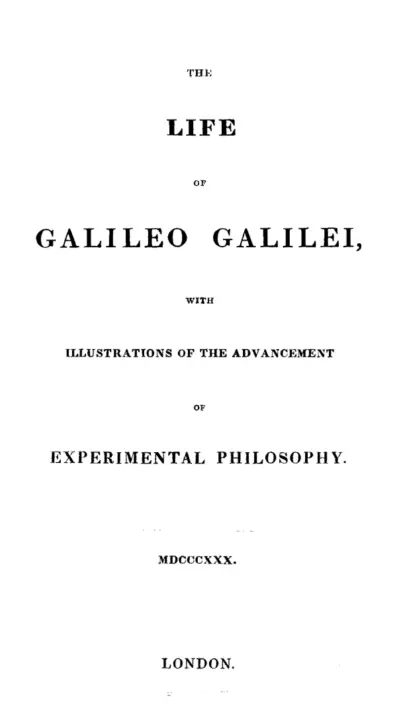
THE CLASSIC COLLECTION · 1830
"The Life of Galileo Galilei, with Illustrations of the Advancement of Experimental Philosophy" is a historical account likely written in the early 19th century. The text presents the life and contributions of the renowned scientist Galileo Galilei, placing significant emphasis on the evolution of philosophical thought and experimental science. It details not just Galileo's personal journey but also the progress of natural philosophy during his time, illustrating the shift from traditional Aristotelian principles to a more experimental and evidence-based approach. The opening portion explores the context of scientific knowledge prior to Galileo's contributions, detailing both the stagnation of natural philosophy and the emergence of a more empirical scientific method. It introduces Galileo's background and early intellectual influences, mentioning how he was motivated to challenge the old paradigms of thought, particularly those of Aristotelian philosophy. The narrative outlines Galileo's initial observations and experiments, emphasizing his pioneering role in advocating for experimental philosophy—a significant turn away from mere observation toward a hands-on methodology, thus setting the stage for the profound impact of his later discoveries.
Introduction adapted from the source catalogue; source summaries may be automatically generated.
Free to read · English · 126,968 words · No account needed
MAKE TIME FOR A GOOD BOOK
On by default. Untick to stop anonymous reading totals. Each page counts after 10 seconds in view. How this works.
Anonymous counting is on unless you have switched it off.
This singular doctrine must not be mistaken for one of Kepler's favourite allegories; he actually and literally professed to believe that the earth was an enormous living animal; and he has enumerated, with a particularity of details into which we forbear to follow him, the analogies he recognized between its habits and those of men and other animals. A few samples of these may speak for the rest. "If any one who has climbed the peaks of the highest mountains throw a stone down their very deep clefts, a sound is heard from them; or if he throw it into one of the mountain lakes, which beyond doubt are bottomless, a storm will immediately arise, just as when you thrust a straw into the ear or nose of a ticklish animal, it shakes its head, or runs shuddering away. What so like breathing, especially of those fish who draw water into their mouths and spout it out again through their gills, as that wonderful tide! For although it is so regulated according to the course of the moon, that, in the preface to my 'Commentaries on Mars,' I have mentioned it as probable that the waters are attracted by the moon as iron is by the loadstone; yet, if any one uphold that the earth regulates its breathing according to the motion of the sun and moon, as animals have daily and nightly alternations of sleep and waking, I shall not think his philosophy unworthy of being listened to; especially if any flexible parts should be discovered in the depths of the earth to supply the functions of lungs or gills."
From the next extract, we must leave the reader to learn as well as he may, how much Kepler did, and how much he did not believe on the subject of genethliac astrology.—"Hence it is that human spirits, at the time of celestial aspects, are particularly urged to complete the matters which they have in hand. What the goad is to the ox, what the spur or the rowel is to the horse, to the soldier the bell and trumpet, an animated speech to an audience, to a crowd of rustics a performance on the fife and bagpipes, that to all, and especially in the aggregate, is a heavenly configuration of suitable planets; so that every single one is excited in his thoughts and actions, and all become more ready to unite and associate their efforts. For instance, in war you may see that tumults, battles, fights, invasions, assaults, attacks, and panic fears, generally happen at the time of the aspects of Mars and Mercury, Mars and Jupiter, Mars and the Sun, Mars and Saturn, &c. In epidemic diseases, a greater number of persons are attacked at the times of the powerful aspects, they suffer more severely, or even die, owing to the failure of nature in her strife with the disease, which strife (and not the death) is occasioned by the aspect. It is not the sky which does all these things immediately, but the faculty of the vital soul, associating its operation with the celestial harmonies, is the principal agent in this so-called influence of the heavens. Indeed this word influence has so fascinated some philosophers that they prefer raving with the senseless vulgar, to learning the truth with me. This essential property is the principal foundation of that admirable genethliac art. For when anything begins to have its being when that is working harmonies, the sensible harmony of the rays of the planets has peculiar influence on it. This then is the cause why those who are born under a season of many aspects among the planets, generally turn out busy and industrious, whether they accustom themselves from childhood to amass wealth, or are born or chosen to direct public affairs, or finally, have given their attention to study. If any one think that I might be taken as an instance of this last class, I do not grudge him the knowledge of my nativity. I am not checked by the reproach of boastfulness, notwithstanding those who, by speech or conduct, condemn as folly all kinds of writing on this subject; the idiots, the half-learned, the inventors of titles and trappings, to throw dust in the eyes of the people, and those whom Picus calls the plebeian theologians: among the true lovers of wisdom, I easily clear myself of this imputation, by the advantage of my reader; for there is no one whose nativity or whose internal disposition and temper I can learn so well as I know my own. Well then, Jupiter nearest the nonagesimal had passed by four degrees the trine of Saturn; the Sun and Venus, in conjunction, were moving from the latter towards the former, nearly in sextiles with both: they were also removing from quadratures with Mars, to which Mercury was closely approaching: the moon drew near the trine of the same planet, close to the Bull's Eye, even in latitude. The 25th degree of Gemini was rising, and the 22d of Aquarius culminating. That there was this triple configuration on that day—namely, the sextile of Saturn and the Sun, the sextile of Mars and Jupiter, the quadrature of Mercury and Mars, is proved by the change of weather; for, after a frost of some days, that very day became warmer, there was a thaw and a fall of rain.[192]
Your reading position is saved on this browser. Take it to another device with a library code. Reading pages adapt to text, rather than matching a printed edition.
BEHIND THE BOOK
This eBook is for the use of anyone anywhere in the United States and most other parts of the world at no cost and with almost no restrictions whatsoever. You may copy it, give it away or re-use it under the terms of the Project Gutenberg License included with this eBook or online at www.gutenberg.org. If you are not located in the United States, you will have to check the laws of the country where you are located before using this eBook. Read the source licence.
The original source file, including credits and licence, is retained by this library. Request an original-format copy at no charge. Please include the book title and Project Gutenberg identifier #43877.
KEEP YOUR CURIOSITY GOING
Cécile Tormay

Moritz Busch
John L. Ransom
Frances Wright
Cécile Tormay

Mabel Potter Daggett