THE CLASSIC COLLECTION✦An outlaw’s diary: the CommuneCLASSIC FREE BOOKS
An outlaw’s diary: the Commune
Cécile Tormay
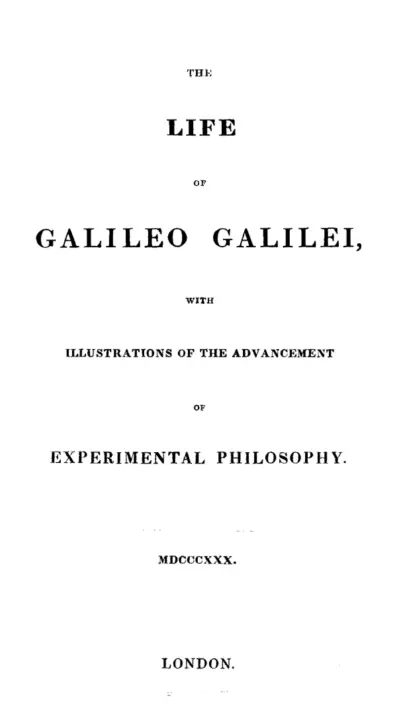
THE CLASSIC COLLECTION · 1830
"The Life of Galileo Galilei, with Illustrations of the Advancement of Experimental Philosophy" is a historical account likely written in the early 19th century. The text presents the life and contributions of the renowned scientist Galileo Galilei, placing significant emphasis on the evolution of philosophical thought and experimental science. It details not just Galileo's personal journey but also the progress of natural philosophy during his time, illustrating the shift from traditional Aristotelian principles to a more experimental and evidence-based approach. The opening portion explores the context of scientific knowledge prior to Galileo's contributions, detailing both the stagnation of natural philosophy and the emergence of a more empirical scientific method. It introduces Galileo's background and early intellectual influences, mentioning how he was motivated to challenge the old paradigms of thought, particularly those of Aristotelian philosophy. The narrative outlines Galileo's initial observations and experiments, emphasizing his pioneering role in advocating for experimental philosophy—a significant turn away from mere observation toward a hands-on methodology, thus setting the stage for the profound impact of his later discoveries.
Introduction adapted from the source catalogue; source summaries may be automatically generated.
Free to read · English · 126,968 words · No account needed
MAKE TIME FOR A GOOD BOOK
On by default. Untick to stop anonymous reading totals. Each page counts after 10 seconds in view. How this works.
Anonymous counting is on unless you have switched it off.
The first on the list was a widow, an intimate friend of his first wife's, and who, on many accounts, appeared a most eligible match. "At first she seemed favourably inclined to the proposal; it is certain that she took time to consider it, but at last she very quietly excused herself." It must have been from a recollection of this lady's good qualities that Kepler was induced to make his offer; for we learn rather unexpectedly, after being informed of her decision, that when he soon afterwards paid his respects to her, it was for the first time that he had seen her during the last six years; and he found, to his great relief, that "there was no single pleasing point about her." The truth seems to be that he was nettled by her answer, and he is at greater pains than appear necessary, considering this last discovery, to determine why she would not accept his offered hand. Among other reasons he suggested her children, among whom were two marriageable daughters; and it is diverting afterwards to find them also in the catalogue which Kepler appeared to be making of all his female acquaintance. He seems to have been much perplexed in attempting to reconcile his astrological theory with the fact of his having taken so much trouble about a negotiation not destined to succeed. "Have the stars exercised any influence here? For just about this time the direction of the Mid-Heaven is in hot opposition to Mars, and the passage of Saturn, through the ascending point of the zodiac, in the scheme of my nativity, will happen again next November and December. But if these are the causes, how do they act? Is that explanation the true one which I have elsewhere given? For I can never think of handing over to the stars the office of deities to produce effects. Let us therefore suppose it accounted for by the stars, that at this season I am violent in my temper and affections, in rashness of belief, in a shew of pitiful tender-heartedness; in catching at reputation by new and paradoxical notions, and the singularity of my actions; in busily inquiring into, and weighing and discussing, various reasons; in the uneasiness of my mind with respect to my choice. I thank God that that did not happen which might have happened; that this marriage did not take place: now for the others." Of these others, one was too old, another in bad health, another too proud of her birth and quarterings; a fourth had learned nothing but shewy accomplishments, "not at all suitable to the sort of life she would have to lead with me." Another grew impatient, and married a more decided admirer, whilst he was hesitating. "The mischief (says he) in all these attachments was, that whilst I was delaying, comparing, and balancing conflicting reasons, every day saw me inflamed with a new passion." By the time he reached the eighth, he found his match in this respect. "Fortune at length has avenged herself on my doubtful inclinations. At first she was quite complying, and her friends also: presently, whether she did or did not consent, not only I, but she herself did not know. After the lapse of a few days, came a renewed promise, which however had to be confirmed a third time; and four days after that, she again repented her confirmation, and begged to be excused from it. Upon this I gave her up, and this time all my counsellors were of one opinion." This was the longest courtship in the list, having lasted three whole months; and quite disheartened by its bad success, Kepler's next attempt was of a more timid complexion. His advances to No. 9, were made by confiding to her the whole story of his recent disappointment, prudently determining to be guided in his behaviour, by observing whether the treatment he had experienced met with a proper degree of sympathy. Apparently the experiment did not succeed; and almost reduced to despair, Kepler betook himself to the advice of a friend, who had for some time past complained that she was not consulted in this difficult negotiation. When she produced No. 10, and the first visit was paid, the report upon her was as follows:—"She has, undoubtedly, a good fortune, is of good family, and of economical habits: but her physiognomy is most horribly ugly; she would be stared at in the streets, not to mention the striking disproportion in our figures. I am lank, lean, and spare; she is short and thick: in a family notorious for fatness she is considered superfluously fat." The only objection to No. 11 seems to have been her excessive youth; and when this treaty was broken of on that account, Kepler turned his back upon all his advisers, and chose for himself one who had figured as No. 5 in the list, to whom he professes to have felt attached throughout, but from whom the representations of his friends had hitherto detained him, probably on account of her humble station.
Your reading position is saved on this browser. Take it to another device with a library code. Reading pages adapt to text, rather than matching a printed edition.
BEHIND THE BOOK
This eBook is for the use of anyone anywhere in the United States and most other parts of the world at no cost and with almost no restrictions whatsoever. You may copy it, give it away or re-use it under the terms of the Project Gutenberg License included with this eBook or online at www.gutenberg.org. If you are not located in the United States, you will have to check the laws of the country where you are located before using this eBook. Read the source licence.
The original source file, including credits and licence, is retained by this library. Request an original-format copy at no charge. Please include the book title and Project Gutenberg identifier #43877.
KEEP YOUR CURIOSITY GOING
Cécile Tormay

Moritz Busch
John L. Ransom
Frances Wright
Cécile Tormay

Mabel Potter Daggett