THE CLASSIC COLLECTION✦An outlaw’s diary: the CommuneCLASSIC FREE BOOKS
An outlaw’s diary: the Commune
Cécile Tormay
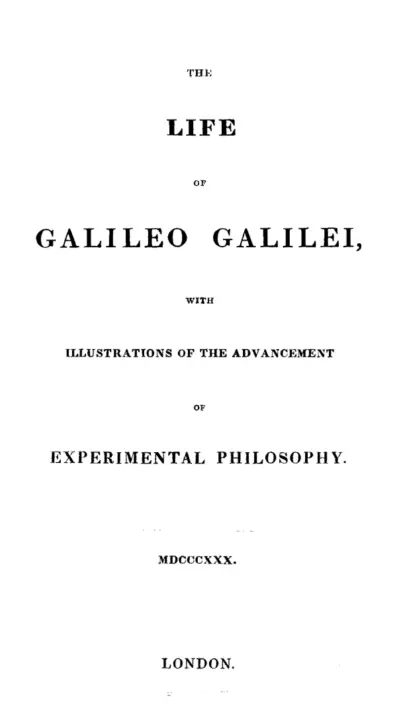
THE CLASSIC COLLECTION · 1830
"The Life of Galileo Galilei, with Illustrations of the Advancement of Experimental Philosophy" is a historical account likely written in the early 19th century. The text presents the life and contributions of the renowned scientist Galileo Galilei, placing significant emphasis on the evolution of philosophical thought and experimental science. It details not just Galileo's personal journey but also the progress of natural philosophy during his time, illustrating the shift from traditional Aristotelian principles to a more experimental and evidence-based approach. The opening portion explores the context of scientific knowledge prior to Galileo's contributions, detailing both the stagnation of natural philosophy and the emergence of a more empirical scientific method. It introduces Galileo's background and early intellectual influences, mentioning how he was motivated to challenge the old paradigms of thought, particularly those of Aristotelian philosophy. The narrative outlines Galileo's initial observations and experiments, emphasizing his pioneering role in advocating for experimental philosophy—a significant turn away from mere observation toward a hands-on methodology, thus setting the stage for the profound impact of his later discoveries.
Introduction adapted from the source catalogue; source summaries may be automatically generated.
Free to read · English · 126,968 words · No account needed
MAKE TIME FOR A GOOD BOOK
On by default. Untick to stop anonymous reading totals. Each page counts after 10 seconds in view. How this works.
Anonymous counting is on unless you have switched it off.
On Tycho's death, Kepler succeeded him as principal mathematician to the emperor; but although he was thus nominally provided with a liberal salary, it was almost always in arrear. The pecuniary embarrassments in which he constantly found himself involved, drove him to the resource of gaining a livelihood by casting nativities. His peculiar temperament rendered him not averse from such speculations, and he enjoyed considerable reputation in this line, and received ample remuneration for his predictions. But although he did not scruple, when consulted, to avail himself in this manner of the credulity of his contemporaries, he passed over few occasions in his works of protesting against the futility of this particular genethliac astrology. His own astrological creed was in a different strain, more singular, but not less extravagant. We shall defer entering into any details concerning it, till we come to treat of his book on Harmonics, in which he has collected and recapitulated the substance of his scattered opinions on this strange subject.
His next works deserving notice are those published on occasion of the new star which shone out with great splendour in 1604, in the constellation Cassiopeia.[181] Immediately on its appearance, Kepler wrote a short account of it in German, marked with all the oddity which characterises most of his productions. We shall see enough of his astronomical calculations when we come to his book on Mars; the following passage will probably be found more amusing.
After comparing this star with that of 1572, and mentioning that many persons who had seen it maintained this to be the brighter of the two, since it was nearly twice the size of its nearest neighbour, Jupiter, he proceeds as follows:—"Yonder one chose for its appearance a time no way remarkable, and came into the world quite unexpectedly, like an enemy storming a town, and breaking into the market-place before the citizens are aware of his approach; but ours has come exactly in the year of which astrologers have written so much about the fiery trigon that happens in it;[182] just in the month in which (according to Cyprian) Mars comes up to a very perfect conjunction with the other two superior planets; just in the day when Mars has joined Jupiter, and just in the place where this conjunction has taken place. Therefore the apparition of this star is not like a secret hostile irruption, as was that one of 1572, but the spectacle of a public triumph, or the entry of a mighty potentate; when the couriers ride in some time before, to prepare his lodgings, and the crowd of young urchins begin to think the time over-long to wait: then roll in, one after another, the ammunition, and money, and baggage waggons, and presently the trampling of horse, and the rush of people from every side to the streets and windows; and when the crowd have gazed with their jaws all agape at the troops of knights; then at last, the trumpeters, and archers, and lackeys, so distinguish the person of the monarch, that there is no occasion to point him out, but every one cries out of his own accord—'Here we have him!'—What it may portend is hard to determine, and thus much only is certain, that it comes to tell mankind either nothing at all, or high and weighty news, quite beyond human sense and understanding. It will have an important influence on political and social relations; not indeed by its own nature, but, as it were, accidentally through the disposition of mankind. First, it portends to the booksellers great disturbances, and tolerable gains; for almost every Theologus, Philosophicus, Medicus, and Mathematicus, or whoever else, having no laborious occupation intrusted to him, seeks his pleasure in studiis, will make particular remarks upon it, and will wish to bring these remarks to the light. Just so will others, learned and unlearned, wish to know its meaning, and they will buy the authors who profess to tell them. I mention these things merely by way of example, because, although thus much can be easily predicted without great skill, yet may it happen just as easily, and in the same manner, that the vulgar, or whoever else is of easy faith, or it may be, crazy, may wish to exalt himself into a great prophet; or it may even happen that some powerful lord, who has good foundation and beginning of great dignities, will be cheered on by this phenomenon to venture on some new scheme, just as if God had set up this star in the darkness merely to enlighten them."
Your reading position is saved on this browser. Take it to another device with a library code. Reading pages adapt to text, rather than matching a printed edition.
BEHIND THE BOOK
This eBook is for the use of anyone anywhere in the United States and most other parts of the world at no cost and with almost no restrictions whatsoever. You may copy it, give it away or re-use it under the terms of the Project Gutenberg License included with this eBook or online at www.gutenberg.org. If you are not located in the United States, you will have to check the laws of the country where you are located before using this eBook. Read the source licence.
The original source file, including credits and licence, is retained by this library. Request an original-format copy at no charge. Please include the book title and Project Gutenberg identifier #43877.
KEEP YOUR CURIOSITY GOING
Cécile Tormay

Moritz Busch
John L. Ransom
Frances Wright
Cécile Tormay

Mabel Potter Daggett