THE CLASSIC COLLECTION✦An outlaw’s diary: the CommuneCLASSIC FREE BOOKS
An outlaw’s diary: the Commune
Cécile Tormay
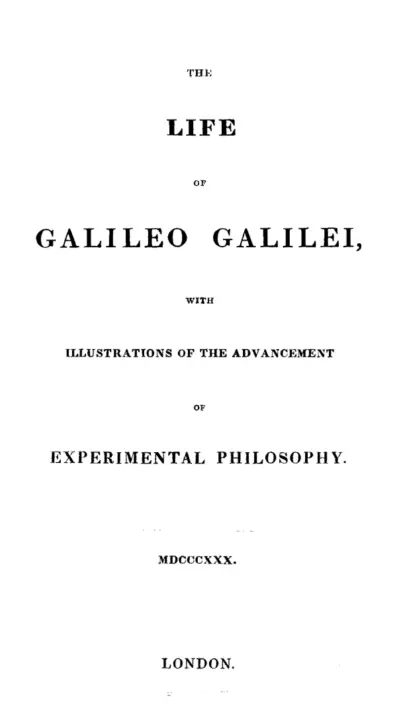
THE CLASSIC COLLECTION · 1830
"The Life of Galileo Galilei, with Illustrations of the Advancement of Experimental Philosophy" is a historical account likely written in the early 19th century. The text presents the life and contributions of the renowned scientist Galileo Galilei, placing significant emphasis on the evolution of philosophical thought and experimental science. It details not just Galileo's personal journey but also the progress of natural philosophy during his time, illustrating the shift from traditional Aristotelian principles to a more experimental and evidence-based approach. The opening portion explores the context of scientific knowledge prior to Galileo's contributions, detailing both the stagnation of natural philosophy and the emergence of a more empirical scientific method. It introduces Galileo's background and early intellectual influences, mentioning how he was motivated to challenge the old paradigms of thought, particularly those of Aristotelian philosophy. The narrative outlines Galileo's initial observations and experiments, emphasizing his pioneering role in advocating for experimental philosophy—a significant turn away from mere observation toward a hands-on methodology, thus setting the stage for the profound impact of his later discoveries.
Introduction adapted from the source catalogue; source summaries may be automatically generated.
Free to read · English · 126,968 words · No account needed
MAKE TIME FOR A GOOD BOOK
On by default. Untick to stop anonymous reading totals. Each page counts after 10 seconds in view. How this works.
Anonymous counting is on unless you have switched it off.
Le Operazioni del Compasso Geom. e Milit. Padova, 1606. Fol. Difesa di Gal. Galilei contr. all. cal. et impost. di Bald. Capra Venezza, 1607. 4to. Sydereus Nuncius Venetiis, 1610. 4to. Discorso int. alle cose che stanno in su l'Acqua Firenze, 1612. 4to. Novantiqua SS. PP. Doctrina de S. Scripturæ Testimoniis Argent, 1612. 4to. Istoria e Demostr. int. alle Macchie Solari Roma, 1613. 4to. Risp. alle oppos. del S. Lod. delle Colombe e del S. Vinc. di Grazia Firenze, 1615. 4to. Discorso delle Comete di Mario Guiducci Firenze, 1619. 4to. Dialogo sopra i due Massimi Sistemi del Mondo Firenze, 1632. 4to. Discorso e Demostr. intorno alle due nuove Scienze Leida, 1638. 4to. Della Scienza Meccanica Ravenna, 1649. 4to. Trattato della Sfera Roma, 1655. 4to. Discorso sopra il Flusso e Reflusso. (Scienze Fisiche di Tozzetti.) Firenze, 1780. 4to. Considerazioni sul Tasso Roma, 1793. Trattato della Fortificazione. (Memorie di Venturi.) Modena, 1818. 4to.
The editions of his collected works (in which is contained much that was never published separately) are—
Opere di Gal. Galilei, Linc. Nob. Fior. &c. Bologna, 1656. 2 vols. 4to. Opere di Gal. Galilei, Nob. Fior. Accad. Linc. &c. Firenze, 1718. 3 vols. 4to. Opere di Gal. Galilei Padova, 1744. 4 vols. 4to. Opere di Gal. Galilei Milano, 1811. 13 vols. 8vo.
Page Co. Line.
5 1 2,
Add: His instructor was the celebrated botanist, Andreas
Cæsalpinus, who was professor of medicine at Pisa from 1567 to 1592.
Hist. Acad. Pisan.; Pisis, 1791.
8 2 18,
Add: According to Kästner, his German name was Wursteisen.
8 2 21, for 1588 read 1586.
15 1 57, for 1632 read 1630.
17 1 29,
Salusbury alludes to the instrument described and figured in "The
Use of the Sector, Crosse Staffe, and other Instruments. London,
1624." It is exactly Galileo's Compass.
17 1 52, for Burg, a German, read Burgi, a Swiss.
27 2 17,
The author here called Brutti was an Englishman: his real name,
perhaps, was Bruce. See p. 99.
50 1 14,
Kepler's Epitome was not published till 1619: it was then inserted
in the Index.
73 1 60, for under read turned from. 80 2 44, for any read an indefinitely small.
[170] The words of his diploma are: Galilæi in mathematicis disciplinis discipulus, in ærumnis socius, Italicum ingenium ita perpolivit optimis artibus ut inter mathematicos sæculi nostri facile princeps per orbem litterarium numeretur.—Tiraboschi.
[171] On this occasion the taste of the time showed itself in the
following anagram:—
Evangelista Torricellieus,
En virescit Galilæus alter.
[172] Compare Son. ii. v. 8 & 9; and Son. iii. v. 2 & 3, with Ger. Lib. c. iv. st. 76, and c. vii. st. 19.—The author gladly owns his obligation for these remarks to the kindness of Sig. Panizzi, Professor of Italian in the University of London.
[173] Lettera di Timauro Antiate. Firenze, 1663.
[174] De phænomenis in orbe Lunæ. Venetiis, 1612.
[175] Venturi.
[176] Notizie sul Ingrandimento delle Scienze Fisiche. Firenze, 1780.
[177] Venturi.
[178] Lettera di Timauro Antiate.
Your reading position is saved on this browser. Take it to another device with a library code. Reading pages adapt to text, rather than matching a printed edition.
BEHIND THE BOOK
This eBook is for the use of anyone anywhere in the United States and most other parts of the world at no cost and with almost no restrictions whatsoever. You may copy it, give it away or re-use it under the terms of the Project Gutenberg License included with this eBook or online at www.gutenberg.org. If you are not located in the United States, you will have to check the laws of the country where you are located before using this eBook. Read the source licence.
The original source file, including credits and licence, is retained by this library. Request an original-format copy at no charge. Please include the book title and Project Gutenberg identifier #43877.
KEEP YOUR CURIOSITY GOING
Cécile Tormay

Moritz Busch
John L. Ransom
Frances Wright
Cécile Tormay

Mabel Potter Daggett