THE CLASSIC COLLECTION✦An outlaw’s diary: the CommuneCLASSIC FREE BOOKS
An outlaw’s diary: the Commune
Cécile Tormay
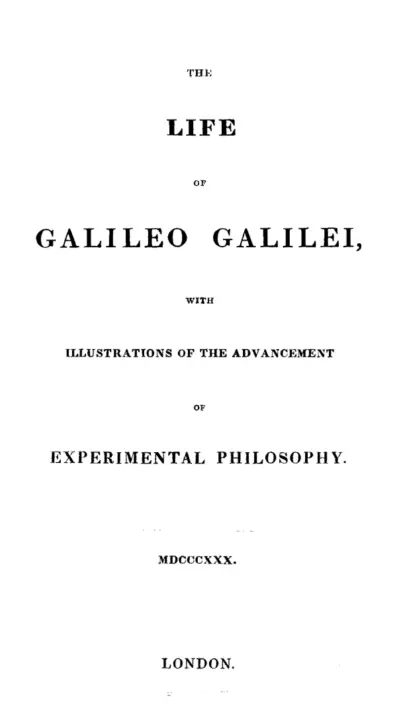
THE CLASSIC COLLECTION · 1830
"The Life of Galileo Galilei, with Illustrations of the Advancement of Experimental Philosophy" is a historical account likely written in the early 19th century. The text presents the life and contributions of the renowned scientist Galileo Galilei, placing significant emphasis on the evolution of philosophical thought and experimental science. It details not just Galileo's personal journey but also the progress of natural philosophy during his time, illustrating the shift from traditional Aristotelian principles to a more experimental and evidence-based approach. The opening portion explores the context of scientific knowledge prior to Galileo's contributions, detailing both the stagnation of natural philosophy and the emergence of a more empirical scientific method. It introduces Galileo's background and early intellectual influences, mentioning how he was motivated to challenge the old paradigms of thought, particularly those of Aristotelian philosophy. The narrative outlines Galileo's initial observations and experiments, emphasizing his pioneering role in advocating for experimental philosophy—a significant turn away from mere observation toward a hands-on methodology, thus setting the stage for the profound impact of his later discoveries.
Introduction adapted from the source catalogue; source summaries may be automatically generated.
Free to read · English · 126,968 words · No account needed
MAKE TIME FOR A GOOD BOOK
On by default. Untick to stop anonymous reading totals. Each page counts after 10 seconds in view. How this works.
Anonymous counting is on unless you have switched it off.
It is not satisfactorily ascertained at what period Galileo embraced the new astronomical theory. Gerard Voss attributes his conversion to a public lecture of Mæstlin, the instructor of Kepler; and later writers (among whom is Laplace) repeat the same story, but without referring to any additional sources of information, and in most instances merely transcribing Voss's words, so as to shew indisputably whence they derived their account. Voss himself gives no authority, and his general inaccuracy makes his mere word not of much weight. The assertion appears, on many accounts, destitute of much probability. If the story were correct, it seems likely that some degree of acquaintance, if not of friendly intercourse, would have subsisted between Mæstlin, and his supposed pupil, such as in fact we find subsisting between Mæstlin and his acknowledged pupil Kepler, the devoted friend of Galileo; but, on the contrary, we find Mæstlin writing to Kepler himself of Galileo as an entire stranger, and in the most disparaging terms. If Mæstlin could lay claim to the honour of so celebrated a disciple, it is not likely that he could fail so entirely to comprehend the distinction it must confer upon himself as to attempt diminishing it by underrating his pupil's reputation. There is a passage in Galileo's works which more directly controverts the claim advanced for Mæstlin, although Salusbury, in his life of Galileo, having apparently an imperfect recollection of its tenor, refers to this very passage in confirmation of Voss's statement. In the second part of the dialogue on the Copernican system, Galileo makes Sagredo, one of the speakers in it, give the following account:—"Being very young, and having scarcely finished my course of philosophy, which I left off as being set upon other employments, there chanced to come into these parts a certain foreigner of Rostoch, whose name, as I remember, was Christianus Urstisius, a follower of Copernicus, who, in an academy, gave two or three lectures upon this point, to whom many flocked as auditors; but I, thinking they went more for the novelty of the subject than otherwise, did not go to hear him; for I had concluded with myself that that opinion could be no other than a solemn madness; and questioning some of those who had been there, I perceived they all made a jest thereof, except one, who told me that the business was not altogether to be laughed at: and because the man was reputed by me to be very intelligent and wary, I repented that I was not there, and began from that time forward, as oft as I met with any one of the Copernican persuasion, to demand of them if they had been always of the same judgment. Of as many as I examined I found not so much as one who told me not that he had been a long time of the contrary opinion, but to have changed it for this, as convinced by the strength of the reasons proving the same; and afterwards questioning them one by one, to see whether they were well possessed of the reasons of the other side, I found them all to be very ready and perfect in them, so that I could not truly say that they took this opinion out of ignorance, vanity, or to show the acuteness of their wits. On the contrary, of as many of the Peripatetics and Ptolemeans as I have asked, (and out of curiosity I have talked with many,) what pains they had taken in the book of Copernicus, I found very few that had so much as superficially perused it, but of those who I thought had understood the same, not one: and, moreover, I have inquired amongst the followers of the Peripatetic doctrine, if ever any of them had held the contrary opinion, and likewise found none that had. Whereupon, considering that there was no man who followed the opinion of Copernicus that had not been first on the contrary side, and that was not very well acquainted with the reasons of Aristotle and Ptolemy, and, on the contrary, that there was not one of the followers of Ptolemy that had ever been of the judgment of Copernicus, and had left that to embrace this of Aristotle;—considering, I say, these things, I began to think that one who leaveth an opinion imbued with his milk and followed by very many, to take up another, owned by very few, and denied by all the schools, and that really seems a great paradox, must needs have been moved, not to say forced, by more powerful reasons. For this cause I am become very curious to dive, as they say, into the bottom of this business." It seems improbable that Galileo should think it worth while to give so detailed an account of the birth and growth of opinion in any one besides himself; and although Sagredo is not the personage who generally in the dialogue represents Galileo, yet as the real Sagredo was a young nobleman, a pupil of Galileo himself, the account cannot refer to him. The circumstance mentioned of the intermission of his philosophical studies, though in itself trivial, agrees very well with Galileo's original medical destination. Urstisius is not a fictitious name, as possibly Salusbury may have thought, when alluding to this passage; he was mathematical professor at Bâle, about 1567, and several treatises by him are still extant. According to Kästner, his German name was Wursteisen. In 1568 Voss informs us that he published some new questions on Purbach's Theory of the Planets. He died at Bâle in 1586, when Galileo was about twenty-two years old.
Your reading position is saved on this browser. Take it to another device with a library code. Reading pages adapt to text, rather than matching a printed edition.
BEHIND THE BOOK
This eBook is for the use of anyone anywhere in the United States and most other parts of the world at no cost and with almost no restrictions whatsoever. You may copy it, give it away or re-use it under the terms of the Project Gutenberg License included with this eBook or online at www.gutenberg.org. If you are not located in the United States, you will have to check the laws of the country where you are located before using this eBook. Read the source licence.
The original source file, including credits and licence, is retained by this library. Request an original-format copy at no charge. Please include the book title and Project Gutenberg identifier #43877.
KEEP YOUR CURIOSITY GOING
Cécile Tormay

Moritz Busch
John L. Ransom
Frances Wright
Cécile Tormay

Mabel Potter Daggett