THE CLASSIC COLLECTION✦Andersonville diaryCLASSIC FREE BOOKS
Andersonville diary
John L. Ransom
THE CLASSIC COLLECTION · 1913
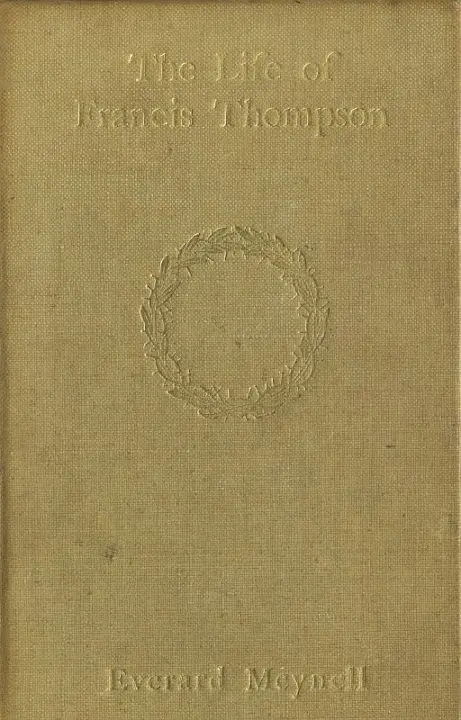
"The Life of Francis Thompson" by Everard Meynell is a biographical account written in the early 20th century. This work delves into the life of Francis Thompson, a Victorian poet best known for his poem "The Hound of Heaven." The biography details Thompson’s formative years, exploring his complex childhood and early influences, setting the stage for his later struggles as an artist in a challenging social landscape. At the start of the biography, we are introduced to the early life of Francis Thompson, born into a family with a rich history yet marked by emotional and social struggles. The narrative recounts his childhood in Preston, revealing a sensitive and introspective boy who grapples with the intricacies of love, loneliness, and imagination. Meynell provides a vivid depiction of Thompson’s upbringing, his relationship with literature, and the emotional undercurrents that shaped his poetic voice. This initial chapter sets an intimate tone, suggesting that Thompson's journey is as much about his internal landscapes as it is about his external circumstances.
Introduction adapted from the source catalogue; source summaries may be automatically generated.
Free to read · English · 114,803 words · No account needed
MAKE TIME FOR A GOOD BOOK
On by default. Untick to stop anonymous reading totals. Each page counts after 10 seconds in view. How this works.
Anonymous counting is on unless you have switched it off.
For a time a few shillings might have been his each week for the fetching; but he did not fetch them. An allowance, sufficient to lodge and feed him, and insufficient to do either fully, was sent to him by his father at a reading-room called, it is thought, the "Clarendon," in the Strand. The more he needed it the greater worry would it seem to collect it. Fear lest it were not there; fear lest he should be refused it because of his rags, and, finally, an illusory certainty--the certainty of dejection--that it had been discontinued, prevented him, until at last, through his default, it did really cease.
He had the words of the Proverb by heart--"Give me neither poverty nor riches; feed me with the food convenient for me"--but he would rather say his prayer in the street than ask for his allowance in the "Clarendon." He was willing to starve both ways: he wrote out for his comfort: "Even in the night-time of the soul wisdom remains."
In addition to the allowance there were relatives and friends to whom Francis might have gone, if assistance in his need had been part of his scheme. Besides those with whom he stayed during his examinations in London, there was a Catholic relative who had an establishment for stationery off the Strand (he was not asked for so much as a pencil), and who died in Church Passage, Chancery Lane, about 1891; his paternal grandmother, then an old lady, lived in City Road, and Edward Healy Thompson had resided in Hinde Street, Manchester Square, and made many town friends.
The time came when he had no lodging; when the nights were an agony of prevented sleep, and the days long blanks of half-warmth and half-ease. After seven nights and days of this kind he is deep immersed in insensibility. Pain, its own narcotic, throbs to painlessness. Touch and sight and hearing are brokenly and dimly experienced, save when some unknown touch switches on the lights of full consciousness. Sensation is still painful, but disjointedly, impotently. When a cart jolts by the noise of its wheels comes to him long after--or before--he troubles to move out of reach of the shafts--the yell of the driver seems to have no part in the incident. He knows not if it came from that or from another quarter. He sees things pass as silently as the figures on a cinematograph screen; one set of nerves, out of time and on another plane, respond to things heard. The boys now running at one end of the alley, in front of him, are behind him the next, and their cries seem to come from any quarter and at random. Is it that they move too quickly for him or that he unknowingly is wheeling about in his walk, or that London herself spins round him? For hours he has stood in one place, or paced one patch of pavement, as if his feet were trapped in the lines between the stones. He remembers that, as a child, he had made rules, treading only on the spaces, or only on the line of the pattern; now they make much stricter bounds. He is tied to the few slabs of stone that fill the space beneath his archway. It seems dreadfully perilous to move beyond them, and he sways within their territory as if they edged a precipice. And then, he knows not how or why, his weakness has passed, and he is drifting along the streets, not wearily, but with dreadful ease, with no hope of having sufficient resolution to halt. Time matters as little to him as the names of the streets, and the very faces of the clocks present, to his thinking, not pictures of time and motion, but stationary, dead countenances. Noting that the hands of one have moved, he wonders at it only because its view of the passage of time is so laughably at variance with his own. Had it marked a minute since he had last looked, or a whole day, he would not have been surprised, but the foolish half-hour it told of is absurd. His time leaped or paused, while the clock went with lying regularity. The street-names, too, deceived him; they were unfamiliar in most familiar places; or they showed well-known names on impossible corners. He seemed to be spinning, like a falling leaf, and tossed by unseen winds of direction. Oxford Street was short and narrow; Wardour Street big enough to hold the tribes of Israel, and the houses of it as high, he guessed, though he dared not lift his head to see, as the divided waves of the Red Sea. Out of confusion came a voice, "Is your soul saved?" It broke in upon his half-consciousness as the school gong wakes the boy. The mantle of protecting delirium fell away; the voice broke in upon his privacy, threatening his reserves, seeking the confidences of the confessional. "What right have you to ask me that question?" he replied.
Your reading position is saved on this browser. Take it to another device with a library code. Reading pages adapt to text, rather than matching a printed edition.
BEHIND THE BOOK
This eBook is for the use of anyone anywhere in the United States and most other parts of the world at no cost and with almost no restrictions whatsoever. You may copy it, give it away or re-use it under the terms of the Project Gutenberg License included with this eBook or online at www.gutenberg.org. If you are not located in the United States, you will have to check the laws of the country where you are located before using this eBook. Read the source licence.
The original source file, including credits and licence, is retained by this library. Request an original-format copy at no charge. Please include the book title and Project Gutenberg identifier #45106.
KEEP YOUR CURIOSITY GOING
John L. Ransom

Herman W. Mudgett

Harriet Monroe
Daniel Dulany Addison
Charles Lanman

Harold Rosher