THE CLASSIC COLLECTION✦Andersonville diaryCLASSIC FREE BOOKS
Andersonville diary
John L. Ransom
THE CLASSIC COLLECTION · 1913
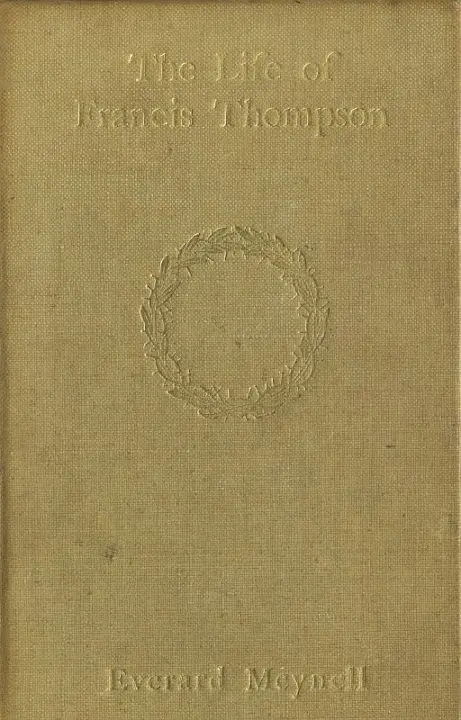
"The Life of Francis Thompson" by Everard Meynell is a biographical account written in the early 20th century. This work delves into the life of Francis Thompson, a Victorian poet best known for his poem "The Hound of Heaven." The biography details Thompson’s formative years, exploring his complex childhood and early influences, setting the stage for his later struggles as an artist in a challenging social landscape. At the start of the biography, we are introduced to the early life of Francis Thompson, born into a family with a rich history yet marked by emotional and social struggles. The narrative recounts his childhood in Preston, revealing a sensitive and introspective boy who grapples with the intricacies of love, loneliness, and imagination. Meynell provides a vivid depiction of Thompson’s upbringing, his relationship with literature, and the emotional undercurrents that shaped his poetic voice. This initial chapter sets an intimate tone, suggesting that Thompson's journey is as much about his internal landscapes as it is about his external circumstances.
Introduction adapted from the source catalogue; source summaries may be automatically generated.
Free to read · English · 114,803 words · No account needed
MAKE TIME FOR A GOOD BOOK
On by default. Untick to stop anonymous reading totals. Each page counts after 10 seconds in view. How this works.
Anonymous counting is on unless you have switched it off.
In 1893 his father was at Rhyl, and Francis sought him there, but without invitation. He writes:--
"I went over on Monday--only to find that he had left the previous Wednesday, after having been there for a month, which things are strange."
To Dr. Thompson the strangeness would be in Francis's unwontedly active desire to see him. It is probable that each exaggerated the other's feeling of estrangement. When, in April 1896, Francis heard that his father was dying, he went to Ashton, but too late. After the funeral he writes:--
"I never saw my father again, I cannot speak about it at present. ---- ---- made it very bitter for me. It has been nothing but ill-health and sorrow lately, but I must not trouble you with these things. I saw my sister looking the merest girl still, and sweeter than ever. She did not look a day older than ten years ago. She said I looked very changed and worn."[38]
At Downing he had neighbours in the Feilding family, and it was to the monastery church that Lady Denbigh came to "make her soul" at the penitential seasons of the year. This church her husband began to build when he was an Anglican; then, changing his religion, he had changed the dedication of his bricks and mortar. From a letter of the Hon. Everard Feilding to W. M. after F. T.'s death:--
"Your letter reached me at a time when my mind, like that, I think, of many others, was full of Francis Thompson; and during the preceding three nights I had been reading and re-reading aloud to two or three friends certain of his poems which had specially touched me, including the Nocturn, infinitely pathetic from my knowledge, however slight, of the man.
"Need I say that I am truly touched to hear that Thompson should have thought my modest appreciation of his work as anything more than the most natural thing in the world? I only met him three times, each time in the company of my friend Head,[39] who shared my admiration. Our meeting came about in an absurd enough wise. A ghost (possibly you have heard, or not heard, of my taste for these creatures) was reported active in the neighbourhood of Pantasaph, on my brother's place in Wales. My own inclination supplied the motive, and an idle week of Head's the occasion, of a visit there, and we camped a few nights in a derelict mansion, rejoicing in the appropriately ominous name of Pickpocket Hall, in hopes of interviewing the spectre. Needless to say, we failed. But we got the story of the Irish monk; also the story of the practical nun, who scented buried treasure which she hoped to unearth to the profit of her community; and of the oldest inhabitant; and, finally, of the Poet. The people at the monastery had told us that Thompson had been a witness, and we decided on a call; and at about five one evening made our way to the tiny cottage where he lodged, and asked for him. He was still in bed. We returned at 6.30. He was still in bed. So we concocted a letter, suitable, as we imagined, to the person who had written Thompson's poems, not quite English, somewhat elided, and as inverted as we could manage, ending with an invitation to breakfast at 9.30 that night and a conference with our hobgoblin. And somewhat pleased with our effort, we retired to our haunted mansion and awaited events. At 9.30 he came and breakfasted while we supped. We said at once to one another: 'This is not the man to whom we wrote that letter.' For, instead of parables in polysyllables and a riot of imagery, we found simplicity and modesty and a manner which would have been almost commonplace if it had not been so sincere. But the charm and interest of his talk grew with the night, and it was already dawn when, the ghost long since forgotten, we escorted him back across the snow to his untimely lunch. He told us, I remember, of his poetical development, and of how, until recently, he had fancied that the end of poetry was reached in the stringing together of ingenious images, an art in which, he somewhat naïvely confessed, he knew himself to excel; but that now he knew it should reach further, and he hoped for an improvement in his future work. New Poems was subsequent to this meeting. It was only in his account of the ghost, which had 'charged his body like a battery so that he felt thunderstorms in his hair,' that the imaginary individual to whom we had addressed our letter revealed himself.
Your reading position is saved on this browser. Take it to another device with a library code. Reading pages adapt to text, rather than matching a printed edition.
BEHIND THE BOOK
This eBook is for the use of anyone anywhere in the United States and most other parts of the world at no cost and with almost no restrictions whatsoever. You may copy it, give it away or re-use it under the terms of the Project Gutenberg License included with this eBook or online at www.gutenberg.org. If you are not located in the United States, you will have to check the laws of the country where you are located before using this eBook. Read the source licence.
The original source file, including credits and licence, is retained by this library. Request an original-format copy at no charge. Please include the book title and Project Gutenberg identifier #45106.
KEEP YOUR CURIOSITY GOING
John L. Ransom

Herman W. Mudgett

Harriet Monroe
Daniel Dulany Addison
Charles Lanman

Harold Rosher