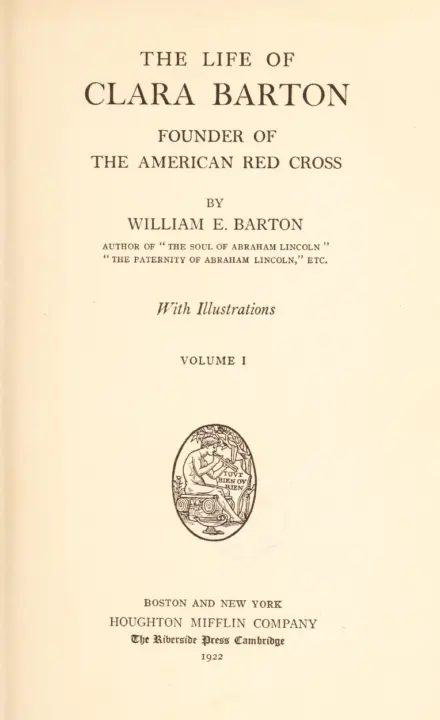
The Life of Clara Barton, Founder of the American Red Cross (Vol. 1 of 2)
William E. (William Eleazar) Barton
THE CLASSIC COLLECTION · 1922
"The Life of Clara Barton, Founder of the American Red Cross (Vol. 2 of 2)" by William E. Barton is a historical account written in the early 20th century. This volume focuses on the remarkable life of Clara Barton, particularly her role in establishing the American Red Cross and her efforts in humanitarian service during wars. The narrative showcases her tenacity and the profound impact she had on the field of war relief. At the start of this volume, the text delves into Clara Barton's discovery of the Red Cross during her time in Europe following her own health struggles. The opening introduces her initial ignorance of the organization and outlines the lack of American involvement in the Red Cross at that time. It highlights her journey to champion humanitarian efforts, as she learned about the principles behind the Red Cross during the Franco-Prussian War and became determined to bring its ideals back to the United States, leading to her eventual advocacy for the nation's participation in the international treaty that recognized the Red Cross. This introduction sets a compelling tone for her challenges and achievements in humanitarian work.
Introduction adapted from the source catalogue; source summaries may be automatically generated.
Free to read · English · 136,245 words · No account needed
MAKE TIME FOR A GOOD BOOK
On by default. Untick to stop anonymous reading totals. Each page counts after 10 seconds in view. How this works.
Anonymous counting is on unless you have switched it off.
Now, my dear, this is all of me, but how is it with you and yours? For I have heard of you ill and suffering, and dared not ask more. I trust that is all past, and I should see only the bright, happy face that left its lovely picture on my memory. The noble husband, is he well? The beautiful “children”--I can scarcely picture them, for some of them are men and women now, and I never forget to pray God to keep and bless them all for the wife’s and mother’s sake. You will remember that the first great love in my heart for you carried me at one bound beyond all lines of courtly etiquette, blinded me to the positions and conditions of rank and royalty, and made me stupidly, awkwardly dumb to every titled phrase and courtly sentence; it closed and sealed my senses to all these, but opened them to the loving, tender wife and mother, the noble woman and the priceless friend. I could not have spoken a word of flattery to you sooner than I could have put it in my prayer; it could never have entered my thought to courtesy or bend the knee in your presence, but I should have lain in the dust at your feet without knowing it, if I had felt that it could serve you. A strange, uncourtly friend you have in me, this far-away American woman, my child, but a friend, nevertheless.
And now comes up that dread theme that first brought me to know you--war, dreadful war. My heart has stood still for weeks in anxiety, fear, and dread. Is Germany, dear Germany, to be drawn into that terrible vortex? Are her mothers to give out their sons, and her wives their husbands again so soon? Are the graves to be opened again almost before they are green, and the wounds before they are healed? Are the fair fingers of her maidens again to ply the busy hours with bandages and lint and the trembling grandmothers to labor again with shirts and socks? And you and yours, who hold and guard the weal of all, are you to stand in jeopardy, and watch in agony again so soon? Are these dreadful days I so well remember all to be lived over again? I cannot yet believe it; neither can I yet rid me of the fear which haunts me day and night. Constantly the question rises, What can I do? And my weakness answers back, “Nothing, nothing.” If I had the strength of ten years ago, and the war opened upon you, I should prepare myself and go, not single-handed and alone, as I was overtaken in 1870, but I would make my arrangements with my people here for all material to work with, select my assistants from the German and German-speaking populations here, take my surgeons and nurses, and go at once and ask you for a field of labor. Surely you and your good husband and father and mother would assign me one somewhere! But it is all too late for this; at the best I can only use my influence and the little strength I have at home. As a means to this, I have written our good friend, Dr. Appia, of Geneva, to ask if any help from me would be desirable, and to say that if it would be acceptable, I would, upon his writing me to that effect, make the effort to establish an international organization in my own country for the collection and receipt of supplies, which should work under the insignia of the Red Cross, and forward through a headquarters which I would attempt to establish somewhere near or at New York. Thus would I try to bring the early and organized efforts of America into direct communication with the activities of Europe, and try for once to make our charities of some timely and real benefit, which the great distance and want of proper organization has hitherto greatly hindered, or nearly prevented. Our people are generous, tender of heart, and quick in their sympathies, but they are busy and spread over a quarter of the globe. They do not become aware of the necessities for assistance in other lands till great suffering exists and the general Press brings it to their knowledge. Then they spring with a bound of sympathy and generosity and give without stint, but their stream has no channel prepared for it to flow in and runs over and wastes, so that little, very little, ever reaches the real scene of suffering and want for which it is so generously given. If I can learn that it would be acceptable and that there can be established a direct coöperation between the charitable activities of America and Europe, and that Europe desires it, I shall do all in my power to organize the work early, at once in America. It is for this I have written Dr. Appia to have him send me his request that I would do it, that I may use it as a lever with our Government to gain its sanction, protection, prestige, and coöperation so far as I can. I shall watch with all interest every movement and I would be so grateful for any information that I might gain from European sources regarding the true condition of things. How glad I should be of any published work or matter, if any exists, which explains the working of your remarkable system of, or what we term, “Relief Societies.” I do not know where to send for this but to you who were the originator and head. If the condition of Europe renders it desirable, and I am strong enough to organize aid in America, every word of information on these points would be held priceless. I am gleaning all I can from such foreign papers as I can get; both the German and French languages are familiarly used in my house. My amanuensis is Swiss and speaks both natively, of course. The more I read, the more I fear what the next months may bring to you, to dear Germany and to all Europe. And the more I fear, the more anxious I am to help. Let us pray God the storm may pass, but if it must come, give us strength and wisdom to meet it well.
Your reading position is saved on this browser. Take it to another device with a library code. Reading pages adapt to text, rather than matching a printed edition.
William E. (William Eleazar) Barton

William E. (William Eleazar) Barton

William E. (William Eleazar) Barton
BEHIND THE BOOK
This eBook is for the use of anyone anywhere in the United States and most other parts of the world at no cost and with almost no restrictions whatsoever. You may copy it, give it away or re-use it under the terms of the Project Gutenberg License included with this eBook or online at www.gutenberg.org. If you are not located in the United States, you will have to check the laws of the country where you are located before using this eBook. Read the source licence.
The original source file, including credits and licence, is retained by this library. Request an original-format copy at no charge. Please include the book title and Project Gutenberg identifier #67954.
KEEP YOUR CURIOSITY GOING
Cécile Tormay

Moritz Busch
John L. Ransom
Frances Wright
Cécile Tormay

Mabel Potter Daggett