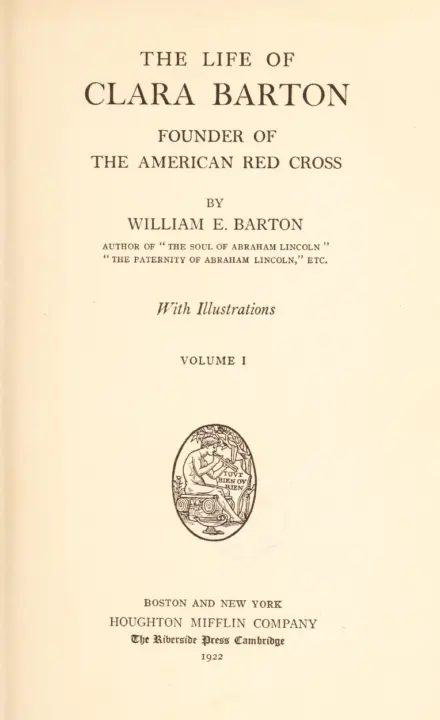
The Life of Clara Barton, Founder of the American Red Cross (Vol. 1 of 2)
William E. (William Eleazar) Barton
THE CLASSIC COLLECTION · 1922
"The Life of Clara Barton, Founder of the American Red Cross (Vol. 2 of 2)" by William E. Barton is a historical account written in the early 20th century. This volume focuses on the remarkable life of Clara Barton, particularly her role in establishing the American Red Cross and her efforts in humanitarian service during wars. The narrative showcases her tenacity and the profound impact she had on the field of war relief. At the start of this volume, the text delves into Clara Barton's discovery of the Red Cross during her time in Europe following her own health struggles. The opening introduces her initial ignorance of the organization and outlines the lack of American involvement in the Red Cross at that time. It highlights her journey to champion humanitarian efforts, as she learned about the principles behind the Red Cross during the Franco-Prussian War and became determined to bring its ideals back to the United States, leading to her eventual advocacy for the nation's participation in the international treaty that recognized the Red Cross. This introduction sets a compelling tone for her challenges and achievements in humanitarian work.
Introduction adapted from the source catalogue; source summaries may be automatically generated.
Free to read · English · 136,245 words · No account needed
MAKE TIME FOR A GOOD BOOK
On by default. Untick to stop anonymous reading totals. Each page counts after 10 seconds in view. How this works.
Anonymous counting is on unless you have switched it off.
At 4 P.M. we were at “Verona” wondering if we should see its “gentlemen” and giving certainly more than our usual interest to this subject, and at five we halted at a singular dépôt, with no rattle of cabs, or hacks, no tramping of horses, still as death all about us, and as we walked out there lay waiting us hundreds of gondolas, black as a pall, some covered, some open, all drawn up to the side of the Canal to take us weary travelers to our hotels. This was, indeed, novel, but we selected our carriage, stepped in with our luggage, sat down, and, leaning lazily back, left it to our gondolier to pick his way through the watery streets, some wide, some narrow, leading into and out of each other, like veritable city streets and lanes, the ways on each side lined perfectly thick with old palaces and majestic buildings of centuries ago, their fronts to the sea and their magnificent stone steps leading directly into the water, and when one would pay a call, the gondolier had only to bring his boat alongside and you stepped out as from another carriage to the steps of a mansion. We were taken to “Hotel Victoria,” made as comfortable as a first-class Italian hotel can make one, and after supper commenced upon the sights. Ah, but there was so much to see, not that it is a city of enterprise, a flourishing mart of trade or business. Oh, no, far from it. Venice only exists upon the record of its former greatness; take all this away and the travelers consequent upon it and I believe twelve months would find a famine there, but there is little danger of this while Byron and Shakespeare remain bright in English literature.
Here, as everywhere in Italy, one must commence with the cathedral, and having gone through this, and some scores of churches, the “Campo Santo” and the Bell Tower, one is at liberty to enter upon the palaces, gardens, and theaters. But Venice offers some deviations from this general rule; most cities have prisons, but they have not all the dungeons of Saint Marc. All have bridges, but all have not a “Rialto” nor a “Bridge of Sighs.” I suspect I do not need to remind you of many old or historical facts. You who are always digging into the past will have them all “papered and labeled” and stored away ready for use. But I might mention the seventy-two little islands upon which Venice was built, which were only a part of the Adriatic, and not reckoned as land at all. A set of not warlike people from here and there in the vicinity, having grown weary and afraid of their fighting and troublesome neighbors, mostly from Austria, determined to place themselves in a position more difficult to attack, came far over the sea to these little islands and commenced a city, and gave a general invitation to all war-pestered, peace-loving citizens of the world to come and join them; from time to time they united their islands, built their houses for dwelling and trade upon the streets laid down upon the piles, with one side opening upon the street of earth and the opposite upon the sea, as I have before described. But--the depravity of human nature!! No sooner were they a little strong and comfortable themselves than they sent out their ships to prey upon and plunder their neighbors, and well-nigh ravaged the cities of the earth. They decorated their palaces with the spoils of other nations, married the sea, and declared themselves Omnipotent and Divine. Among other things their religion and church must have a Hero, and they sent afar, and got (as they said) the body of Saint Mark, brought it, and great numbers of relics belonging to him, buried it with the divinest honors in their principal church, and named it Saint Mark, or “San Marco.” This was as early as the ninth century. It is a large but not handsome edifice, facing a paved court, a “piazza” some six hundred feet in length, surrounded by palaces, now used for public purposes, stores, etc. All the world of Venice walks in the “Piazza of San Marco.” The pigeon was esteemed a sacred bird with them, and he is still cherished here and treated with great honor. One of the curiosities to be seen are the “pigeons of San Marco.” I cannot at this moment recollect definitely enough to state to you how many hundreds are supposed to reside in the immediate vicinity, but their dinner hour is two o’clock in the afternoon. The great bell of the clock strikes three quarters past one and they commence wheeling and circling into the court, they cover the fronts of all the buildings, sit as thickly as possible upon every window seat, hang in all the cornices, and stand in full platoons in every foot of spare pavement for a number of rods around the especial corner where their dinner is served. A young man (it was formerly a young girl) is appointed by the Government as feeder of the pigeons. It is not necessary to say that he is punctual with his repast--he could not live with his tumultuous boarders if he were not. As the bell strikes two, he pours the grain from--
Your reading position is saved on this browser. Take it to another device with a library code. Reading pages adapt to text, rather than matching a printed edition.
William E. (William Eleazar) Barton

William E. (William Eleazar) Barton

William E. (William Eleazar) Barton
BEHIND THE BOOK
This eBook is for the use of anyone anywhere in the United States and most other parts of the world at no cost and with almost no restrictions whatsoever. You may copy it, give it away or re-use it under the terms of the Project Gutenberg License included with this eBook or online at www.gutenberg.org. If you are not located in the United States, you will have to check the laws of the country where you are located before using this eBook. Read the source licence.
The original source file, including credits and licence, is retained by this library. Request an original-format copy at no charge. Please include the book title and Project Gutenberg identifier #67954.
KEEP YOUR CURIOSITY GOING
Cécile Tormay

Moritz Busch
John L. Ransom
Frances Wright
Cécile Tormay

Mabel Potter Daggett