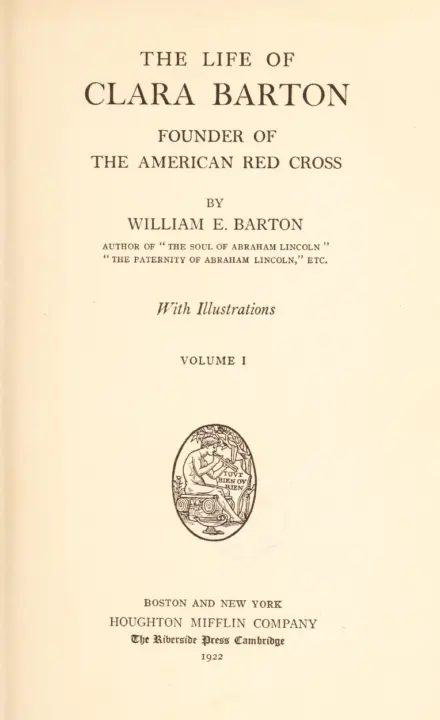
The Life of Clara Barton, Founder of the American Red Cross (Vol. 1 of 2)
William E. (William Eleazar) Barton
THE CLASSIC COLLECTION · 1922
"The Life of Clara Barton, Founder of the American Red Cross (Vol. 2 of 2)" by William E. Barton is a historical account written in the early 20th century. This volume focuses on the remarkable life of Clara Barton, particularly her role in establishing the American Red Cross and her efforts in humanitarian service during wars. The narrative showcases her tenacity and the profound impact she had on the field of war relief. At the start of this volume, the text delves into Clara Barton's discovery of the Red Cross during her time in Europe following her own health struggles. The opening introduces her initial ignorance of the organization and outlines the lack of American involvement in the Red Cross at that time. It highlights her journey to champion humanitarian efforts, as she learned about the principles behind the Red Cross during the Franco-Prussian War and became determined to bring its ideals back to the United States, leading to her eventual advocacy for the nation's participation in the international treaty that recognized the Red Cross. This introduction sets a compelling tone for her challenges and achievements in humanitarian work.
Introduction adapted from the source catalogue; source summaries may be automatically generated.
Free to read · English · 136,245 words · No account needed
MAKE TIME FOR A GOOD BOOK
On by default. Untick to stop anonymous reading totals. Each page counts after 10 seconds in view. How this works.
Anonymous counting is on unless you have switched it off.
Barton, Clara, her autobiography, I: 1 seq.;
her ancestry, 9 seq.;
her parents, 16 seq.;
her childhood, 19 seq.;
her timidity, 20;
her education, 20 seq.;
her dog, Button, 26;
her fondness for verses, 26;
her skill as a horsewoman, 27;
her horse, Billy, 30;
her presence at the killing of an ox, 34;
her youth, 36 seq.;
her illness in childhood, 37;
nurse of her brother David, 37;
ceased to grow at 12, 38;
learned to weave, 38;
how she kept the Sabbath, 39;
did not learn to dance, 42;
a child’s party, 43;
her books, 48;
her first experience as a teacher, 50;
her “waifish dresses,” 56;
at Clinton Institute, 60;
teacher at Bordentown, 62;
her home letters, 68 seq.;
her verses on the steamboat, 75;
her lovers, 76 seq.;
her too great sensitiveness, 20, 85;
her work in the Patent Office, 89 seq.;
her styles of handwriting, 91;
her home letters, 94-101;
cares for soldiers of Sixth Massachusetts, 107;
at Battle of Bull Run, 119;
her relations with her family, 131 seq.;
visit to New England in December, 1861, 136;
return to Washington with supplies, 137;
letter to Frances Childs, 141-44;
her father’s last sickness, 145 seq.;
letter to her brother Stephen, 147 seq.;
decided to give herself to work at the battle-front, 154, 157;
letter after Fredericksburg quoted, 154;
letter to Gov. John A. Andrew, 158;
her father’s death and burial, 161-63;
her disappointment concerning permission to go to the front, 164;
permission and passes obtained, 164;
started for the front, 167;
letter to Corporal Poor, 169;
at Culpeper, or Cedar Mountain, 172 seq.;
another letter to Corporal Poor, 174;
at Second Bull Run, 175 seq.;
letter to sister Julia, 192;
starts for Harper’s Ferry, 194 seq.;
at Antietam, 199 seq.;
at Fredericksburg, 212 seq.;
letter to Vira Stone, 212 seq.;
how she dressed at the front, 220, 221;
received a box from Anna Childs, 221 seq.;
at Hilton Head, S.C., 225 seq.;
witnesses futile attempt to capture Ft. Sumter, 238;
serenaded as the Florence Nightingale of America, 242;
her views of peace and patriotism, 245-48;
her requisition for a flatiron, 248;
witnessed assault on Ft. Wagner, 248-50;
sick in summer of 1863, 250 seq.;
met with official arrogance, 254;
declined to criticize Dorothea Dix, 255 seq.;
her position in Patent Office, 258 seq.;
returned to Washington, 262;
at Worcester, 263;
listened to H. W. Beecher, 263;
her political views in 1864, 264-68;
listened to George Thompson, 269;
her change of opinion concerning John Brown, 269;
at Spotsylvania and Wilderness, 272 seq.;
returns to Washington to better care for soldiers, 278-79;
why she did not work under Commissions, 280;
returns to Washington in 1864, 282;
appointed superintendent of nurses, Army of the James, 282 seq.;
describes Fourth of July celebration, 283-85;
letters to Frances Childs Vassall and Annie Childs, 286-96;
describes death of her brother Stephen, 298-99;
her verses on “The Women Who Went to the Field,” 301-03;
drew her salary as clerk in the Patent Office till August, 1865,
304;
at Andersonville, 304 seq.;
appointed by President Lincoln to find missing soldiers, 305;
assisted in her work by Pres. Andrew Johnson, 307-09;
approved and passes issued by Gen. Grant, 309-10;
sometimes had greater success than missing men desired, 311-13;
letter from grateful soldier, 313-14;
four years in work for missing men, 316;
appointed by Secretary Stanton to visit Andersonville, 317 seq.;
devotes herself to release of Dorence Atwater, 321-25;
publishes his lists in New York Tribune, 326;
wanted to write a book, 328-33;
chose lecture platform instead, 342 seq.;
her finances, 340-41;
bought a new home, 347;
nervous breakdown, 348;
first voyage to Europe, II: 1;
first knowledge of the Red Cross, 2;
in Switzerland, 8;
in Corsica, 8;
in Berne, 9;
accepts invitation to serve Red Cross in Franco-Prussian War, 11
seq.;
at Basle, 12;
at Mülhausen, 14;
at Strassburg, 17;
at Carlsruhe, 19;
letter to Frances Childs Vassall, 23;
at Paris, 31;
at Lyons, 32;
at Carlsruhe, 40;
at Belforte, 44;
declines gift and receives annuity, 53;
letter to her sister Sarah, 55;
at Montbéliard, 56;
in Italy, 64;
in London, 65;
at Isle of Wight, 73 seq.;
in London, 77;
letter to Mrs. Vassall, 79;
letter to Bernard Barton Vassall, 81;
letter to Mamie Barton Stafford, 83;
returns to America, 84;
only person in America in 1873 wearing Red Cross, 88;
the nature of her sickness, 89-91;
letter to Mr. Dwight, 91-92;
at Dansville Sanitarium, 92 seq.;
letter to John D. De Frieze, 93;
letter to the Grand Duchess of Baden, 95-100;
recovery of health, 100 seq.;
letter to Mamie Stafford, 104;
letter to German professor, 106;
receives ovation on Memorial Day, 112;
letter to Dr. Louis Appia, 121;
his reply, 124;
further correspondence, 130 seq.;
first pamphlet concerning Red Cross, 139;
her first attempt at publicity, 145-46;
correspondence with Pres. Garfield, 147-49;
interview with James G. Blaine, 149 seq.;
interview with Robert T. Lincoln, 151;
letter from James G. Blaine approving Red Cross, 154;
her first public announcement of the Red Cross, 157;
elected president American Red Cross, 159;
organizes first local Red Cross society in America, 162;
interviews President Arthur, 163;
appears before Senate Committee, 164;
first work of American Red Cross, 169;
encounters opposition of rival organizations, 172 seq.;
visits State Department, 179 seq.;
sees the Red Cross Treaty, 179-81;
receives news of adoption of Treaty, 184;
in Mississippi floods, 196 seq.;
becomes matron at Sherborn, 199-214;
her love of the color of red, 218, 347;
Louisiana tornado, 220;
Ohio River floods, 221;
Texas famine, 224;
Mount Vernon tornado, 228;
yellow fever epidemic, 229;
Johnstown, 231;
Sea Islands hurricane, 240;
Armenia, 244;
in Constantinople, 248;
decorated by Sultan, 254;
attended International Conference at Geneva, 260;
introduced the “American Amendment,” 261;
letter from Louise, Grand Duchess of Baden, 264;
letter to Mamie Stafford, 268;
address at Wellesley, 270;
is pressed for money for expenses of Red Cross, 271;
accepts Red Cross Farm, 272 seq.;
in Cuba, 280-93;
receives thanks of Congress, 293;
at Galveston, 294;
at St. Petersburg, 296;
friction in Red Cross, 298;
Committee of Investigation, 300;
resigns from Red Cross, 300;
considers removal to Mexico, 301;
at home, 307-16;
her religion, 317-25;
her personality, 326-60;
her last years, 361-68;
her death, 369-74;
her funeral, 374-78;
her resurrection, 379.
Your reading position is saved on this browser. Take it to another device with a library code. Reading pages adapt to text, rather than matching a printed edition.
William E. (William Eleazar) Barton

William E. (William Eleazar) Barton

William E. (William Eleazar) Barton
BEHIND THE BOOK
This eBook is for the use of anyone anywhere in the United States and most other parts of the world at no cost and with almost no restrictions whatsoever. You may copy it, give it away or re-use it under the terms of the Project Gutenberg License included with this eBook or online at www.gutenberg.org. If you are not located in the United States, you will have to check the laws of the country where you are located before using this eBook. Read the source licence.
The original source file, including credits and licence, is retained by this library. Request an original-format copy at no charge. Please include the book title and Project Gutenberg identifier #67954.
KEEP YOUR CURIOSITY GOING
Cécile Tormay

Moritz Busch
John L. Ransom
Frances Wright
Cécile Tormay

Mabel Potter Daggett