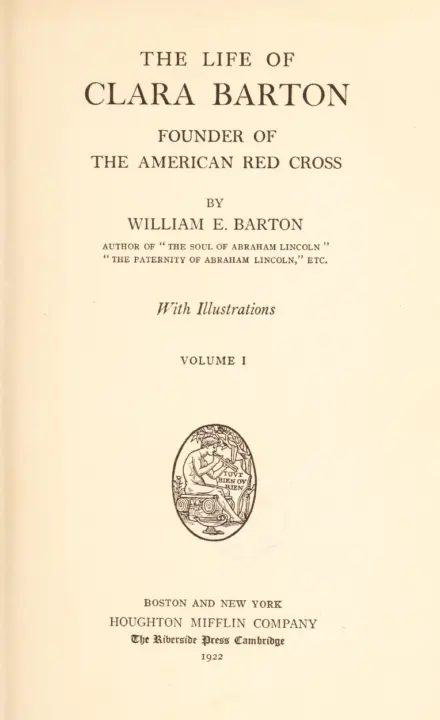
The Life of Clara Barton, Founder of the American Red Cross (Vol. 1 of 2)
William E. (William Eleazar) Barton
THE CLASSIC COLLECTION · 1922
"The Life of Clara Barton, Founder of the American Red Cross (Vol. 2 of 2)" by William E. Barton is a historical account written in the early 20th century. This volume focuses on the remarkable life of Clara Barton, particularly her role in establishing the American Red Cross and her efforts in humanitarian service during wars. The narrative showcases her tenacity and the profound impact she had on the field of war relief. At the start of this volume, the text delves into Clara Barton's discovery of the Red Cross during her time in Europe following her own health struggles. The opening introduces her initial ignorance of the organization and outlines the lack of American involvement in the Red Cross at that time. It highlights her journey to champion humanitarian efforts, as she learned about the principles behind the Red Cross during the Franco-Prussian War and became determined to bring its ideals back to the United States, leading to her eventual advocacy for the nation's participation in the international treaty that recognized the Red Cross. This introduction sets a compelling tone for her challenges and achievements in humanitarian work.
Introduction adapted from the source catalogue; source summaries may be automatically generated.
Free to read · English · 136,245 words · No account needed
MAKE TIME FOR A GOOD BOOK
On by default. Untick to stop anonymous reading totals. Each page counts after 10 seconds in view. How this works.
Anonymous counting is on unless you have switched it off.
If I were to make an apology as long as my offense, I could write nothing else, but I don’t like apologies; you don’t either, do you? Then let me hasten to proclaim myself an idle, lazy, procrastinating, miserable do-nothing and good-for-nothing; if that isn’t enough, I leave the sentence open for you to finish and I sign it squarely when you have done and call it “quits.” But really it has been too bad. I have neglected everybody in general, not you in particular. I thought I was too busy to write. I don’t suppose I was, only that I did not employ my time well. I know this is often so and perhaps always. I wish I had been better educated in this regard as well as every other. If you are ever married, as you doubtless will be, and have a family of eight or ten children, I beg you will make it a specialty in their several educations that they be taught to do things in the proper time. You will do me a favor to remember this as one of “my efforts for the good of humanity.”
[Illustration: [Facsimile]]
I wanted all last winter to tell you about my “dressmaking” and describe to you my “shop.” I knew it would interest you if no one else. Now, wasn’t that the last thing you would have thought of, that I should come to Europe and set up dressmaking, and French dressmaking at that? I knew the fact would be a little surprise to most of my old friends who knew me best, but to you I imagine it a matter of bewildering astonishment. Well, you should have seen the patterns! “Did I have patterns?” Didn’t I? And didn’t I cut them myself? And didn’t I direct all the making until I had imparted my wonderful art to others? And you think my garments were fearfully and wonderfully made! Well, that opinion comes of your being an old maid and so particular. I assure you, Miss Annie Childs, that they were nice garments and prettily cut and well made, and I found them in excellent demand; every one wanted them and never a word of complaint of the price; everybody seemed to be perfectly convinced that they were cheap enough at my first offer. I had ten young girls (like yours) dressmakers, and from one to three men “tailors” who worked twelve hours a day, but only with the shears, never an hour’s sewing; and no one sewed at my “shop”; only those who must be taught to take something out and do it over. And we made dresses and sacques and petticoats and chemises and aprons and hoods and mittens and pantaloons, vests, blouses, shirts, socks, of all kinds of material and all sizes that ever the tiniest baby grew to. Oh, yes, and such lots of things for babies,--little dresses, little bonnets, cloaks, blankets, two thousand garments every week. I don’t think they were gored and flounced and frilled as much as yours, Miss Annie Childs, but they were strong and warm and handsome. It is true all my seamstresses had not such nimble, delicate fingers as one might desire for the finest work; they wore very large thimbles sometimes; but there were plenty of small fingers in the family. They came very gladly twice a week to see me and showed me with great pride their successful efforts; always the work came home in the market basket, and always I knew that that same basket would load the other way with bread and a little meat if it were possible, but this was not always. But it was such a comfort to see them, week by week, grow better clothed themselves and the children, till by and by a woman and her baby came to look only like a big and a little bundle of the same clothing she carried in her basket. And all the working-people of the city came to look like walking bundles of the same clothing. To be sure, it took away something from the picturesque style of the city as I first saw it when at least ten thousand human beings were perfectly arranged for models for the painter and the sculptor. I admit that it was highly artistic, but I thought it a “peutrop” for the season, considering that the earliest snows had commenced to fall. Oh, but don’t you wish now that you had come and worked at the head of my “shop”--didn’t I wish it? More than once I sighed in my inmost soul for you. How rich I should have been, with you at my side! Just think of it! I shall write to Fannie sometime when I hain’t told all the news to you--please hand her this if she looks patient and strong enough to stand it.
Your reading position is saved on this browser. Take it to another device with a library code. Reading pages adapt to text, rather than matching a printed edition.
William E. (William Eleazar) Barton
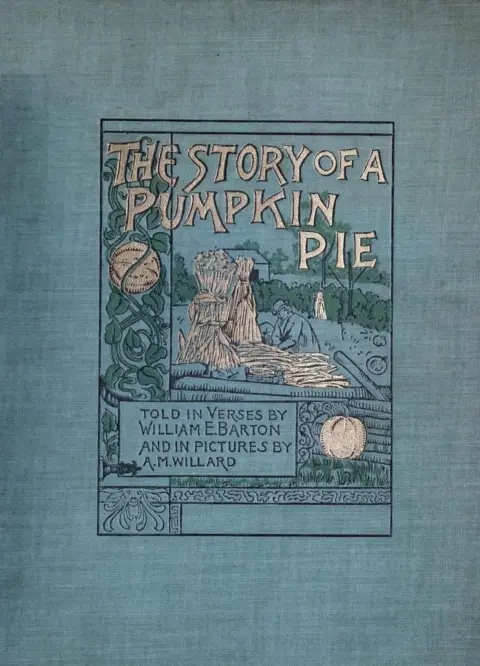
William E. (William Eleazar) Barton

William E. (William Eleazar) Barton
BEHIND THE BOOK
This eBook is for the use of anyone anywhere in the United States and most other parts of the world at no cost and with almost no restrictions whatsoever. You may copy it, give it away or re-use it under the terms of the Project Gutenberg License included with this eBook or online at www.gutenberg.org. If you are not located in the United States, you will have to check the laws of the country where you are located before using this eBook. Read the source licence.
The original source file, including credits and licence, is retained by this library. Request an original-format copy at no charge. Please include the book title and Project Gutenberg identifier #67954.
KEEP YOUR CURIOSITY GOING
Cécile Tormay

Moritz Busch
John L. Ransom
Frances Wright
Cécile Tormay

Mabel Potter Daggett