THE CLASSIC COLLECTION✦The Life of Clara Barton, Founder of the American Red Cross (Vol. 2 of 2)CLASSIC FREE BOOKS
The Life of Clara Barton, Founder of the American Red Cross (Vol. 2 of 2)
William E. (William Eleazar) Barton
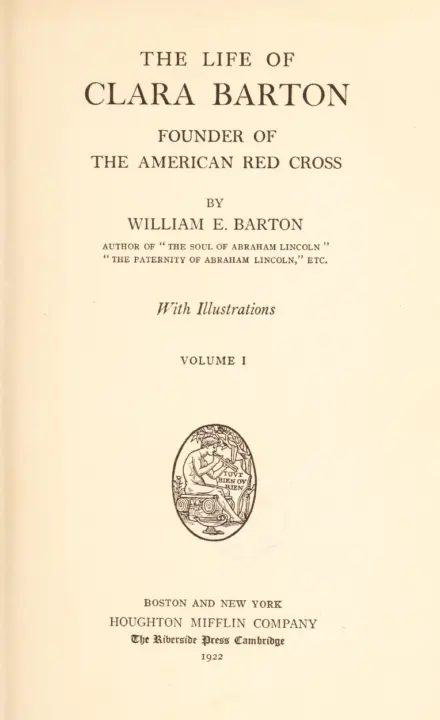
THE CLASSIC COLLECTION · 1922
"The Life of Clara Barton, Founder of the American Red Cross (Vol. 1 of 2)" by William E. Barton is a historical account written in the early 20th century. This biography chronicles the life and contributions of Clara Barton, highlighting her role in founding the American Red Cross and her significant impact on humanitarian efforts during her lifetime. The book presents both her personal journey and the broader social changes occurring during her life, providing insight into her character and the historical context in which she operated. The opening of the book establishes a framework for understanding Clara Barton's life. It introduces her early attempts at autobiographical writing and recounts her birth on Christmas Day, 1821. The introduction emphasizes her lifelong dedication to humanitarian service, detailing her early education, familial influences, and the personal experiences that shaped her character. Key themes of resilience, determination, and philanthropy emerge as Barton navigates her childhood, including her initial endeavors in teaching, which reflect her nurturing spirit and commitment to social causes. As the text explores her ancestry and upbringing, a portrait of a woman destined to lead and innovate in the field of humanitarianism begins to take shape.
Introduction adapted from the source catalogue; source summaries may be automatically generated.
Free to read · English · 110,898 words · No account needed
MAKE TIME FOR A GOOD BOOK
On by default. Untick to stop anonymous reading totals. Each page counts after 10 seconds in view. How this works.
Anonymous counting is on unless you have switched it off.
So good-bye.
Your affectionate sister
The country was steadily drifting toward war, and Clara Barton felt the danger of it. Although she was convinced that slavery ought not to be extended further, she was not yet an abolitionist, and she felt that violent agitators were taking upon themselves a serious risk in bringing the Nation to the very brink of bloodshed. She did not approve of the John Brown raid, and she was greatly concerned about the meetings that were held that seemed to her calculated to induce riot. She had her convictions, and was never afraid to speak them boldly, but she said, “It will be a strange pass when the Bartons get fanatical, and cannot abide by and support the laws they live under.” A neighbor who had been with Stephen in Carolina was driven away on account of utterances that followed the John Brown raid. She wrote to her brother Stephen at this time--the letter is not dated--and gave the fullest account of her own feelings and convictions concerning the issues then before the country, having in special mind the duty of Northern people resident in the South to be considerate of the conditions under which Southern people had to live. It is a very interesting letter, and the author of this volume could wish that it had been in his possession while Clara Barton was living, that he might have asked her to what extent her views changed in the years that followed:
I have not seen Mr. Seaver since his return, and regret exceedingly that there should have been any necessity for such a termination to his residence in the South. I should not have supposed that he would have felt it his duty to uphold such a cause as “Harper’s Ferry,” and if he did not, it is a pity he had the misfortune to make it appear so. Of course I could not for a moment believe him a dangerous man, hostile to either human life, rights, or interests, or antagonistic to the community among whom he resided, but if they felt him to be so, I do not by any means blame them for the course they took. Situated as they are, they have a right to be cautious, and adopt any measures for safety and quiet which their own judgment may suggest. They have a right even to be afraid, and it is not for the North, who in no way share in the danger, to brand them as cowards; they are the same that people the world over are and would be under the circumstances. Unorganized men everywhere are timid, easy and quick to take alarm. It is only when bodies of men are organized and disciplined, and prepared to defend themselves against expected dangers, that they stand firm and unshrinking, and face death unmoved. Occasionally we hear that you have been or will be requested to leave--this amuses me. It would be singular, indeed, if in all this time your Southern friends had not learned you well enough to tolerate you. It will be a strange pass when the Bartons get fanatical, and cannot abide by and support the laws they live under, and mind their own business closely enough to remain anywhere they may chance to be. I am grieved and ashamed of the course which our Northern people have taken relative to the John Brown affair. Of their relief societies, and mass meetings and sympathetic gatherings, I can say nothing, for I have never witnessed one, and never shall. From the first they seemed to me to be wrong and ill-advised, and had a strained and forced appearance; and the longer they are persisted in, and the greater extent to which they are carried, the more ridiculous they become in my sight. If they represented the true sentiments and feeling of the majority of candid thinking men at the North, it would savor more of justice, but this I believe to be very far from the facts. Their gatherings and speechifyings serve the purpose of a few loud-mouthed, foaming, eloquent fanatics, who would be just as ready in any other cause as this. They preach for notoriety and oratorical praise, fearlessly and injudiciously, with characters long stamped and nothing to lose. It matters little to them that every rounded sentence which falls from their chiseled lips, every burst of eloquence which “brings down the house,” drives home one more rivet in slavery’s chain; if slavery be an evil, they are but helping it on; it is only human nature that it should be so, and so plain a fact “that the wayfaring man cannot err therein.” Nature, and cause and effect, are, I suppose, much the same the world over, and if our Southern neighbors clasp their rights all the firmer, when assailed, and plant the foot of resistance toe to toe with the foot of aggression, it is not for us to complain of it; what differently should we ourselves do? That slavery be an evil I am neither going to affirm nor deny; let those pass judgment whom greater experience and observation have made capable of judging; but allowing the affirmative in its most exaggerated form, could it possibly be equal to the pitiful scene of confusion, distrust, and national paralysis before and around us at the present hour, with the prospect of all the impending danger threatening our vast Republic? Men talk flippantly of dissolving the Union. This may happen, but in my humble opinion never till our very horses gallop in human blood.
Your reading position is saved on this browser. Take it to another device with a library code. Reading pages adapt to text, rather than matching a printed edition.
William E. (William Eleazar) Barton
William E. (William Eleazar) Barton

William E. (William Eleazar) Barton
BEHIND THE BOOK
This eBook is for the use of anyone anywhere in the United States and most other parts of the world at no cost and with almost no restrictions whatsoever. You may copy it, give it away or re-use it under the terms of the Project Gutenberg License included with this eBook or online at www.gutenberg.org. If you are not located in the United States, you will have to check the laws of the country where you are located before using this eBook. Read the source licence.
The original source file, including credits and licence, is retained by this library. Request an original-format copy at no charge. Please include the book title and Project Gutenberg identifier #67505.
KEEP YOUR CURIOSITY GOING
Cécile Tormay

Moritz Busch
John L. Ransom
Frances Wright
Cécile Tormay

Mabel Potter Daggett