THE CLASSIC COLLECTION✦The Life of Clara Barton, Founder of the American Red Cross (Vol. 2 of 2)CLASSIC FREE BOOKS
The Life of Clara Barton, Founder of the American Red Cross (Vol. 2 of 2)
William E. (William Eleazar) Barton
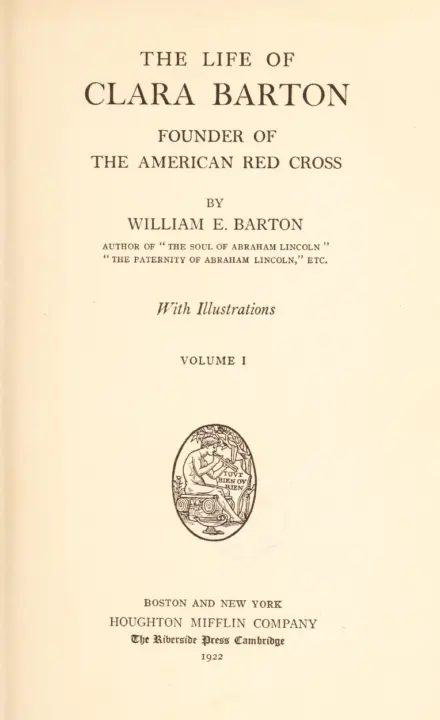
THE CLASSIC COLLECTION · 1922
"The Life of Clara Barton, Founder of the American Red Cross (Vol. 1 of 2)" by William E. Barton is a historical account written in the early 20th century. This biography chronicles the life and contributions of Clara Barton, highlighting her role in founding the American Red Cross and her significant impact on humanitarian efforts during her lifetime. The book presents both her personal journey and the broader social changes occurring during her life, providing insight into her character and the historical context in which she operated. The opening of the book establishes a framework for understanding Clara Barton's life. It introduces her early attempts at autobiographical writing and recounts her birth on Christmas Day, 1821. The introduction emphasizes her lifelong dedication to humanitarian service, detailing her early education, familial influences, and the personal experiences that shaped her character. Key themes of resilience, determination, and philanthropy emerge as Barton navigates her childhood, including her initial endeavors in teaching, which reflect her nurturing spirit and commitment to social causes. As the text explores her ancestry and upbringing, a portrait of a woman destined to lead and innovate in the field of humanitarianism begins to take shape.
Introduction adapted from the source catalogue; source summaries may be automatically generated.
Free to read · English · 110,898 words · No account needed
MAKE TIME FOR A GOOD BOOK
On by default. Untick to stop anonymous reading totals. Each page counts after 10 seconds in view. How this works.
Anonymous counting is on unless you have switched it off.
This is an excessively warm day, and Julia scarcely thinks she can get her courage up to the sticking point to sit down to letter-writing, but I will try it, for the weather is all alike to me, only just comfortably warm, and I can as well scribble letters as anything. We are rejoiced to hear such good reports from Stephen. It cannot be, however, that he was ready to return with you? For his sake I hope he could, but should be frightened if I knew he attempted it. We are all well; received your short letter in due time. Julia has discoursed considerably upon the propriety of that word “destitute” which you made use of. She says you left her with a barrel and a half of flour, a barrel and a half of crackers, a good new milch cow, fish, ham, dried beef, a barrel of pork, four good hogs in the pen, a field of early potatoes just coming on, a good garden, plenty of fowls, a good grain crop in and a man to take care of them, a good team, thirty cords of wood at the door and a horse and chaise to ride where she pleased. This she thinks is one of the last specimens of destitution. Can scarcely sleep at night through fear of immediate want--and beside we have not mentioned the crab apples. I shouldn’t wonder if we have fifty bushels of them; this only depends upon the size they attain, there are certainly enough in number. The hoeing is all done once, and the piece out by Mr. Baker’s gone over the second time. Uncle Joe helped. The taxes are paid, yours, Colonel Davis’s, and Brine’s. The two latter I have charged to them and pasted the receipts in the books. I have put down Brine’s[1] time for last week and made out a new time page for July. Brine has gone to Worcester with old Eb to-day, and I have put that down and carried his account to a new page. Whitlock has not paid yet, but the 2´-40´´ man on the hill has paid .75. Old Mrs. Collier is going to pay before she gets herself a new pair of shoes, and Sam avers that she is not only in need of shoes, but stockings, to which fact he is a living eye-witness. Johnson “hasn’t a cent--will pay next week--” This, I believe, finishes up the schedule of money matters until we report next time. Mr. Samuel Smith is dead. Was buried Thursday, I think. I have just written to the Colonel at Boston and to Cousin Ira[2] the intelligence from Stephen when we first learned that he was really better, and had hardly sent the letters away before the Judge came in. He was anxious to hear from us and also to attend the funeral, so took the morning train and came out, took dinner, and then he and father took Dick and the chaise and went to the funeral, came back, stayed to supper, and I went and carried him to the depot. We had a most delightful visit from him. Every time I see Cousin Ira, I think he is a better and better cousin. It is hardly possible for us to esteem him enough. I forgot to tell you about the garden. Julia has hoed it all over, set out the cabbage plants, waters them almost every day; they are looking finely. She has weeded all the beds, and Sam says he will help her some about the garden. Brine doesn’t seem to take an interest in the fine arts. Julia says she hopes you will not take a moment’s trouble about us, for we are getting on finely and shall do so, but you must take care of yourself. We--i.e. Julia and I--shall ride down to the Colonel’s this evening after sundown. I should like to see him and know he would like to hear from you again. I have not heard where Stephen is or how since you wrote, but trust he is no worse, and I also hope you may be able to favor and counsel him so as to keep him up when he gets back. I feel as much solicitude on your account as his, for I know how liable you are to get out of fix. I wish every day that I was there to see that both of you had what you needed to take and to be done for you. I was earnest in what I wished you to say to Stephen, that I was ready to go to Carolina or anywhere else if I could serve him; not that I want a job, as I should insist on putting my labor against my board, but earnestly if you are both going to try to summer there and Stephen so feeble as he is, I shall be glad to be with you. Still, if not proper or acceptable, I, of course, shall not urge myself or feel slighted, but I feel afraid to have you both there by yourselves; while you go away on business, he will be obliged to do something at home to get sick, and maybe I could do it for him if I were there, or at least take care of him in time. I am not afraid of naked negroes or rough houses, and you know the only things in all the world I should fear, for I told you--nothing else aside from these. I have no precaution or care for anything there could be there, but I have said enough and too much. Stephen may think I am willing to make myself more plenty than welcome, but I have obeyed the dictates of my feelings and judgment and can do no more, and I could not have done it and done less, so I leave it. If I can serve you, tell me. I have seen neither of the Washington tourists yet, and I went to the depot this morning to meet Irving[3] if he was there, but he did not come. Please tell me if Mr. Vassall talks of going to Carolina this summer, or will he come North? I have offered Julia this space to fill up, but she says I have told all the news and declines, and it is almost time to get ready to ride; so good-bye, and write a word or two often. Don’t trouble to send long letters, it is hot work to write. Sleep all you can, don’t drink ice water, be careful about grease, don’t expose yourself to damp evenings or mornings if too misty, or you will get the chills. Love to Stephen. Will he ever write me, I wonder?
Your reading position is saved on this browser. Take it to another device with a library code. Reading pages adapt to text, rather than matching a printed edition.
William E. (William Eleazar) Barton
William E. (William Eleazar) Barton

William E. (William Eleazar) Barton
BEHIND THE BOOK
This eBook is for the use of anyone anywhere in the United States and most other parts of the world at no cost and with almost no restrictions whatsoever. You may copy it, give it away or re-use it under the terms of the Project Gutenberg License included with this eBook or online at www.gutenberg.org. If you are not located in the United States, you will have to check the laws of the country where you are located before using this eBook. Read the source licence.
The original source file, including credits and licence, is retained by this library. Request an original-format copy at no charge. Please include the book title and Project Gutenberg identifier #67505.
KEEP YOUR CURIOSITY GOING
Cécile Tormay

Moritz Busch
John L. Ransom
Frances Wright
Cécile Tormay

Mabel Potter Daggett