THE CLASSIC COLLECTION✦The Life of Clara Barton, Founder of the American Red Cross (Vol. 2 of 2)CLASSIC FREE BOOKS
The Life of Clara Barton, Founder of the American Red Cross (Vol. 2 of 2)
William E. (William Eleazar) Barton
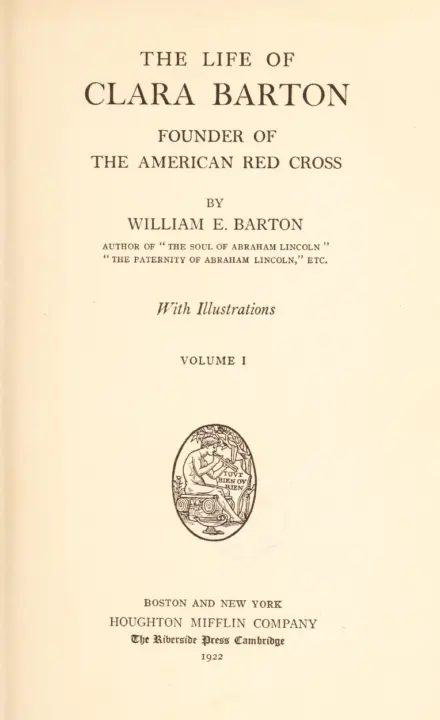
THE CLASSIC COLLECTION · 1922
"The Life of Clara Barton, Founder of the American Red Cross (Vol. 1 of 2)" by William E. Barton is a historical account written in the early 20th century. This biography chronicles the life and contributions of Clara Barton, highlighting her role in founding the American Red Cross and her significant impact on humanitarian efforts during her lifetime. The book presents both her personal journey and the broader social changes occurring during her life, providing insight into her character and the historical context in which she operated. The opening of the book establishes a framework for understanding Clara Barton's life. It introduces her early attempts at autobiographical writing and recounts her birth on Christmas Day, 1821. The introduction emphasizes her lifelong dedication to humanitarian service, detailing her early education, familial influences, and the personal experiences that shaped her character. Key themes of resilience, determination, and philanthropy emerge as Barton navigates her childhood, including her initial endeavors in teaching, which reflect her nurturing spirit and commitment to social causes. As the text explores her ancestry and upbringing, a portrait of a woman destined to lead and innovate in the field of humanitarianism begins to take shape.
Introduction adapted from the source catalogue; source summaries may be automatically generated.
Free to read · English · 110,898 words · No account needed
MAKE TIME FOR A GOOD BOOK
On by default. Untick to stop anonymous reading totals. Each page counts after 10 seconds in view. How this works.
Anonymous counting is on unless you have switched it off.
One characteristic of Clara Barton during these four years deserves mention and emphasis because her independent position might have made it easy for her to assume a critical attitude toward those who worked under the regular organization or through different channels. In all her letters, in all the entries in her diaries, there is found no hint of jealousy toward any of the women who worked as nurses in the hospitals, or under the Sanitary or Christian Commission.
Clara Barton from her childhood was given to versifying. She was once called upon to respond to a toast to the women who went to the front. She did it in rhyme as follows:
The women who went to the field, you say, The women who went to the field; and pray What did they go for? just to be in the way!-- They’d not know the difference betwixt work and play, What did they know about war anyway? What could they do?--of what use could they be? They would scream at the sight of a gun, don’t you see? Just fancy them round where the bugle notes play, And the long roll is bidding us on to the fray. Imagine their skirts ’mong artillery wheels, And watch for their flutter as they flee ’cross the fields When the charge is rammed home and the fire belches hot;-- They never will wait for the answering shot. They would faint at the first drop of blood, in their sight. What fun for us boys,--(ere we enter the fight;) They might pick some lint, and tear up some sheets, And make us some jellies, and send on their sweets, And knit some soft socks for Uncle Sam’s shoes, And write us some letters, and tell us the news. And thus it was settled by common consent, That husbands, or brothers, or whoever went, That the place for the women was in their own homes, There to patiently wait until victory comes. But later, it chanced, just how no one knew, That the lines slipped a bit, and some ’gan to crowd through; And they went,--where did they go?--Ah; where did they not? Show us the battle,--the field,--or the spot Where the groans of the wounded rang out on the air That her ear caught it not, and her hand was not there, Who wiped the death sweat from the cold clammy brow, And sent home the message;--“’Tis well with him now”? Who watched in the tents, whilst the fever fires burned, And the pain-tossing limbs in agony turned, And wet the parched tongue, calmed delirium’s strife Till the dying lips murmured, “My Mother,” “My Wife”! And who were they all?--They were many, my men; Their record was kept by no tabular pen: They exist in traditions from father to son. Who recalls, in dim memory, now here and there one.-- A few names were writ, and by chance live to-day; But’s a perishing record fast fading away. Of those we recall, there are scarcely a score, Dix, Dame, Bickerdyke,--Edson, Harvey, and Moore, Fales, Whittenmeyer, Gilson, Safford and Lee, And poor Cutter dead in the sands of the sea; And Frances D. Gage, our “Aunt Fanny” of old, Whose voice rang for freedom when freedom was sold. And Husband, and Etheridge, and Harlan and Case, Livermore, Alcott, Hancock, and Chase, And Turner, and Hawley, and Potter, and Hall. Ah! the list grows apace, as they come at the call: Did these women quail at the sight of a gun? Will some soldier tell us of one he saw run? Will he glance at the boats on the great western flood, At Pittsburg and Shiloh, did they faint at the blood? And the brave wife of Grant stood there with them then, And her calm, stately presence gave strength to his men. And Marie of Logan; she went with them too; A bride, scarcely more than a sweetheart, ’tis true. Her young cheek grows pale when the bold troopers ride. Where the “Black Eagle” soars, she is close at his side, She staunches his blood, cools the fever-burnt breath, And the wave of her hand stays the Angel of Death; She nurses him back, and restores once again To both army and state the brave leader of men.
Your reading position is saved on this browser. Take it to another device with a library code. Reading pages adapt to text, rather than matching a printed edition.
William E. (William Eleazar) Barton
William E. (William Eleazar) Barton
William E. (William Eleazar) Barton
BEHIND THE BOOK
This eBook is for the use of anyone anywhere in the United States and most other parts of the world at no cost and with almost no restrictions whatsoever. You may copy it, give it away or re-use it under the terms of the Project Gutenberg License included with this eBook or online at www.gutenberg.org. If you are not located in the United States, you will have to check the laws of the country where you are located before using this eBook. Read the source licence.
The original source file, including credits and licence, is retained by this library. Request an original-format copy at no charge. Please include the book title and Project Gutenberg identifier #67505.
KEEP YOUR CURIOSITY GOING
Cécile Tormay

Moritz Busch
John L. Ransom
Frances Wright
Cécile Tormay

Mabel Potter Daggett