THE CLASSIC COLLECTION✦The Life of Clara Barton, Founder of the American Red Cross (Vol. 2 of 2)CLASSIC FREE BOOKS
The Life of Clara Barton, Founder of the American Red Cross (Vol. 2 of 2)
William E. (William Eleazar) Barton
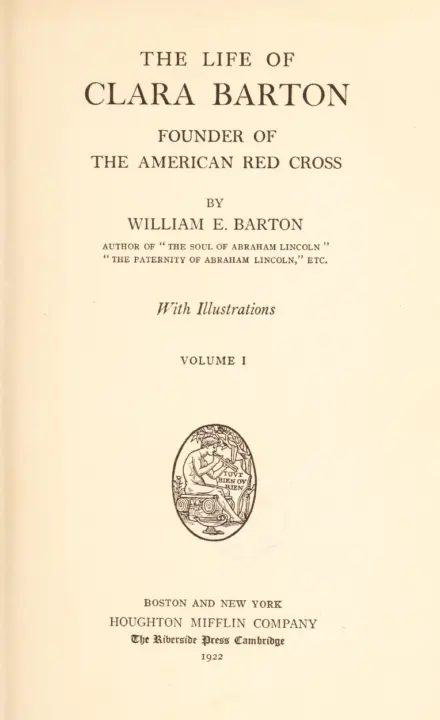
THE CLASSIC COLLECTION · 1922
"The Life of Clara Barton, Founder of the American Red Cross (Vol. 1 of 2)" by William E. Barton is a historical account written in the early 20th century. This biography chronicles the life and contributions of Clara Barton, highlighting her role in founding the American Red Cross and her significant impact on humanitarian efforts during her lifetime. The book presents both her personal journey and the broader social changes occurring during her life, providing insight into her character and the historical context in which she operated. The opening of the book establishes a framework for understanding Clara Barton's life. It introduces her early attempts at autobiographical writing and recounts her birth on Christmas Day, 1821. The introduction emphasizes her lifelong dedication to humanitarian service, detailing her early education, familial influences, and the personal experiences that shaped her character. Key themes of resilience, determination, and philanthropy emerge as Barton navigates her childhood, including her initial endeavors in teaching, which reflect her nurturing spirit and commitment to social causes. As the text explores her ancestry and upbringing, a portrait of a woman destined to lead and innovate in the field of humanitarianism begins to take shape.
Introduction adapted from the source catalogue; source summaries may be automatically generated.
Free to read · English · 110,898 words · No account needed
MAKE TIME FOR A GOOD BOOK
On by default. Untick to stop anonymous reading totals. Each page counts after 10 seconds in view. How this works.
Anonymous counting is on unless you have switched it off.
For a few days previous she had been reading “No Name,” by Wilkie Collins. She compared his style to that of Dickens with some discriminating comments on the literary work of each. But she discontinued “No Name” when near the end of it, in order to read in preparation for the lecture by George Thompson. It will be well to quote her entry in her diary for the 5th and 6th of April:
Washington, April 5th, 1864, Tuesday. Rained all day just as if it had not rained every other day for almost two weeks, and I read as steadily indoors as it rained out; am nearly through with “No Name.” Until 4 o’clock P.M. I had no disturbance, and then a most pleasant one. Mr. Brown came in to bring me letters from Mary Norton and Julia, and next to ask me to mend a little clothing, and next to present me a beautiful scrapbook designed for my own articles. It is a very beautiful article and I prize it much. Then my friend, Mr. Parker, called for a chat, and I read to him some two hours, in order to prepare his mind for George Thompson’s lecture which is to occur to-morrow night. Then a call from Senator W., and next Dr. Elliott which lasted till just now, and it is almost eleven o’clock, and I have set my fire out and apparently passed the day to little purpose; still, I think it has glided away very innocently, and with a few minutes’ preparation I shall retire with a grateful heart for the even, pleasant days which run so smoothly in my course.
Washington, April 6th, 1864, Wednesday. There are signs of clear weather, although it is by no means an established fact yet. I laid my reading aside, and took up my pen to address a letter to Mr. Wilson. I wrote at greater length than I had expected and occupied quite a portion of the day. The subject woke up the recollection of a train of ills and wrongs submitted to and borne so long that I suffered intensely in the reproduction of them, but I did reproduce, whether to any purpose or not time will reveal. It is not to be supposed that any decided revolution is to follow, as this is never to be looked for in my case. I have done expecting it, and done, I trust, with my efforts in behalf of others. I must take the little remnant of life that may remain to me as my own special property, and appropriate it accordingly. I had asked an appointment, as before referred to. I find I cannot make the use of it I had desired, and I have asked to recall the application. I have said I could not afford to make it. This was the day preceding the night of Mr. George Thompson’s lecture in the Hall of Representatives. I went early with Mr. Brown. We went into the gallery and took a front seat in a side gallery. The House commenced to fill very rapidly with one of the finest-looking audiences that could be gathered in Washington. Conspicuous among them were Mr. Chase, Governor Sprague, Senator Wilson, Governor Boutwell and lady, Speaker Colfax, Thad. Stevens, and, to cap all, the brother of “Old John Brown” came and sat with us. At eight the orator of the evening entered the Hall in the same group with President Lincoln, Vice-President Hamlin, Rev. Mr. Pierpont, and others whom I did not recognize. Preliminary remarks were made by Mr. Pierpont. Next followed Mr. Hamlin, who introduced Mr. Thompson, who arose under so severe emotions that he could scarce utter a word. It seemed for a time that he would fall before the audience he had come to address. The contrast was evidently too great to be contemplated with composure; his sensitive mind reverted doubtless to his previous visits to this country, when he had seen himself hung and burnt in effigy, been mobbed, stoned, and assailed with “filthy missiles,” and now he stood, almost deafened with applause, in the Hall of Representatives of America, America “free” from the shackles of slavery, and to address the President, and great political heads of the Nation. No wonder he was overcome, no wonder that the air felt thick, and his words came feebly, and his body bent beneath the weight of the contrast, the glorious consummation of all he had so earnestly labored and so devoutly prayed for. But by degrees his strength returned, and the rich melody of his voice filled every inch of the vast hall, and delighted every loyal, truth-loving ear. It would be useless for me to attempt a description of his address--it is so far immortal as to be always found, I trust, among the records of the glorious doings and sayings of our country’s supporters. His endorsement of the President was one of the most touching and sublime things I have ever heard uttered, and the messages from England to him breathed a spirit of friendship which I was not prepared to listen to. Surely we are not to growl at and complain of England as jealous and hostile when her working-people, deprived of their daily labor and the support of their families through our difficulties, bid us Godspeed, and never to yield till our purpose has been accomplished, and congratulate us upon having achieved our independence in the War of the Revolution, and ask us now to go on and achieve a still greater independence, which shall embrace the whole civilized world. Surely these words show a nobler spirit in England than we had any reason or real right to expect. His remarks touching John Brown were strong, and, sitting as I was, watching the immediate effect upon the brother at my side, and when in a few minutes the band struck up the familiar air dedicated to him the world over, I truly felt that John Brown’s Soul was marching on, and that the mouldering in the grave was of little account; the brother evidently felt the same. There was a glistening of the eye and a compression of the lip which spoke it all and more; he was evidently proud of the gallows rope that hung Old John Brown, “Old Hero Brown!”
Your reading position is saved on this browser. Take it to another device with a library code. Reading pages adapt to text, rather than matching a printed edition.
William E. (William Eleazar) Barton
William E. (William Eleazar) Barton
William E. (William Eleazar) Barton
BEHIND THE BOOK
This eBook is for the use of anyone anywhere in the United States and most other parts of the world at no cost and with almost no restrictions whatsoever. You may copy it, give it away or re-use it under the terms of the Project Gutenberg License included with this eBook or online at www.gutenberg.org. If you are not located in the United States, you will have to check the laws of the country where you are located before using this eBook. Read the source licence.
The original source file, including credits and licence, is retained by this library. Request an original-format copy at no charge. Please include the book title and Project Gutenberg identifier #67505.
KEEP YOUR CURIOSITY GOING
Cécile Tormay

Moritz Busch
John L. Ransom
Frances Wright
Cécile Tormay

Mabel Potter Daggett