THE CLASSIC COLLECTION✦The Life of Clara Barton, Founder of the American Red Cross (Vol. 2 of 2)CLASSIC FREE BOOKS
The Life of Clara Barton, Founder of the American Red Cross (Vol. 2 of 2)
William E. (William Eleazar) Barton
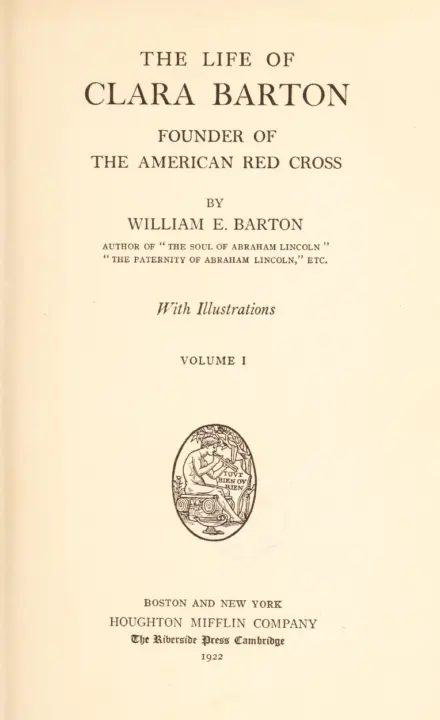
THE CLASSIC COLLECTION · 1922
"The Life of Clara Barton, Founder of the American Red Cross (Vol. 1 of 2)" by William E. Barton is a historical account written in the early 20th century. This biography chronicles the life and contributions of Clara Barton, highlighting her role in founding the American Red Cross and her significant impact on humanitarian efforts during her lifetime. The book presents both her personal journey and the broader social changes occurring during her life, providing insight into her character and the historical context in which she operated. The opening of the book establishes a framework for understanding Clara Barton's life. It introduces her early attempts at autobiographical writing and recounts her birth on Christmas Day, 1821. The introduction emphasizes her lifelong dedication to humanitarian service, detailing her early education, familial influences, and the personal experiences that shaped her character. Key themes of resilience, determination, and philanthropy emerge as Barton navigates her childhood, including her initial endeavors in teaching, which reflect her nurturing spirit and commitment to social causes. As the text explores her ancestry and upbringing, a portrait of a woman destined to lead and innovate in the field of humanitarianism begins to take shape.
Introduction adapted from the source catalogue; source summaries may be automatically generated.
Free to read · English · 110,898 words · No account needed
MAKE TIME FOR A GOOD BOOK
On by default. Untick to stop anonymous reading totals. Each page counts after 10 seconds in view. How this works.
Anonymous counting is on unless you have switched it off.
I remember, four long months ago, one cold, dreary, windy day, I dragged me out from a chilly street-car that had found me ankle-deep in the mud of the 6th Street wharf, and up the slippery street and my long flights of stairs into a room, cheerless, in confusion, and alone, looking in most respects as I had left it some months before, with the exception of a mysterious box which stood unopened in the middle of the floor. All things looked strange to me, for in that few months I had taken in so much that yet I had no clear views. The great artist had been at work upon my brain and sketched it all over with life scenes, and death scenes, never to be erased. The fires of Fredericksburg still blazed before my eyes, and her cannon still thundered at my ear, while away down in the depths of my heart I was smothering the groans and treasuring the prayers of her dead and dying heroes; worn, weak, and heartsick, I was home from Fredericksburg; and when, there, for the first time I looked at myself, shoeless, gloveless, ragged, and blood-stained, a new sense of desolation and pity and sympathy and weariness, all blended, swept over me with irresistible force, and, perfectly overpowered, I sank down upon the strange box, unquestioning its presence or import, and wept as I had never done since the soft, hazy, winter night that saw our attacking guns silently stealing their approach to the river, ready at the dawn to ring out the shout of death to the waiting thousands at their wheels.
I said I wept, and so I did, and gathered strength and calmness and consciousness--and finally the strange box, which had afforded me my first rest, began to claim my attention; it was clearly and handsomely marked to myself at Washington, and came by express--so much for the outside; and a few pries with a hatchet, to hands as well accustomed as mine, soon made the inside as visible, only for the neat paper which covered all. It was doubtless something sent to some soldier; pity I had not had it earlier--it might be too late now; he might be past his wants or the kind remembrances of the loved ones at home. The while I was busy in removing the careful paper wrappings a letter, addressed to me, opened--“From friends in Oxford and Worcester”--no signature. Mechanically I commenced lifting up, one after another, hoods, shoes, boots, gloves, skirts, handkerchiefs, collars, linen,--and that beautiful dress! look at it, all made--who--! Ah, there is no mistaking the workmanship--Annie’s scissors shaped and her skillful fingers fitted that. Now, I begin to comprehend; while I had been away in the snows and frosts and rains and mud of Falmouth, forgetting my friends, myself, to eat or sleep or rest, forgetting everything but my God and the poor suffering victims around me, these dear, kind friends, undismayed and not disheartened by the great national calamity which had overtaken them, mourning, perhaps, the loss of their own, had remembered me, and with open hearts and willing hands had prepared this noble, thoughtful gift for me at my return. It was too much, and this time, burying my face in the dear tokens around me, I wept again as heartily as before, but with very different sensations; a new chord was struck; my labors, slight and imperfect as they had been, had been appreciated; I was not alone; and then and there again I re-dedicated myself to my little work of humanity, pledging before God all that I have, all that I am, all that I can, and all that I hope to be, to the cause of Justice and Mercy and Patriotism, my Country, and my God. And cheered and sustained as I have been by the kind remembrances of old friends, the cordial greeting of new ones, and the tearful, grateful blessings of the thousands of noble martyrs to whose relief or comfort it has been my blessed privilege to add my mite, I feel that my cup of happiness is more than full. It is an untold privilege to have lived in this day when there is work to be done, and, still more, to possess health and strength to do it, and most of all to feel that I bear with me the kindly feelings and perhaps prayers of the noble mothers and sisters who have sent sons and brothers to fight the battles of the world in the armies of Freedom. Annie, if it is not asking too much, now that I have gathered up resolution enough to speak of the subject at all (for I have never been able to before), I would like to know to whom besides yourself I am indebted for these beautiful and valuable gifts. It is too tame and too little to say that I am thankful for them. You did not want that, but I will say that, God willing, I will yet wear them where none of the noble donors would be ashamed to have them seen. Some of those gifts shall yet see service if Heaven spare my life. With thanks I am the friend of my “Friends in Oxford and Worcester.”
Your reading position is saved on this browser. Take it to another device with a library code. Reading pages adapt to text, rather than matching a printed edition.
William E. (William Eleazar) Barton
William E. (William Eleazar) Barton
William E. (William Eleazar) Barton
BEHIND THE BOOK
This eBook is for the use of anyone anywhere in the United States and most other parts of the world at no cost and with almost no restrictions whatsoever. You may copy it, give it away or re-use it under the terms of the Project Gutenberg License included with this eBook or online at www.gutenberg.org. If you are not located in the United States, you will have to check the laws of the country where you are located before using this eBook. Read the source licence.
The original source file, including credits and licence, is retained by this library. Request an original-format copy at no charge. Please include the book title and Project Gutenberg identifier #67505.
KEEP YOUR CURIOSITY GOING
Cécile Tormay

Moritz Busch
John L. Ransom
Frances Wright
Cécile Tormay

Mabel Potter Daggett