THE CLASSIC COLLECTION✦The Life of Clara Barton, Founder of the American Red Cross (Vol. 2 of 2)CLASSIC FREE BOOKS
The Life of Clara Barton, Founder of the American Red Cross (Vol. 2 of 2)
William E. (William Eleazar) Barton
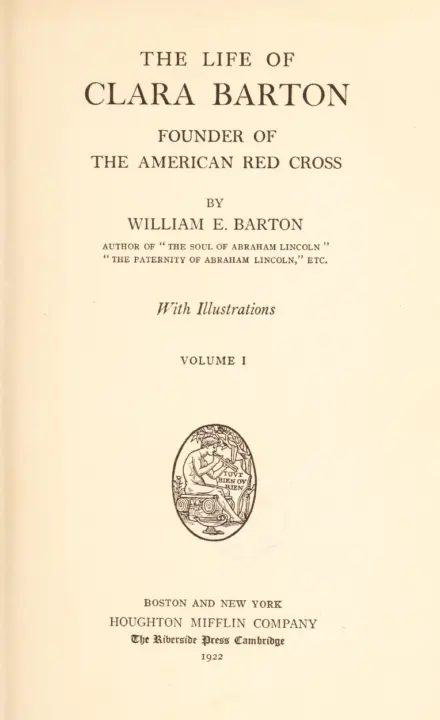
THE CLASSIC COLLECTION · 1922
"The Life of Clara Barton, Founder of the American Red Cross (Vol. 1 of 2)" by William E. Barton is a historical account written in the early 20th century. This biography chronicles the life and contributions of Clara Barton, highlighting her role in founding the American Red Cross and her significant impact on humanitarian efforts during her lifetime. The book presents both her personal journey and the broader social changes occurring during her life, providing insight into her character and the historical context in which she operated. The opening of the book establishes a framework for understanding Clara Barton's life. It introduces her early attempts at autobiographical writing and recounts her birth on Christmas Day, 1821. The introduction emphasizes her lifelong dedication to humanitarian service, detailing her early education, familial influences, and the personal experiences that shaped her character. Key themes of resilience, determination, and philanthropy emerge as Barton navigates her childhood, including her initial endeavors in teaching, which reflect her nurturing spirit and commitment to social causes. As the text explores her ancestry and upbringing, a portrait of a woman destined to lead and innovate in the field of humanitarianism begins to take shape.
Introduction adapted from the source catalogue; source summaries may be automatically generated.
Free to read · English · 110,898 words · No account needed
MAKE TIME FOR A GOOD BOOK
On by default. Untick to stop anonymous reading totals. Each page counts after 10 seconds in view. How this works.
Anonymous counting is on unless you have switched it off.
This was an old farmhouse. Six large kettles were picked up and set over fires, almost as quickly as I can tell it, and I was mixing water and meal for gruel.
It occurred to us to explore the cellar. The chimney rested on an arch, and, forcing the door, we discovered three barrels and a bag. “They are full,” said the sergeant, and, rolling one into the light, found that it bore the mark of Jackson’s army. These three barrels of flour and a bag of salt had been stored there by the rebel army during its upward march.
I shall never experience such a sensation of wealth and competency again, from utter poverty to such riches.
All that night my thirty men (for my corps of workers had increased to that number during the day) carried buckets of hot gruel for miles down the line to the wounded and dying where they fell.
This time, profiting by experience, we had lanterns to hang in and around the barn, and, having directed it to be done, I went to the house and found the surgeon in charge, sitting alone, beside a table, upon which he rested his elbow, apparently meditating upon a bit of tallow candle which flickered in the center.
Approaching carefully, I said, “You are tired, Doctor.” He started up with a look almost savage, “Tired! Yes, I am tired, tired of such heartlessness, such carelessness!” Turning full upon me, he continued: “Think of the condition of things. Here are at least one thousand wounded men, terribly wounded, five hundred of whom cannot live till daylight, without attention. That two inches of candle is all I have or can get. What can I do? How can I endure it?”
I took him by the arm, and, leading him to the door, pointed in the direction of the barn where the lanterns glistened like stars among the waving corn.
“What is that?” he exclaimed.
“The barn is lighted,” I said, “and the house will be directly.”
“Who did it?”
“I, Doctor.”
“Where did you get them?”
“Brought them with me.”
“How many have you?”
“All you want--four boxes.”
He looked at me a moment, as if waking from a dream, turned away without a word, and never alluded to the circumstances, but the deference which he paid me was almost painful.
During a lecture in the West, Miss Barton related this incident, and as she closed a gentleman sprang upon the stage, and, addressing the audience, exclaimed: “Ladies and gentlemen, if I never have acknowledged that favor, I will do it now. I am that surgeon.”
Your reading position is saved on this browser. Take it to another device with a library code. Reading pages adapt to text, rather than matching a printed edition.
William E. (William Eleazar) Barton

William E. (William Eleazar) Barton

William E. (William Eleazar) Barton
BEHIND THE BOOK
This eBook is for the use of anyone anywhere in the United States and most other parts of the world at no cost and with almost no restrictions whatsoever. You may copy it, give it away or re-use it under the terms of the Project Gutenberg License included with this eBook or online at www.gutenberg.org. If you are not located in the United States, you will have to check the laws of the country where you are located before using this eBook. Read the source licence.
The original source file, including credits and licence, is retained by this library. Request an original-format copy at no charge. Please include the book title and Project Gutenberg identifier #67505.
KEEP YOUR CURIOSITY GOING
Cécile Tormay

Moritz Busch
John L. Ransom
Frances Wright
Cécile Tormay

Mabel Potter Daggett