THE CLASSIC COLLECTION✦The Life of Clara Barton, Founder of the American Red Cross (Vol. 2 of 2)CLASSIC FREE BOOKS
The Life of Clara Barton, Founder of the American Red Cross (Vol. 2 of 2)
William E. (William Eleazar) Barton
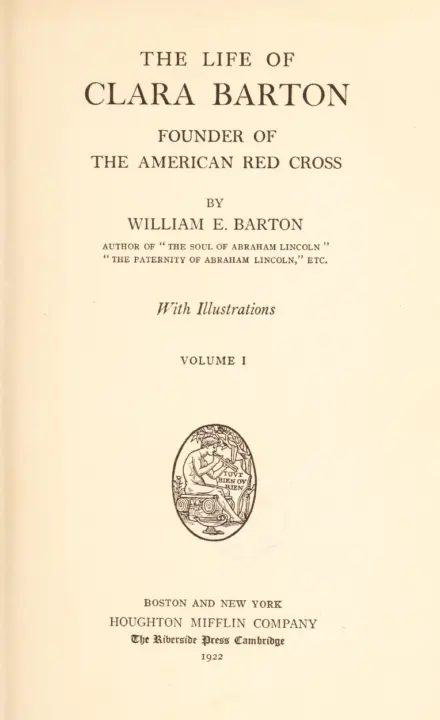
THE CLASSIC COLLECTION · 1922
"The Life of Clara Barton, Founder of the American Red Cross (Vol. 1 of 2)" by William E. Barton is a historical account written in the early 20th century. This biography chronicles the life and contributions of Clara Barton, highlighting her role in founding the American Red Cross and her significant impact on humanitarian efforts during her lifetime. The book presents both her personal journey and the broader social changes occurring during her life, providing insight into her character and the historical context in which she operated. The opening of the book establishes a framework for understanding Clara Barton's life. It introduces her early attempts at autobiographical writing and recounts her birth on Christmas Day, 1821. The introduction emphasizes her lifelong dedication to humanitarian service, detailing her early education, familial influences, and the personal experiences that shaped her character. Key themes of resilience, determination, and philanthropy emerge as Barton navigates her childhood, including her initial endeavors in teaching, which reflect her nurturing spirit and commitment to social causes. As the text explores her ancestry and upbringing, a portrait of a woman destined to lead and innovate in the field of humanitarianism begins to take shape.
Introduction adapted from the source catalogue; source summaries may be automatically generated.
Free to read · English · 110,898 words · No account needed
MAKE TIME FOR A GOOD BOOK
On by default. Untick to stop anonymous reading totals. Each page counts after 10 seconds in view. How this works.
Anonymous counting is on unless you have switched it off.
A little later, the plaintive wail of a single fife, the slow beat of a muffled drum, the steady tramp, tramp, tramp of heavy feet, the gleam of ten thousand bayonets on the hills, and with bowed heads and speechless lips, poor Kearny’s leaderless men came marching through
This was the signal for retreat. All day they came, tired, hungry, ragged, defeated, retreating, they knew not whither--they cared not whither.
The enemy’s cavalry, skirting the hills, admonished us each moment that we must soon decide to go from them or with them. But our work must be accomplished, and no wounded men once given into our hands must be left. And with the spirit of desperation, we struggled on.
At three o’clock an officer galloped up to me, with “Miss Barton, can you ride?” “Yes, sir,” I replied.
“But you have no lady’s saddle--could you ride mine?”
“Yes, sir, or without it, if you have blanket and surcingle.”
“Then you can risk another hour,” he exclaimed, and galloped off.
At four he returned at a break-neck speed, and, leaping from his horse, said, “Now is your time. The enemy is already breaking over the hills; try the train. It will go through, unless they have flanked, and cut the bridge a mile above us. In that case I’ve a reserve horse for you, and you must take your chances to escape across the country.”
In two minutes I was on the train. The last wounded man at the station was also on. The conductor stood with a torch which he applied to a pile of combustible material beside the track. And we rounded the curve which took us from view and we saw the station ablaze, and a troop of cavalry dashing down the hill. The bridge was uncut and midnight found us at Washington.
You have the full record of my sleep--from Friday night till Wednesday morning--two hours. You will not wonder that I slept during the next twenty-four.
On Friday (the following), I repaired to Armory Square Hospital to learn who, of all the hundreds sent, had reached that point.
I traced the chaplain’s record, and there upon the last page freshly written stood the name of Hugh Johnson
Turning to Chaplain Jackson, I asked--“Did that man live until to-day?”
“He died during the latter part of last night,” he replied. “His friends reached him some two days ago, and they are now taking his body from the ward to be conveyed to the depot.”
Your reading position is saved on this browser. Take it to another device with a library code. Reading pages adapt to text, rather than matching a printed edition.
William E. (William Eleazar) Barton

William E. (William Eleazar) Barton

William E. (William Eleazar) Barton
BEHIND THE BOOK
This eBook is for the use of anyone anywhere in the United States and most other parts of the world at no cost and with almost no restrictions whatsoever. You may copy it, give it away or re-use it under the terms of the Project Gutenberg License included with this eBook or online at www.gutenberg.org. If you are not located in the United States, you will have to check the laws of the country where you are located before using this eBook. Read the source licence.
The original source file, including credits and licence, is retained by this library. Request an original-format copy at no charge. Please include the book title and Project Gutenberg identifier #67505.
KEEP YOUR CURIOSITY GOING
Cécile Tormay

Moritz Busch
John L. Ransom
Frances Wright
Cécile Tormay

Mabel Potter Daggett