THE CLASSIC COLLECTION✦The Life of Clara Barton, Founder of the American Red Cross (Vol. 2 of 2)CLASSIC FREE BOOKS
The Life of Clara Barton, Founder of the American Red Cross (Vol. 2 of 2)
William E. (William Eleazar) Barton
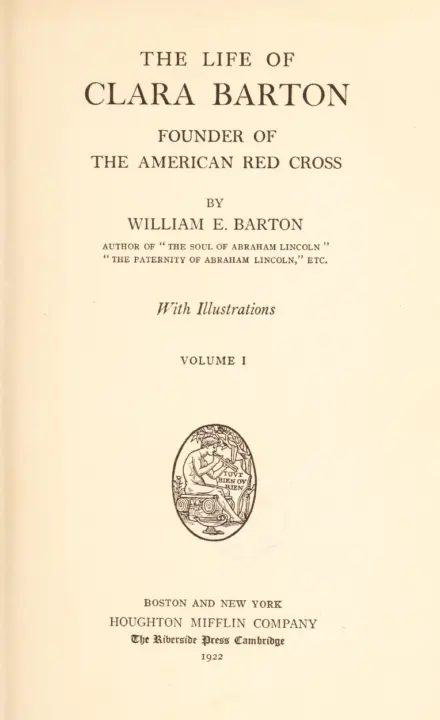
THE CLASSIC COLLECTION · 1922
"The Life of Clara Barton, Founder of the American Red Cross (Vol. 1 of 2)" by William E. Barton is a historical account written in the early 20th century. This biography chronicles the life and contributions of Clara Barton, highlighting her role in founding the American Red Cross and her significant impact on humanitarian efforts during her lifetime. The book presents both her personal journey and the broader social changes occurring during her life, providing insight into her character and the historical context in which she operated. The opening of the book establishes a framework for understanding Clara Barton's life. It introduces her early attempts at autobiographical writing and recounts her birth on Christmas Day, 1821. The introduction emphasizes her lifelong dedication to humanitarian service, detailing her early education, familial influences, and the personal experiences that shaped her character. Key themes of resilience, determination, and philanthropy emerge as Barton navigates her childhood, including her initial endeavors in teaching, which reflect her nurturing spirit and commitment to social causes. As the text explores her ancestry and upbringing, a portrait of a woman destined to lead and innovate in the field of humanitarianism begins to take shape.
Introduction adapted from the source catalogue; source summaries may be automatically generated.
Free to read · English · 110,898 words · No account needed
MAKE TIME FOR A GOOD BOOK
On by default. Untick to stop anonymous reading totals. Each page counts after 10 seconds in view. How this works.
Anonymous counting is on unless you have switched it off.
This letter bears written on its back these endorsements by Dr. Alfred Hitchcock and Governor Andrew:
I do not think at the present time Miss Barton had better undertake to go to Burnside’s Division to act as a nurse.
March 25th, 1862.
Respectfully referred for the information of Miss Barton.
March 25, /62.
Old Captain Stephen Barton died at last, aged almost eighty-eight. The entries in Clara Barton’s diary on these days are brief and interesting:
Thursday, March 20, 1862. Wrote Governor Andrew, and watched by poor, suffering Grandpa. Sent a letter to Irving by the morning mail.
Friday, March 21, 1862. At 10.16 at night, my poor father breathed his last. By him were Misses Grover, Hollendrake, Mrs. Vial, David, Julia, and I.
Saturday, March 22, 1862. David and Julia went to Worcester. Mrs. Rich here. Sent letters to Irving, Judge, Mary, Dr. Darling.
Sunday, March 23, 1862. Call from Deacon Smith.
Monday, March 24, 1862. Mrs. Rich went to Worcester for me. Left a note for Arba Pierce to make a wreath for poor Grandpa’s coffin.
Tuesday, March 25, 1862. At two P.M., commenced the services of the burial, Rev. Mr. Holmes of Charlton officiating. House and grounds crowded. Ceremony solemn and impressive. At evening Cousin Jerry Stone came and brought me a letter from Governor J. A. Andrew.
This was all she found time to write in the diary. Of the letters she wrote to her cousin, Corporal Leander A. Poor, relating to her father’s death, one has been recovered:
NORTH OXFORD, March 27th, 1862
Thursday Afternoon
Your welcome second letter came to me this noon--doubtless before this you have learned the answer to your kind inquiry, “How is Grandsire?” But if not, and the sentinel post is mine, I must answer, “All is well.” Down under the little pines, beside my mother, he rests quietly, sleeps peacefully, dreams happily. The old soldier’s heavy march is ended, for him the last tattoo has sounded, and, resting upon the unfailing arms of truth, hope, and faith, he awaits the “reveille of the eternal morning.”
“Grandsire” had been steadily failing since I came home. For more than thirty days he did not taste a morsel of food, and could retain nothing stronger or more nourishing than a little milk and water--for over ten of the last days not that, simply a little cold water, which he dared not swallow. And still he lived and moved himself and talked strongly and sensibly and wisely as you had always heard him. Who ever heard of such constitutional strength?
Your reading position is saved on this browser. Take it to another device with a library code. Reading pages adapt to text, rather than matching a printed edition.
William E. (William Eleazar) Barton

William E. (William Eleazar) Barton
William E. (William Eleazar) Barton
BEHIND THE BOOK
This eBook is for the use of anyone anywhere in the United States and most other parts of the world at no cost and with almost no restrictions whatsoever. You may copy it, give it away or re-use it under the terms of the Project Gutenberg License included with this eBook or online at www.gutenberg.org. If you are not located in the United States, you will have to check the laws of the country where you are located before using this eBook. Read the source licence.
The original source file, including credits and licence, is retained by this library. Request an original-format copy at no charge. Please include the book title and Project Gutenberg identifier #67505.
KEEP YOUR CURIOSITY GOING
Cécile Tormay

Moritz Busch
John L. Ransom
Frances Wright
Cécile Tormay

Mabel Potter Daggett