THE CLASSIC COLLECTION✦The Life of Clara Barton, Founder of the American Red Cross (Vol. 2 of 2)CLASSIC FREE BOOKS
The Life of Clara Barton, Founder of the American Red Cross (Vol. 2 of 2)
William E. (William Eleazar) Barton
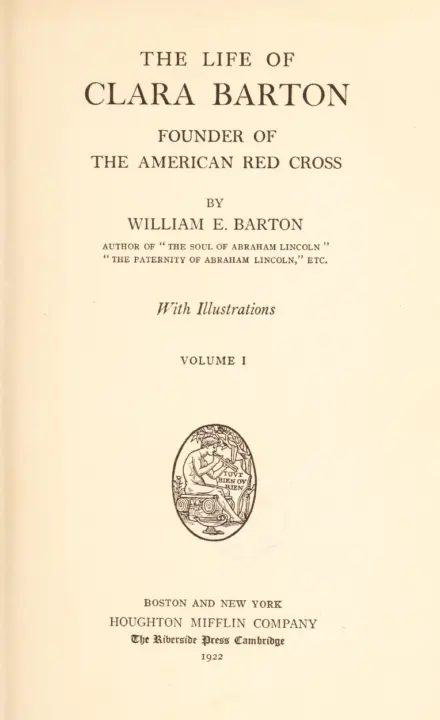
THE CLASSIC COLLECTION · 1922
"The Life of Clara Barton, Founder of the American Red Cross (Vol. 1 of 2)" by William E. Barton is a historical account written in the early 20th century. This biography chronicles the life and contributions of Clara Barton, highlighting her role in founding the American Red Cross and her significant impact on humanitarian efforts during her lifetime. The book presents both her personal journey and the broader social changes occurring during her life, providing insight into her character and the historical context in which she operated. The opening of the book establishes a framework for understanding Clara Barton's life. It introduces her early attempts at autobiographical writing and recounts her birth on Christmas Day, 1821. The introduction emphasizes her lifelong dedication to humanitarian service, detailing her early education, familial influences, and the personal experiences that shaped her character. Key themes of resilience, determination, and philanthropy emerge as Barton navigates her childhood, including her initial endeavors in teaching, which reflect her nurturing spirit and commitment to social causes. As the text explores her ancestry and upbringing, a portrait of a woman destined to lead and innovate in the field of humanitarianism begins to take shape.
Introduction adapted from the source catalogue; source summaries may be automatically generated.
Free to read · English · 110,898 words · No account needed
MAKE TIME FOR A GOOD BOOK
On by default. Untick to stop anonymous reading totals. Each page counts after 10 seconds in view. How this works.
Anonymous counting is on unless you have switched it off.
In the first place, let me remove the one great error, prevalent among all (Union) people at the South, I presume,--viz., that this is a war of “Abolitionism” or abolitionists. This is not so; our Government has for its object the restoration of the Union as it was, and will do so, unless the resistance of the South prove so obstinate and prolonged that the abolition or overthrow of slavery follow as a consequence--never an object. Again, the idea of “subjugation.” This application never originated with the North, nor is it tolerated there, for an instant; desired by no one unless, like the first instance, it follows as a necessity incident upon a course of protracted warfare. Both these ideas are used as stimulants by the Southern (mis)leaders, and without them they could never hold their army together a month. The North are fighting for the maintenance of the Constitutional Government of the United States and the defense and honor of their country’s flag. This accomplished, the army are ready to lay down their arms and return to their homes and peaceable pursuits, and our leaders are willing to disband them. Until such time, there will be found no willingness on the part of either. We have now in the field between 500,000 and 600,000 soldiers; more cavalry and artillery than we can use to advantage, our navy growing to a formidable size, and all this vast body of men, clothed, fed, and paid, as was never an army on the face of the earth before, perfectly uniformed, and hospital stores and clothing lying idly by waiting to be used; we feel no scarcity of money. I am not saying that we are not getting a large national debt, but I mean to say that our people are not feeling the pinchings of “war-time.” The people of the North are as comfortable as you used to see them. You should be set down in the streets of Boston, Worcester, New York, or Philadelphia to-day, and only by a profusion of United States flags and occasionally a soldier home on a furlough would you ever mistrust that we were at war. Let the fire bells ring in any of those cities, and you will never miss a man from the crowds you have ordinarily seen gather on such occasions. We can raise another army like the one we have in the field (only better men as a mass), arm and equip them for service, and still have men and means enough left at home for all practical purposes. Our troops are just beginning to be effective, only just properly drilled, and are now ready to commence work in earnest or just as ready to lay down their arms when the South are ready to return to the Union, as “loyal and obedient States”; not obedient to the North, but obedient to the laws of the whole country. Our relations with foreign countries are amicable, and our late recent victories must for a long time set at rest all hope or fears of foreign interference, and even were such an event probable, the Federal Government would not be dismayed. We are doubtless in better condition to meet a foreign foe, along with all our home difficulties to-day, than we should have been all together one year ago to-day. Foreign powers stand off and look with wonder to see what the Americans have accomplished in ten months; they will be wary how they wage war with “Yankees” after this. I must caution here, lest you think there is in all I say something of the spirit of “brag.” There is not a vestige of it. I am only stating plain facts, and not the hundredth part of them. I do not feel exultant, but humble and grateful that under the blessing of God, my country and my people have accomplished what they have; and even were I exulting, it would be for you, and not over, or against you, for “according to the straightest of your sect,” have you lived a “Yankee.” And this brings me to the point of my subject; here comes my request, my prayer, supplication, entreaty, command--call it what you will, only heed it, at once. COME HOME, not home to Massachusetts, but home to my home; I want you in Washington. I could cover pages, fill volumes, in telling you all the anxiety that has been felt for you, all the hours of anxious solicitude that I have known in the last ten months, wondering where you were, or if you were at all, and planning ways of getting to you, or getting you to me, but never until now has any safe or suitable method presented itself, and now that the expedition has opened a means of escape, I am tortured with the fear that, under the recent call of the State, you may have been drafted into the enemy’s service. If you are still at your place and this letter reaches you, I desire, and most sincerely advise, you to make ready, and, when the opportunity shall present (which surely will), place yourself, with such transportable things as you may desire to take, on board one of our boats, under protection of our officers, and be taken to the landing at Roanoke, and from thence by some of our transports up to Annapolis, where either myself or friends will be waiting for you, then go with me to Washington and call your days of trial over;--for so it can be done. If we could have known when General Burnside’s expedition left, that it was destined for your place, Sam would have accompanied them, and made his way to you on the first boat up your river; as it is, he is coming now, hoping that he may be in time to reach you, and have your company back. I want in some way that this and other letters reach you before he does, that you may make such preparations as will be necessary, and be ready, whenever he shall appear, to step on board and set your face toward a more peaceful quarter. You will meet a welcome from our officers such as you little dream of, unless perchance you have already met them. If you have, you have found them gentlemen and friends; you will find scores of old friends in that expedition, all anxious to see you, would do anything to serve you if you were with them, but don’t know where to find you. There are some down on the Island, among General Burnside’s men, who have your address, but they would scarcely be on our gunboats. There are plenty of men there who have not only your name in their pockets, but your memory in their hearts, and would hail you with a brother’s welcome. General Butler came in at Hatteras with a long letter in his possession relating to you, and if he had advanced so far, he would have claimed you. I don’t know how many of our prominent Worcester men have come or sent to me for your address, to make it known among our troops if ever they reached you, that they might offer you any aid in their power. No one can bear the idea of our forces going near you without knowing all about you, and claiming and treating you as a brother; you were never as near and dear to the people of Worcester County as you are to-day. I have seen the tears roll over more than one man’s face when told that Sam was going to see and take something to you, and bring you away if you would come. “God grant he may” is the hearty ejaculation which follows. I want to tell you who you will find among the officers and men composing the Expedition near you; Massachusetts has five regiments--21st, 23rd, 24th, 25th, 27th; the 21st and 25th were raised in Worcester, the former under Colonel Augustus Morse, of Leominster, formerly Major-General Morse, of the 3rd Division, State Militia: he is detached from the regiment and is commandant (or second in command now) of the post at Annapolis. It is he who will send Sam free of cost to you. He is a good, true friend of mine, and tells me to send Sam to him, and he will put him on the track to you. He will also interest both General Burnside and Commander Goldsburgh in both of you and leave nothing undone for your comfort and interest. In the meantime he is waiting to grasp your hand, and share his table and blanket with you at Annapolis. So much for him; the other officers of the regiment are Lieutenant-Colonel Maggi, Major Clark (of Amherst College, Professor of Chemistry), Dr. Calvin Cutter as surgeon (you remember Cutter’s Physiology), Adjutant Stearns, Chaplain Ball, etc. etc. all of whom know me, are my friends, and will be yours in an instant; among the men are scores of boys whom you know. You can’t enter that regiment without a shout of welcome, unless you do it very slyly. Then for the 25th, Colonel Upton, of Fitchburg, Lieutenant-Colonel Sprague, of Worcester, Major Caffidy, of W., Chaplain Reverend Horace James, of the Old South, Cousin Ira’s old minister, one of the bravest men in the regiment, one of my best friends, and yours too; Captain I. Waldo Denny, son of Denny the insurance agent. The Captain has been talking about you for the last six months, and if he once gets hold of you will be slow to release you unless you set your face for me; the old gentleman (his father) has been very earnest in devising plans all through the difficulties to reach, aid, or get you away as might be best. He came to me in Washington for your address and all particulars long months ago, hoping that he could reach you through just some such opening as the present. I state all this because it is due you that you should know the state of feeling held towards you by your old friends and acquaintances whether you choose to come among them or not. Even old Brine was in here a few minutes ago, and is trying to have Sam take a hundred dollars of his money out to you, lest you should need it and cannot get it there; the old fellow urged it upon me with the tears running down his cheeks. There is no bitterness here, even towards the Southerners themselves, and men would give their lives to save the Union men of the South. The North feel it to be a necessity to put down a rebellion, and there the animosity ends. Now, my advice to you would be this; if you do not see fit to follow it, you will promise not to take offense or think me conceited in presuming to advise you; under ordinary circumstances I would not think of the thing, as you very well know. I get my privilege merely from the different standpoint I occupy. No word or expression has ever come from you, and you are regarded as a Union man closed in and unable to leave, standing by your property to guard it. This expedition is supposed to have opened the way for your safe exit or escape to your native land, friends, and loyal Government, and if now you should take the first opportunity to leave and report yourself at your own Government you would find yourself a hundred times more warmly received than if you had been here naturally, all the time. So far as lay in the power of our troops your property would be sacredly protected, far more so than if you remained on it in a manner a little hostile or doubtful. I am not certain but the best thing for Mr. Riddick would be for you to leave just in this way, and surely I would have his property harmed no more than yours. I have understood Mr. Riddick to be a Union man at heart like hundreds of other men whom our Government desires to protect from all harm and secure against all loss. This being the case, the best course for both of you which could be adopted, in my judgment, is for you to leave with our troops. This will secure the property against them; they would never harm a hair of it intentionally knowing it to belong to you, a Union man who had come away with them, and you could so represent the case of Mr. Riddick that his rights and property would be respected by them. He would be infinitely more secure for such a move on your part, while his connection with you would, I trust, be sufficient to secure your property from molestation by his neighbors, who would be slow to offend or injure him. If you leave and your property be unofficially injured by our troops, the Federal Government must be held responsible for it, and if, after matters are settled, and business revives, you should find your attachment to your home so strong as to desire to return, I trust you could do so, as I would by no means have you do anything to weaken the goodly feeling between you and your friend, Mr. Riddick, for whom we have all learned to feel the utmost degree of grateful respect, and I cannot for a moment think that he would seriously disagree with my conclusions or advice. At all events, I am willing he should know them, or see or hear any portions of this letter which might be desired. I deal perfectly fairly and honestly with all, and I have written or said nothing that I am or shall be unwilling to have read by either side. I am a plain Northern Union woman, honest in my feelings and counsels, desiring only the good of all, disguising nothing, covering nothing, and so far my opinions are entitled to respect, and will, I trust, be received with confidence. If you will do this as I suggest and come at once to me at Washington, you need have no fears of remaining idle. This Sam will tell you of when you see him, better than for me to write so much. Washington had never so many people and so much business as now. Some of it would be for you at once.
Your reading position is saved on this browser. Take it to another device with a library code. Reading pages adapt to text, rather than matching a printed edition.
William E. (William Eleazar) Barton

William E. (William Eleazar) Barton

William E. (William Eleazar) Barton
BEHIND THE BOOK
This eBook is for the use of anyone anywhere in the United States and most other parts of the world at no cost and with almost no restrictions whatsoever. You may copy it, give it away or re-use it under the terms of the Project Gutenberg License included with this eBook or online at www.gutenberg.org. If you are not located in the United States, you will have to check the laws of the country where you are located before using this eBook. Read the source licence.
The original source file, including credits and licence, is retained by this library. Request an original-format copy at no charge. Please include the book title and Project Gutenberg identifier #67505.
KEEP YOUR CURIOSITY GOING
Cécile Tormay

Moritz Busch
John L. Ransom
Frances Wright
Cécile Tormay

Mabel Potter Daggett