THE CLASSIC COLLECTION✦The Life of Clara Barton, Founder of the American Red Cross (Vol. 2 of 2)CLASSIC FREE BOOKS
The Life of Clara Barton, Founder of the American Red Cross (Vol. 2 of 2)
William E. (William Eleazar) Barton
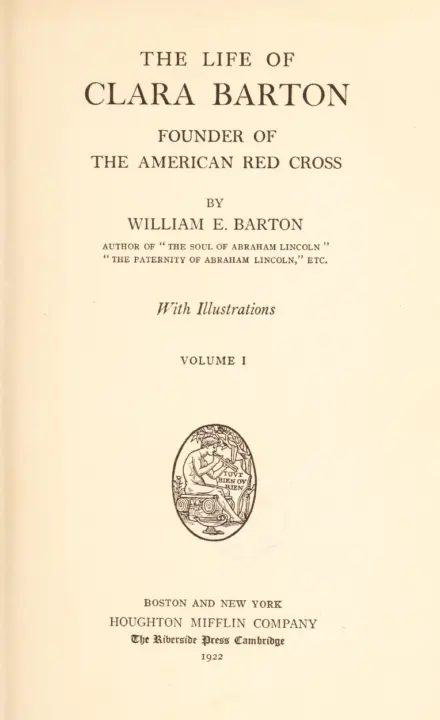
THE CLASSIC COLLECTION · 1922
"The Life of Clara Barton, Founder of the American Red Cross (Vol. 1 of 2)" by William E. Barton is a historical account written in the early 20th century. This biography chronicles the life and contributions of Clara Barton, highlighting her role in founding the American Red Cross and her significant impact on humanitarian efforts during her lifetime. The book presents both her personal journey and the broader social changes occurring during her life, providing insight into her character and the historical context in which she operated. The opening of the book establishes a framework for understanding Clara Barton's life. It introduces her early attempts at autobiographical writing and recounts her birth on Christmas Day, 1821. The introduction emphasizes her lifelong dedication to humanitarian service, detailing her early education, familial influences, and the personal experiences that shaped her character. Key themes of resilience, determination, and philanthropy emerge as Barton navigates her childhood, including her initial endeavors in teaching, which reflect her nurturing spirit and commitment to social causes. As the text explores her ancestry and upbringing, a portrait of a woman destined to lead and innovate in the field of humanitarianism begins to take shape.
Introduction adapted from the source catalogue; source summaries may be automatically generated.
Free to read · English · 110,898 words · No account needed
MAKE TIME FOR A GOOD BOOK
On by default. Untick to stop anonymous reading totals. Each page counts after 10 seconds in view. How this works.
Anonymous counting is on unless you have switched it off.
I suspect that, after the daily letter of your husband, inimitable correspondent and conversationist that he is, there is nothing left for me to relate of our big city, grown up so strangely like a gourd all in a night; places which never before dreamed of being honored by an inhabitant save dogs, cats, and rats, are converted into “elegantly furnished rooms for rent,” and people actually live in them with all the city airs of people really living in respectable houses, and I suspect many of them do not know that they are positively living in sheds, but we, who have become familiar with every old roof years agone, know perfectly well what shelters them. Well, the present aspect of our capital is a wide, fruitful field for description, and I will leave it for the Doctor; he will clothe it in a far richer dress than I could do.
Perhaps you wish to know somewhat about my journey with my big trunks. Well, it was perfectly quiet; nothing like an adventure to enliven until we reached Baltimore, to which I had checked my baggage as the nearest point to Annapolis, for which place I could not get checks, but to which I had determined to go before proceeding to Washington. I delivered my checks to the expressman, took receipts, and gave every conductor on the train to understand that my baggage was to be taken through the city in the same train with myself (for we disconnect and come through Baltimore in horse-cars); but just imagine my vexation when, as our train commenced to move off, I saw my baggage just moving by slow teams up the street in the direction of our train. It had no checks, and I must not become long separated from it; the train was in motion and I could not leave it. I had no idea what would be done with it, whether retained in Baltimore, sent to Annapolis junction, or forwarded to Washington. I had to think fast, and you remember it was Saturday night. Relay House was the nearest station. I left the train there (Irving went on to Washington), and proceeded directly to the telegraph office and telegraphed back to Baltimore describing the baggage and directing it to come on the next train one hour later. They had just time to get it aboard, and on the arrival of the train I found it in the baggage car, took that train, and proceeded “nine miles to the junction,” stopped too late for Annapolis that night, chartered the parlor and sofa,--every room in the house filled with officers,--and as good luck would have it a train (special) ran down from Annapolis the next day about eleven, for a regiment of Zouaves, and I claimed my seat, and went, too, and the first any one knew I presented myself at the Headquarters of the 21st. You will have to imagine the cordial, affable Colonel springing from his seat with both hands extended, the extremely polite Lieutenant-Colonel Maggie, always in full dress with the constantly worn sword, with eyes and hair so much blacker than night, going through a succession of bows and formalities, which I, a simple, home-bred, unsophisticated Yankee didn’t know what upon earth to do with, completely confounded!--till the clear, appreciative, knowing twinkle of our “cute” Major Clark’s eyes set things right again; and almost the last, our honest, modest “Cousin” Fletcher coming up away round on the other side for his word, and not one among them all to whom I could extend a more cordial greeting. Please tell Grandma that he hasn’t broken a limb; his horse fell with him and hurt his shoulder, but it is nearly well now. I was just in time for a seat between the Colonel and Lieutenant-Colonel at dinner, and accompanying them to the Chapel to listen to the opening discourse of their newly arrived chaplain, Rev. Mr. Ball, Unitarian. He addressed the men with great kindness of manner, beseeching them to come near to him with all their trials, burdens, and temptations, and let him help to bear them. He was strong to bear, patient to hear, and willing to do, and his arm, and his ear, and his heart were theirs for all good purposes. There was many a glistening eye among that thousand waiting men, still as the night of death; for a regiment of soldiers can be the stillest living thing I ever looked at. The 21st are in the main good, true men, and I was glad that a man of gentle speech and kind and loving heart had come among them.
Your reading position is saved on this browser. Take it to another device with a library code. Reading pages adapt to text, rather than matching a printed edition.
William E. (William Eleazar) Barton

William E. (William Eleazar) Barton

William E. (William Eleazar) Barton
BEHIND THE BOOK
This eBook is for the use of anyone anywhere in the United States and most other parts of the world at no cost and with almost no restrictions whatsoever. You may copy it, give it away or re-use it under the terms of the Project Gutenberg License included with this eBook or online at www.gutenberg.org. If you are not located in the United States, you will have to check the laws of the country where you are located before using this eBook. Read the source licence.
The original source file, including credits and licence, is retained by this library. Request an original-format copy at no charge. Please include the book title and Project Gutenberg identifier #67505.
KEEP YOUR CURIOSITY GOING
Cécile Tormay

Moritz Busch
John L. Ransom
Frances Wright
Cécile Tormay

Mabel Potter Daggett