THE CLASSIC COLLECTION✦The Life of Clara Barton, Founder of the American Red Cross (Vol. 2 of 2)CLASSIC FREE BOOKS
The Life of Clara Barton, Founder of the American Red Cross (Vol. 2 of 2)
William E. (William Eleazar) Barton
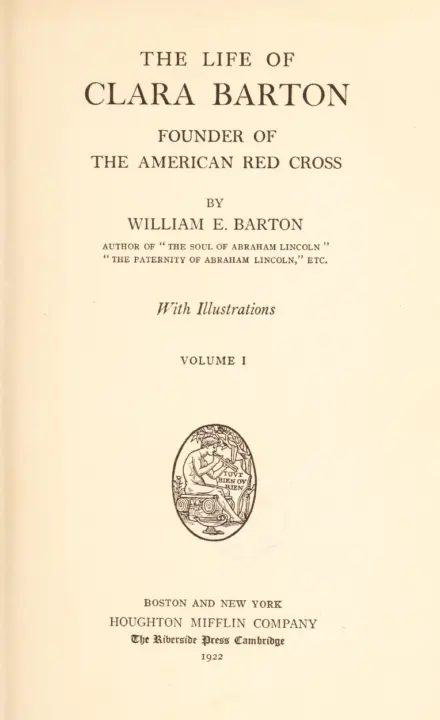
THE CLASSIC COLLECTION · 1922
"The Life of Clara Barton, Founder of the American Red Cross (Vol. 1 of 2)" by William E. Barton is a historical account written in the early 20th century. This biography chronicles the life and contributions of Clara Barton, highlighting her role in founding the American Red Cross and her significant impact on humanitarian efforts during her lifetime. The book presents both her personal journey and the broader social changes occurring during her life, providing insight into her character and the historical context in which she operated. The opening of the book establishes a framework for understanding Clara Barton's life. It introduces her early attempts at autobiographical writing and recounts her birth on Christmas Day, 1821. The introduction emphasizes her lifelong dedication to humanitarian service, detailing her early education, familial influences, and the personal experiences that shaped her character. Key themes of resilience, determination, and philanthropy emerge as Barton navigates her childhood, including her initial endeavors in teaching, which reflect her nurturing spirit and commitment to social causes. As the text explores her ancestry and upbringing, a portrait of a woman destined to lead and innovate in the field of humanitarianism begins to take shape.
Introduction adapted from the source catalogue; source summaries may be automatically generated.
Free to read · English · 110,898 words · No account needed
MAKE TIME FOR A GOOD BOOK
On by default. Untick to stop anonymous reading totals. Each page counts after 10 seconds in view. How this works.
Anonymous counting is on unless you have switched it off.
In the Wars of the Roses the Bartons were with the house of Lancaster, and the Red Rose is the traditional flower of the Barton family. Clara Barton, when she wore flowers, habitually wore red roses; and whatever her attire there was almost invariably about it somewhere a touch of red, “her color,” she called it, as it had been the color of her ancestors for many generations.
In the seventeenth century there were several families of Bartons in the American colonies. The name is found early in Virginia, in Pennsylvania, in Massachusetts, Rhode Island, New Jersey, and other colonies.
Salem had two families of Bartons, probably related,--those of Dr. John Barton, physician and chirurgeon, who came from Huntingdonshire, England, in 1672, and was prominent in the early life of Salem, and Edward Barton, who arrived thirty-two years earlier, but, receiving a grant of land on the Piscataqua, removed to Portsmouth, and about 1666 to Cape Porpoise, Maine. On account of Indian troubles, the homestead was deserted for some years, but Cape Porpoise continued to be the traditional home of this branch of the Barton family.
Edward’s eldest son, Matthew, returned to Salem, and lived there, at Portsmouth, and at Cape Porpoise. His eldest son, born probably at Salem in or about 1664, was Samuel Barton, founder of the Barton family of Oxford.
Not long after the pathetic witchcraft delusion of Salem, a number of enterprising families migrated from Salem to Framingham, among them the family of Samuel Barton. On July 19, 1716, as recorded in the Suffolk County Registry of Deeds in Boston, Jonathan Provender, husbandman, of Oxford, sold to Samuel Barton, Sr., husbandman, of Framingham, a tract of land including about one-thirtieth of the village of Oxford, as well as a fourth interest in two mills, a sawmill and a gristmill.
In 1720, Samuel Barton and a few of his neighbors met at the home of John Towne, where, after prayer, “they mutually considered their obligations to promote the kingdom of their Lord and Saviour, Jesus Christ,” and covenanted together to seek to establish and build a church of Christ in Oxford. On January 3, 1721, the church was formally constituted, Samuel Barton and his wife bringing their letters of dismission from the church in Framingham of which both were members, and uniting as charter members of the new church in Oxford. The Reverend John Campbell was their first pastor. For over forty years he led his people, and his name lives in the history of that town as a man of learning, piety, and rare capacity for spiritual leadership. Long after his death, it was discovered that he was Colonel John Campbell, of Scotland, heir to the earldom of Loudon, who had fled from Scotland for political reasons, and who became a soldier of Christ in the new world.
Your reading position is saved on this browser. Take it to another device with a library code. Reading pages adapt to text, rather than matching a printed edition.
William E. (William Eleazar) Barton

William E. (William Eleazar) Barton

William E. (William Eleazar) Barton
BEHIND THE BOOK
This eBook is for the use of anyone anywhere in the United States and most other parts of the world at no cost and with almost no restrictions whatsoever. You may copy it, give it away or re-use it under the terms of the Project Gutenberg License included with this eBook or online at www.gutenberg.org. If you are not located in the United States, you will have to check the laws of the country where you are located before using this eBook. Read the source licence.
The original source file, including credits and licence, is retained by this library. Request an original-format copy at no charge. Please include the book title and Project Gutenberg identifier #67505.
KEEP YOUR CURIOSITY GOING
Cécile Tormay

Moritz Busch
John L. Ransom
Frances Wright
Cécile Tormay

Mabel Potter Daggett