THE CLASSIC COLLECTION✦An outlaw’s diary: the CommuneCLASSIC FREE BOOKS
An outlaw’s diary: the Commune
Cécile Tormay
THE CLASSIC COLLECTION · 1883
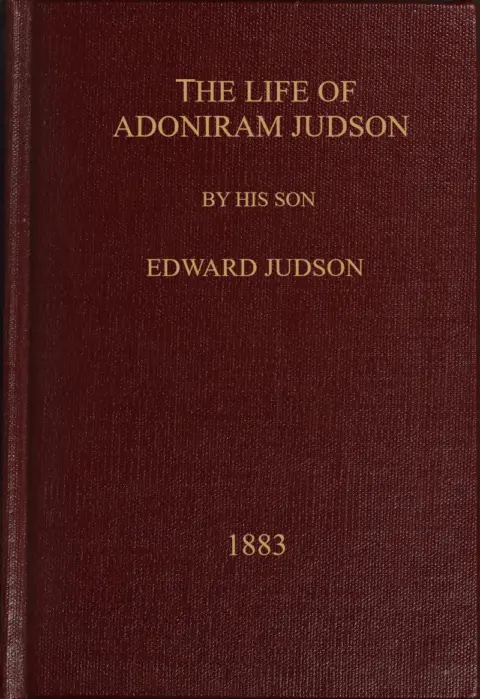
"The Life of Adoniram Judson" by Edward Judson is a historical account written in the late 19th century. This biography chronicles the life and achievements of Adoniram Judson, a pioneering American missionary known for his extensive work in Burma (now Myanmar). The text explores Judson's early years, education, conversion to Christianity, and eventual dedication to missionary work, providing insight into his character and the significant impact he had on American foreign missionary endeavors. The opening of the biography presents a transcriber's note explaining the formatting of the text, followed by Edward Judson's dedication to the children of missionaries. In the initial chapters, the focus is on Adoniram Judson's early years, highlighting his precociousness, ambition, and formative familial relationships. The narrative recounts his academic achievements, struggles with skepticism, and eventual commitment to missionary work, influenced by a pivotal sermon he encountered during his studies. It sets the stage for Judson's eventual consecration to missionary life, foreshadowing his journey to the East and the trials he would face while spreading Christianity in Burma.
Introduction adapted from the source catalogue; source summaries may be automatically generated.
Free to read · English · 222,953 words · No account needed
MAKE TIME FOR A GOOD BOOK
On by default. Untick to stop anonymous reading totals. Each page counts after 10 seconds in view. How this works.
Anonymous counting is on unless you have switched it off.
“September 30, 1815. Had the following conversation with my teacher, as nearly as I can recollect it. This man has been with me about three months, and is the most sensible, learned, and candid man that I have ever found among the Burmans. He is forty-seven years of age, and his name is Oo Oungmen. I began by saying, Mr. J—— is dead. Oo. I have heard so. J. His soul is lost, I think. Oo. Why so? J. He was not a disciple of Christ. Oo. How do you know that? You could not see his soul. J. How do you know whether the root of that mango-tree is good? You can not see it; but you can judge by the fruit on its branches. Thus I know that Mr. J. was not a disciple of Christ, because his words and actions were not such as indicate a disciple. Oo. And so all who are not disciples of Christ are lost? J. Yes, all, whether Burmans or foreigners. Oo. This is hard. J. Yes, it is hard indeed; otherwise I should not have come all this way, and left parents and all, to tell you of Christ. He seemed to feel the force of this, and after stopping a little he said, How is it that the disciples of Christ are so fortunate above all men? J. Are not all men sinners, and deserving of punishment in a future state? Oo. Yes, all must suffer in some future state for the sins they commit. The punishment follows the crime as surely as the wheel of the cart follows the footsteps of the ox. J. Now, according to the Burman system, there is no escape. According to the Christian system, there is. Jesus Christ has died in the place of sinners—has borne their sins; and now those who believe on Him, and become His disciples, are released from the punishment they deserve. At death, they are received into heaven, and are happy forever. Oo. That I will never believe. My mind is very stiff on this one point, namely, that all existence involves in itself principles of misery and destruction. The whole universe is only destruction and reproduction. It therefore becomes a wise man to raise his desires above all things that exist, and aspire to nigban, the state where there is no existence. J. Teacher, there are two evil futurities, and one good. A miserable future existence is evil, and annihilation, or nigban, is an evil, a fearful evil. A happy future existence is alone good. Oo. I admit that is best, if it could be perpetual; but it can not be. Whatever is, is liable to change, and misery, and destruction. Nigban is the only permanent good, and that good has been attained by Gaudama, the last deity. J. If there be no eternal being, you can not account for anything. Whence this world, and all that we see? Oo. Fate. J. Fate! The cause must always be equal to the effect. See, I raise this table. See also that ant under it Suppose I were invisible, would a wise man say the ant raised it? Now, fate is not even an ant. Fate is a word; that is all. It is not an agent; not a thing. What is fate? Oo. The fate of creatures is the influence which their good or bad deeds have on their future existence. J. If influence be exerted, there must be an exerter. If there be a determination, there must be a determiner. Oo. No, there is no determiner. There can not be an eternal being. J. Consider this point. It is a main point of true wisdom. Whenever there is an execution of a purpose, there must be an agent. Oo. (After a little thought.) I must say that my mind is very decided and hard, and unless you tell me something more to the purpose, I shall never believe. J. Well, teacher, I wish you to believe, not for my profit, but for yours. I daily pray the true God to give you light that you may believe. Whether you will ever believe in this world, I do not know; but when you die, I know you will believe what I now say. You will then appear before the God that you now deny. Oo. I don’t know that. J. I have heard that one Burman, many years ago, embraced the Portuguese religion, and that he was your relation. Oo. He was a brother of my grandfather. J. At Ava, or here? Oo. At Ava he became a Portuguese; afterwards went to a ship country with a ship-priest, and returned to Ava. J. I have heard he was put to death for his religion. Oo. No, he was imprisoned and tortured by order of the emperor. At last he escaped from their hands, fled to Rangoon, and afterwards to Bengal, where they say he died. J. Did any of his family join him? Oo. None; all forsook him; and he wandered about, despised and rejected by all. J. Do you think that he was a decided Christian, and had got a new mind? Oo. I think so; for when he was tortured hard, he held out. J. Did he ever talk with you about religion? Oo. Yes. J. Why did you not listen to him? Oo. I did not listen. J. Did you ever know any other Burman that changed his own for a foreign religion? Oo. I have heard that there is one now in Rangoon, who became a Portuguese; but he keeps himself concealed, and I have never seen him.”
Your reading position is saved on this browser. Take it to another device with a library code. Reading pages adapt to text, rather than matching a printed edition.
BEHIND THE BOOK
This eBook is for the use of anyone anywhere in the United States and most other parts of the world at no cost and with almost no restrictions whatsoever. You may copy it, give it away or re-use it under the terms of the Project Gutenberg License included with this eBook or online at www.gutenberg.org. If you are not located in the United States, you will have to check the laws of the country where you are located before using this eBook. Read the source licence.
The original source file, including credits and licence, is retained by this library. Request an original-format copy at no charge. Please include the book title and Project Gutenberg identifier #70894.
KEEP YOUR CURIOSITY GOING
Cécile Tormay

Moritz Busch
John L. Ransom
Frances Wright
Cécile Tormay

Mabel Potter Daggett