THE CLASSIC COLLECTION✦An outlaw’s diary: the CommuneCLASSIC FREE BOOKS
An outlaw’s diary: the Commune
Cécile Tormay
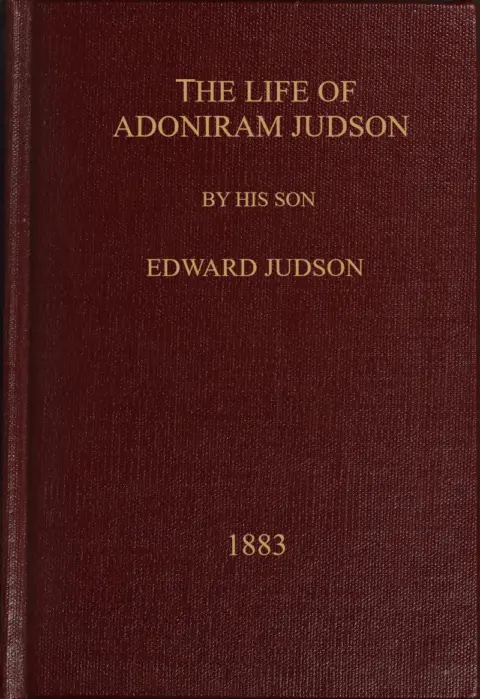
THE CLASSIC COLLECTION · 1883
"The Life of Adoniram Judson" by Edward Judson is a historical account written in the late 19th century. This biography chronicles the life and achievements of Adoniram Judson, a pioneering American missionary known for his extensive work in Burma (now Myanmar). The text explores Judson's early years, education, conversion to Christianity, and eventual dedication to missionary work, providing insight into his character and the significant impact he had on American foreign missionary endeavors. The opening of the biography presents a transcriber's note explaining the formatting of the text, followed by Edward Judson's dedication to the children of missionaries. In the initial chapters, the focus is on Adoniram Judson's early years, highlighting his precociousness, ambition, and formative familial relationships. The narrative recounts his academic achievements, struggles with skepticism, and eventual commitment to missionary work, influenced by a pivotal sermon he encountered during his studies. It sets the stage for Judson's eventual consecration to missionary life, foreshadowing his journey to the East and the trials he would face while spreading Christianity in Burma.
Introduction adapted from the source catalogue; source summaries may be automatically generated.
Free to read · English · 222,953 words · No account needed
MAKE TIME FOR A GOOD BOOK
On by default. Untick to stop anonymous reading totals. Each page counts after 10 seconds in view. How this works.
Anonymous counting is on unless you have switched it off.
1845, July 5, arrived from Port Louis in the Isle of France.
1845, July 23, embarked on the Sophia Walker, Capt. Codman, bound to
the United States.
1845, July 25, sailed from Port Louis.
1845, Aug. 26, arrived at St. Helena.
1845, Sept. 1, Mrs. J. died at 3 A.M., was buried at 6 P.M., and we sailed from St. Helena in the evening.
1845, Oct. 15, arrived in Boston.
1845, Nov. 13, parted with my children, leaving Adoniram and Elnathan at Worcester, and sending Abby Ann to Plymouth.
1845, Nov. 28, heard of the death of little Charlie at Maulmain, August 5, 1845, aged 1 year and 7½ months.
1846, Jan. 5, commenced an acquaintance with Emily Chubbuck.
1846, April 6, removed Abby Ann from Plymouth to Bradford.
1846, June 2, was married at Hamilton, N. Y., to Emily Chubbuck, born at Eaton, N. Y., Aug. 22, 1817, the daughter of Charles and Lavinia Chubbuck.
1846, July 4, took leave of Adoniram and Elnathan at Worcester.
1846, July 9, took leave of Abby Ann at Bradford.
1846, July 11, took leave of George D. Boardman, the Lincoln families, the Colbys, the Gillettes, Anne Maria Anable, and numberless other friends, and embarked with Mrs. Judson, Miss Lillybridge, the Beechers, and the Harrises, on the ship Faneuil Hall, Capt. Hallet, bound to Maulmain.
1846, Nov. 30, arrived in Maulmain.
1847, Feb. 15, embarked with my family for Rangoon.
1847, June 1, Mrs. J. finished the memoir of the late Mrs. J.
1847, Aug. 31, re-embarked for Maulmain.
1847, Sept. 5, arrived in Maulmain.
1847, Dec. 24, Emily Frances Judson was born in Maulmain.
1848, Feb. 25, removed into the old house.
1849, Jan. 24, finished the English and Burmese dictionary.
There is one Being who exists eternally; who is exempt from sickness, old age, and death; who was, and is, and will be, without beginning, and without end. Besides this, the true God, there is no other God. The true God is diverse from all other beings. Uniting three in one, God the Father, God the Son, and God the Holy Ghost, these three are one God. God is a spirit, without bodily form. Although omnipresent, it is above the heavens that he clearly discovers his glory. His power and wisdom are infinite. He is pure and good, and possessed of everlasting felicity. Before this world was made, God remained happy, surrounded by the pure and incorporeal sons of heaven. In order to display his perfections, and make creatures happy, God created the heavens, the sun, moon, and all the stars, the earth, the various kinds of brute creatures, and man. The first man and woman, at their original creation, were not liable to sickness or death; they were exempt from every kind of evil, and their mind was upright and pure. Afterwards, because, by violating the command of God, they transgressed against their Benefactor, the sum of all perfections, beyond compare, the light of the divine countenance disappeared, and those two, together with all their posterity, became darkened, and unclean, and wicked; they became subject, in the present state, to sickness, death, and all other evils; and they became deserving of suffering, in the future state, the dreadful punishment of hell. Above four thousand years after mankind was thus destroyed, God, being moved with compassion for man involved in misery, sent to the earth, the abode of man, God the Son, the second yadana among the three yadanas [anything superlatively excellent—in the present application it conveys no additional idea, but is requisite in Burman to the intelligibility of the sentence]. The circumstances of his being sent were thus:—God the Son, uniting the divine and the human natures, without destroying or confounding them, in the land of Israel, and country of Judea, in the womb of a virgin, was conceived by the divine power, and was born. This God-man, who is named Jesus Christ, being man, endured in our stead severe sufferings and death, the punishment due to our sins; and being God, is able by virtue of having endured those sufferings, to deliver all his disciples from the punishment of hell, redeeming them with his own life, and to instate them in heaven. On the third day after Jesus Christ suffered death, his soul re-entered his body, and he lived again. For the space of forty days he remained, giving instruction to his disciples, after which he commissioned them thus—“Go ye into all countries on earth, and proclaim the glad news to all men. He that believeth in me, and is baptized, shall be saved; he that believeth not shall be damned, or shall suffer endless punishment in hell.” Then, in the presence of many of his disciples, he ascended to heaven, and took up his abode in the place where God displays his glory. According to the final command of Jesus Christ, his disciples, beginning with Judea, travelled about through various countries and kingdoms, and proclaimed the glad news; and many believed, and became disciples of Jesus Christ. The true religion afterwards spread into the countries of the west; and now to this country of Burmah, among the countries of the east, a teacher of religion, from the country of America, has arrived, and is beginning to proclaim the glad news. About one or two hundred years hence the religion of Boodh, of Brahma, of Mahomet, and of Rome, together with all other false religions, will disappear and be lost, and the religion of Christ will pervade the whole world; all quarrels and wars will cease, and all the tribes of man will be like a band of mutually loving brothers. [End of Part 1.]
Your reading position is saved on this browser. Take it to another device with a library code. Reading pages adapt to text, rather than matching a printed edition.
BEHIND THE BOOK
This eBook is for the use of anyone anywhere in the United States and most other parts of the world at no cost and with almost no restrictions whatsoever. You may copy it, give it away or re-use it under the terms of the Project Gutenberg License included with this eBook or online at www.gutenberg.org. If you are not located in the United States, you will have to check the laws of the country where you are located before using this eBook. Read the source licence.
The original source file, including credits and licence, is retained by this library. Request an original-format copy at no charge. Please include the book title and Project Gutenberg identifier #70894.
KEEP YOUR CURIOSITY GOING
Cécile Tormay

Moritz Busch
John L. Ransom
Frances Wright
Cécile Tormay

Mabel Potter Daggett