THE CLASSIC COLLECTION✦An outlaw’s diary: the CommuneCLASSIC FREE BOOKS
An outlaw’s diary: the Commune
Cécile Tormay
THE CLASSIC COLLECTION · 1883
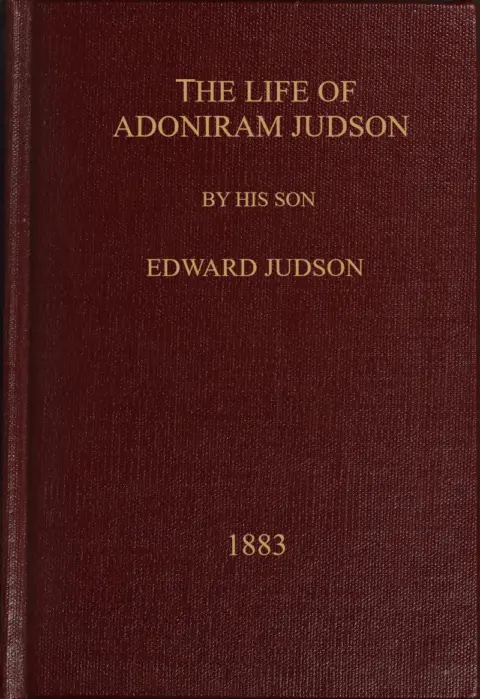
"The Life of Adoniram Judson" by Edward Judson is a historical account written in the late 19th century. This biography chronicles the life and achievements of Adoniram Judson, a pioneering American missionary known for his extensive work in Burma (now Myanmar). The text explores Judson's early years, education, conversion to Christianity, and eventual dedication to missionary work, providing insight into his character and the significant impact he had on American foreign missionary endeavors. The opening of the biography presents a transcriber's note explaining the formatting of the text, followed by Edward Judson's dedication to the children of missionaries. In the initial chapters, the focus is on Adoniram Judson's early years, highlighting his precociousness, ambition, and formative familial relationships. The narrative recounts his academic achievements, struggles with skepticism, and eventual commitment to missionary work, influenced by a pivotal sermon he encountered during his studies. It sets the stage for Judson's eventual consecration to missionary life, foreshadowing his journey to the East and the trials he would face while spreading Christianity in Burma.
Introduction adapted from the source catalogue; source summaries may be automatically generated.
Free to read · English · 222,953 words · No account needed
MAKE TIME FOR A GOOD BOOK
On by default. Untick to stop anonymous reading totals. Each page counts after 10 seconds in view. How this works.
Anonymous counting is on unless you have switched it off.
In a letter to the Corresponding Secretary, Rev. Dr. Bolles, Mr. Judson
wrote:
“So far, therefore, as I had a view to the attainment of religious toleration in accompanying the embassy, I have entirely failed. I feel the disappointment more deeply on account of the many tedious delays which have already occurred, and which we anticipate during our return; so that, instead of four or five months, I shall be absent from home seven or eight.
“But, above all, the news of the death of my beloved wife has not only thrown a gloom over all my future prospects, but has forever embittered my recollections of the present journey, in consequence of which I have been absent from her dying bed, and prevented from affording the spiritual comfort which her lonely circumstances peculiarly required, and of contributing to avert the fatal catastrophe which has deprived me of one of the first of women, the best of wives.
“I commend myself and motherless child to your sympathy and prayers.”
But when writing to the mother of his beloved wife, he describes still more fully the sorrowful experience through which he passed:
To Mrs. Hasseltine, of Bradford, Mass.
“AVA, December 7, 1826.
“DEAR MOTHER HASSELTINE: This letter, though intended for the whole family, I address particularly to you; for it is a mother’s heart that will be most deeply interested in its melancholy details. I propose to give you, at different times, some account of my great, irreparable loss, of which you will have heard before receiving this letter.
“I left your daughter, my beloved wife, at Amherst, the 5th of July last, in good health, comfortably situated, happy in being out of the reach of our savage oppressors, and animated in prospect of a field of missionary labor opening under the auspices of British protection. It affords me some comfort that she not only consented to my leaving her, for the purpose of joining the present embassy to Ava, but uniformly gave her advice in favor of the measure, whenever I hesitated concerning my duty. Accordingly I left her. On the 5th of July I saw her for the last time. Our parting was much less painful than many others had been. We had been preserved through so many trials and vicissitudes, that a separation of three or four months, attended with no hazards to either party, seemed a light thing. We parted, therefore, with cheerful hearts, confident of a speedy reunion, and indulging fond anticipations of future years of domestic happiness. After my return to Rangoon, and subsequent arrival at Ava, I received several letters from her, written in her usual style, and exhibiting no subject of regret or apprehension, except the declining health of our little daughter, Maria. Her last was dated the 14th of September. She says, ‘I have this day moved into the new house, and, for the first time since we were broken up at Ava, feel myself at home. The house is large and convenient, and if you were here I should feel quite happy. The native population is increasing very fast, and things wear rather a favorable aspect. Moung Ing’s school has commenced with ten scholars, and more are expected. Poor little Maria is still feeble. I sometimes hope she is getting better; then again she declines to her former weakness. When I ask her where papa is, she always starts up and points toward the sea. The servants behave very well, and I have no trouble about anything, excepting you and Maria. Pray take care of yourself, particularly as it regards the intermittent fever at Ava. May God preserve and bless you, and restore you in safety to your new and old home, is the prayer of your affectionate Ann.’
Your reading position is saved on this browser. Take it to another device with a library code. Reading pages adapt to text, rather than matching a printed edition.
BEHIND THE BOOK
This eBook is for the use of anyone anywhere in the United States and most other parts of the world at no cost and with almost no restrictions whatsoever. You may copy it, give it away or re-use it under the terms of the Project Gutenberg License included with this eBook or online at www.gutenberg.org. If you are not located in the United States, you will have to check the laws of the country where you are located before using this eBook. Read the source licence.
The original source file, including credits and licence, is retained by this library. Request an original-format copy at no charge. Please include the book title and Project Gutenberg identifier #70894.
KEEP YOUR CURIOSITY GOING
Cécile Tormay

Moritz Busch
John L. Ransom
Frances Wright
Cécile Tormay

Mabel Potter Daggett