THE CLASSIC COLLECTION✦An outlaw’s diary: the CommuneCLASSIC FREE BOOKS
An outlaw’s diary: the Commune
Cécile Tormay
THE CLASSIC COLLECTION · 1883
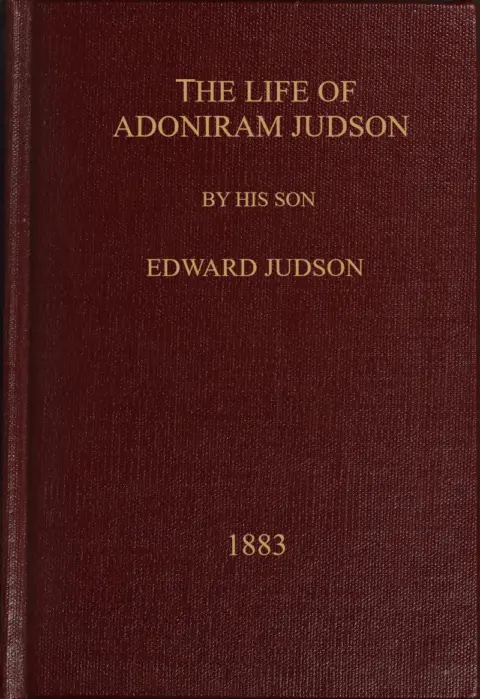
"The Life of Adoniram Judson" by Edward Judson is a historical account written in the late 19th century. This biography chronicles the life and achievements of Adoniram Judson, a pioneering American missionary known for his extensive work in Burma (now Myanmar). The text explores Judson's early years, education, conversion to Christianity, and eventual dedication to missionary work, providing insight into his character and the significant impact he had on American foreign missionary endeavors. The opening of the biography presents a transcriber's note explaining the formatting of the text, followed by Edward Judson's dedication to the children of missionaries. In the initial chapters, the focus is on Adoniram Judson's early years, highlighting his precociousness, ambition, and formative familial relationships. The narrative recounts his academic achievements, struggles with skepticism, and eventual commitment to missionary work, influenced by a pivotal sermon he encountered during his studies. It sets the stage for Judson's eventual consecration to missionary life, foreshadowing his journey to the East and the trials he would face while spreading Christianity in Burma.
Introduction adapted from the source catalogue; source summaries may be automatically generated.
Free to read · English · 222,953 words · No account needed
MAKE TIME FOR A GOOD BOOK
On by default. Untick to stop anonymous reading totals. Each page counts after 10 seconds in view. How this works.
Anonymous counting is on unless you have switched it off.
“January 2, 1823. To-day I informed the king that it was my intention to return to Rangoon. ‘Will you proceed thence to your own country?’ ‘Only to Rangoon.’ His majesty gave an acquiescing nod. The a-twen-woon Moung Zah inquired, ‘Will you both go, or will the doctor remain?’ I said that he would remain. Brother Price made some remark on the approaching hot season, and the inconvenience of our present situation; on which Moung Zah, inferring that it was on account of the climate that I was about leaving, turned to me, saying, ‘Then you will return here, after the hot season.’ I looked at the king, and said that if it was convenient, I would return; which his majesty again sanctioned by an acquiescing nod and smile, and in reply to brother Price, said, ‘Let a place be given him.’ Brother Price, however, thinks of retaining the small place on which we now live for medical purposes, and getting a place at Chagaing, on the opposite side of the river, for his permanent residence.
“In the evening had a long conversation with Moung Zah on religion. He believes that there is an eternal God, and that Gaudama, and Christ, and Mahomet, and others are great teachers, who communicated as much truth respectively as they could, but that their communications are not the word of God. I pressed my arguments as far as I dared; but he seemed to have reflected much on the subject, and to have become quite settled and inflexible in his conclusions. He may be called a deistic Buddhist, the first that I have met in the country. On parting, however, he remarked, ‘This is a deep and difficult subject. Do you, teacher, consider further, and I also will consider.’
“January 7. Among the many places which I endeavored in vain to procure was a small one, sufficient for one family only, pleasantly situated on the banks of the river, just without the walls of the town, and about a mile from the palace. But it had been appropriated by the chief woon-gyee, and partly fenced in, with the intention of building a temporary zayat for his recreation and refreshment, when accompanying the king in that quarter of the city, and was, therefore, placed beyond any reasonable hope of attainment. Among other desperate attempts, however, I wrote a short petition, asking for that place, and begging leave to express my gratitude, by presenting a certain sum of money. It was necessary to put this into his own hand; and I was, therefore, obliged to follow him about, and watch his movements, for two or three days, until a favorable opportunity occurred, when he was apart from all his retinue. I seized the moment, presented myself before him, and held up the paper. He read it, and smiled. ‘You are indefatigable in your search after a place. But you can not have that. It is for my own use. Nor, if otherwise, could you get it for money. Search further.’ I now concluded to return to Rangoon for the present, and wait until the town should be settled, when, as all inform me, I shall be able to accommodate myself better. I accordingly informed the king of my purpose, as mentioned above, and began to look about for a boat. In the meantime, it occurred to me to make a ‘seventh attempt to fix the thread,’ and I sought another interview with the chief woon-gyee, a being who is really more difficult of access than the king himself. This evening I was so fortunate as to find him at his house, lying down, surrounded by forty or fifty of his people. I pressed forward into the foremost rank, and placed myself in a proper attitude. After a while, his eye fell upon me, and I held up a small bottle of eau de luce, and desired to present it. One of his officers carried it to him. He happened to be much pleased with it, and sat upright. ‘What kind of a house do you intend to build?’ I told him, but added, ‘I have no place to build on, my lord.’ He remained in a meditating attitude a few moments, and then suddenly replied, ‘If you want the little enclosure, take it!’ I expressed my gratitude. He began to take more notice of me, inquired about my character and profession, and then entered, with considerable spirit, on the subject of religion. After some conversation, he desired a specimen of my mode of worship and preaching; and I was obliged to repeat much more than I did before the king; for whenever I desisted, he ordered me to go on. When his curiosity was satisfied, he lay down, and I quietly retired.
Your reading position is saved on this browser. Take it to another device with a library code. Reading pages adapt to text, rather than matching a printed edition.
BEHIND THE BOOK
This eBook is for the use of anyone anywhere in the United States and most other parts of the world at no cost and with almost no restrictions whatsoever. You may copy it, give it away or re-use it under the terms of the Project Gutenberg License included with this eBook or online at www.gutenberg.org. If you are not located in the United States, you will have to check the laws of the country where you are located before using this eBook. Read the source licence.
The original source file, including credits and licence, is retained by this library. Request an original-format copy at no charge. Please include the book title and Project Gutenberg identifier #70894.
KEEP YOUR CURIOSITY GOING
Cécile Tormay

Moritz Busch
John L. Ransom
Frances Wright
Cécile Tormay

Mabel Potter Daggett