THE CLASSIC COLLECTION✦An outlaw’s diary: the CommuneCLASSIC FREE BOOKS
An outlaw’s diary: the Commune
Cécile Tormay
THE CLASSIC COLLECTION · 1883
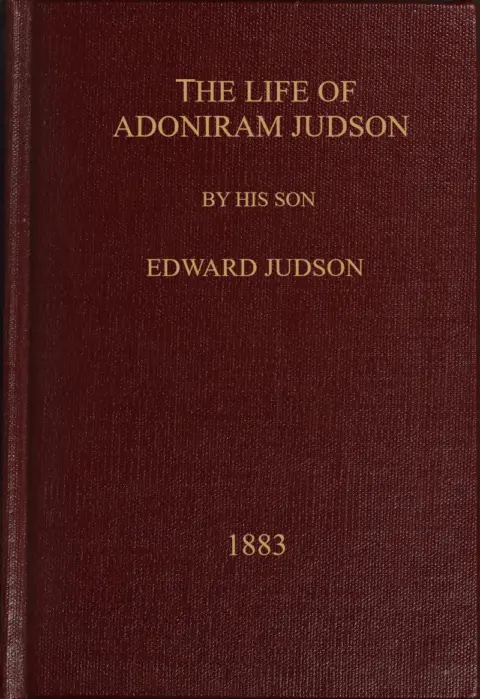
"The Life of Adoniram Judson" by Edward Judson is a historical account written in the late 19th century. This biography chronicles the life and achievements of Adoniram Judson, a pioneering American missionary known for his extensive work in Burma (now Myanmar). The text explores Judson's early years, education, conversion to Christianity, and eventual dedication to missionary work, providing insight into his character and the significant impact he had on American foreign missionary endeavors. The opening of the biography presents a transcriber's note explaining the formatting of the text, followed by Edward Judson's dedication to the children of missionaries. In the initial chapters, the focus is on Adoniram Judson's early years, highlighting his precociousness, ambition, and formative familial relationships. The narrative recounts his academic achievements, struggles with skepticism, and eventual commitment to missionary work, influenced by a pivotal sermon he encountered during his studies. It sets the stage for Judson's eventual consecration to missionary life, foreshadowing his journey to the East and the trials he would face while spreading Christianity in Burma.
Introduction adapted from the source catalogue; source summaries may be automatically generated.
Free to read · English · 222,953 words · No account needed
MAKE TIME FOR A GOOD BOOK
On by default. Untick to stop anonymous reading totals. Each page counts after 10 seconds in view. How this works.
Anonymous counting is on unless you have switched it off.
“April 20. Mah Men-la and her friends have been with Mrs. Judson all day. She gives increasing evidence of being a real disciple, but is extremely timid, through fear of persecution. One of her remarks deserves notice, as a natural expression of true Christian feeling. ‘I am surprised,’ said she, ‘to find this religion has such an effect on my mind as to make me love the disciples of Christ more than my dearest natural relations.’ She is a woman of very superior discernment and mental energy. One of the women, who has frequently accompanied her in her visits, met with a tract at Old Pegu about six weeks ago, and came all the way to Rangoon, chiefly, she says, on that account.
“This day I have finished the translation of the Epistle to the Ephesians, begun before I went to Ava, but intermitted on account of the weakness of my eyes. It is with real joy that I put this precious writing into the hands of the disciples. It is a great accession to their scanty stock of Scripture; for they have had nothing hitherto but Matthew. Intend to give them Acts as fast as my eyes will allow.
“April 30. Lord’s day. One of the busiest days I have ever spent. Not a multitude of visitants, as formerly. That we can not expect in present circumstances. But, besides the usual evening assembly, there were eight or ten present at worship, some of whom were with me from nine in the morning till ten at night. Mah Men-la and her company were with Mrs. Judson, who, by the way, has had a serious attack of the liver complaint for a fortnight past, and is now in a course of salivation.
“Oo Yan, after having searched out all the difficult points of religion, came to-day to the ne plus ultra—How are sin and eternal misery reconcilable with the character of an infinitely holy, wise, and powerful God? He at length obtained such satisfaction that he could not restrain laughing, from pure mental delight, and kept recurring to the subject, and repeating my remarks to those around him. He was accompanied, as usual, by his two friends, Moung Thah-a and Moung Myat-lah, husband of Mah Men-la. With these came also one Moung Yo, a disciple of Moung Shwa-gnong, a poor man, but a sharp reasoner. He was, or pretended to be, on the semi-atheistic plan. After ascertaining his precise ground, I used an argument which, in a late combat with Oo Yan, I found quite invincible. It is simply this: ‘No mind, no wisdom; temporary mind, temporary wisdom; eternal mind, eternal wisdom.’ Now, as all the semi-atheists firmly believe in eternal wisdom, this concise statement sweeps with irresistible sway through the very joints and marrow of their system. And, though it may seem rather simple and inconclusive to one unacquainted with Burman reasoning, its effect is uniformly decisive. No sooner is this short sentence uttered than one significantly nods his head, as if to say, ‘There you have it.’ Another cries out to the opponent, ‘You are undone, destroyed.’ Another says, ‘Talk about wisdom! where else will you find it?’ The disputant himself, who was perhaps preparing a learned speech about the excellence, and efficacy, and eternity of wisdom, quite disconcerted by this unexpected onset, sits looking at the wreck of his system, and wondering at the simple means which has spread such ruin around him; presently he looks up (for the Burmans are frequently candid), and says, ‘Your words are very appropriate’; and perhaps his next question is, ‘How can I become a disciple of the God you worship?’ All the visitors to-day, and, indeed, all the semi-atheists, are despisers of Gaudama and the established religion of the land. Moung Shwa-gnong has disseminated this heresy in Rangoon for several years; but since he has become acquainted with us, he frequently tells his adherents, ‘I know nothing; if you want true wisdom, go to the foreign teacher, and there you will find it.’ I have reason to believe that this heresy is not confined to Rangoon, but is taking root in various parts of the country and preparing the way for the Christian religion. O for toleration—a little toleration! We will be content to baptize in the night, and hold worship in private; but we do pray that we may not be utterly banished from the land; that we may not be cut up, root and branch. O that these poor souls, who are groping in the dark, feeling after the truth, may have time and opportunities to find the precious treasure which will enrich them forevermore! We are all looking with anxiety toward the golden feet. Our viceroy, Moung Shwa-thah, has gone thither on a visit; and it is doubtful whether he will return, or his rival, Mya-day-men. If the latter, there is some reason to hope that we shall keep footing in Rangoon, at least during his administration.
Your reading position is saved on this browser. Take it to another device with a library code. Reading pages adapt to text, rather than matching a printed edition.
BEHIND THE BOOK
This eBook is for the use of anyone anywhere in the United States and most other parts of the world at no cost and with almost no restrictions whatsoever. You may copy it, give it away or re-use it under the terms of the Project Gutenberg License included with this eBook or online at www.gutenberg.org. If you are not located in the United States, you will have to check the laws of the country where you are located before using this eBook. Read the source licence.
The original source file, including credits and licence, is retained by this library. Request an original-format copy at no charge. Please include the book title and Project Gutenberg identifier #70894.
KEEP YOUR CURIOSITY GOING
Cécile Tormay

Moritz Busch
John L. Ransom
Frances Wright
Cécile Tormay

Mabel Potter Daggett