THE CLASSIC COLLECTION✦An outlaw’s diary: the CommuneCLASSIC FREE BOOKS
An outlaw’s diary: the Commune
Cécile Tormay
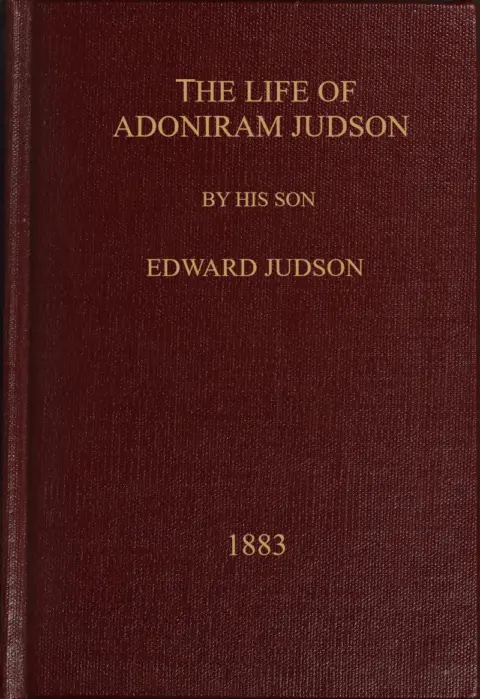
THE CLASSIC COLLECTION · 1883
"The Life of Adoniram Judson" by Edward Judson is a historical account written in the late 19th century. This biography chronicles the life and achievements of Adoniram Judson, a pioneering American missionary known for his extensive work in Burma (now Myanmar). The text explores Judson's early years, education, conversion to Christianity, and eventual dedication to missionary work, providing insight into his character and the significant impact he had on American foreign missionary endeavors. The opening of the biography presents a transcriber's note explaining the formatting of the text, followed by Edward Judson's dedication to the children of missionaries. In the initial chapters, the focus is on Adoniram Judson's early years, highlighting his precociousness, ambition, and formative familial relationships. The narrative recounts his academic achievements, struggles with skepticism, and eventual commitment to missionary work, influenced by a pivotal sermon he encountered during his studies. It sets the stage for Judson's eventual consecration to missionary life, foreshadowing his journey to the East and the trials he would face while spreading Christianity in Burma.
Introduction adapted from the source catalogue; source summaries may be automatically generated.
Free to read · English · 222,953 words · No account needed
MAKE TIME FOR A GOOD BOOK
On by default. Untick to stop anonymous reading totals. Each page counts after 10 seconds in view. How this works.
Anonymous counting is on unless you have switched it off.
“At night our people returned. They had found Moung Zah, and presented the petition for a passport, to which he made no other reply but ‘Come to-morrow.’
“February 4. Sent the people, early in the morning, with a handsome present to Moung Zah. They returned late at night. He accepted the present, and assured them he would do our business to-morrow.
“February 5. Sent the people as usual, our trusty Moung Nau accompanying them, with a quantity of silver. This did the business. Late in the evening I had the pleasure of taking into my hand the pointed palm-leaf. It has cost us the value of thirty dollars.
“February 6. Pushed off from the beach of O-ding-man. I could moralize half an hour on the apt resemblance, the beautiful congruity between the desolate state of our feelings and the sandy, barren surface of this miserable beach. But ‘‘tis idle all.’ Let the beach and our sorrow go together. Something better will turn up to-morrow.
“February 12. Reached Pyee, two hundred and thirty miles from Ava; our descent on the river being, of course, much more rapid than our ascent. Here, to our great surprise, we met with the teacher, Moung Shwa-gnong. He had come up from Rangoon, a few days ago, to visit an old acquaintance, who was dangerously ill; expects to return shortly; would gladly go with us, if we could wait a day or two. We stated to him all our adventures at court, the distressing result of the expedition, and the present danger of propagating or professing the religion of Christ, and wound off with the story of the iron mall. He appeared to be less affected and intimidated by the relation than we could have expected. Indeed, his language was rather too high for the occasion. I therefore told him that it was not for him that we were concerned, but for those who had become disciples of Christ. When they were accused and persecuted, they could not worship at the pagodas, or recant before the Mangen teacher. He felt the force of the reflection, and tried to explain his past conduct. ‘Say nothing,’ said I; ‘one thing you know to be true—that, when formerly accused, if you had not, in some way or other, satisfied the mind of the Mangen teacher, your life would not now be remaining in your body.’ ‘Then,’ said he, ‘if I must die, I shall die in a good cause. I know it is the cause of truth.’ He then repeated, with considerable emphasis, the most prominent points of his present faith, as follows: ‘I believe in the eternal God, in His Son Jesus Christ, in the atonement which Christ has made, and in the writings of the apostles, as the true and only word of God. Perhaps,’ continued he, ‘you may not remember that, during one of my last visits, you told me that I was trusting in my own understanding, rather than the divine word. From that time I have seen my error, and endeavored to renounce it. You explained to me also the evil of worshipping at pagodas, though I told you that my heart did not partake in the worship. Since you left Rangoon, I have not lifted up my folded hands before a pagoda. It is true, I sometimes follow the crowd, on days of worship, in order to avoid persecution; but I walk up one side of the pagoda, and walk down the other. Now, you say that I am not a disciple. What lack I yet?’ I was now satisfied that he had made a little advance since our last interview, which required a corresponding advance on my side. I replied, therefore, ‘Teacher, you may be a disciple of Christ in heart, but you are not a full disciple. You have not faith and resolution enough to keep all the commands of Christ, particularly that which requires you to be baptized, though in the face of persecution and death. Consider the words of Jesus, just before He returned to heaven, “He that believeth and is baptized shall be saved.”’ He received this communication in profound silence, and with that air which I have observed to come upon him when he takes a thing into serious consideration. Soon after I hinted our intention of leaving Rangoon, since the emperor had virtually prohibited the propagation of the Christian religion, and no Burman, under such circumstances, would dare to investigate, much less to embrace it. This intelligence evidently roused him, and showed us that we had more interest in his heart than we thought. ‘Say not so,’ said he; ‘there are some who will investigate, notwithstanding; and rather than have you quit Rangoon, I will go myself to the Mangen teacher, and have a public dispute. I know I can silence him. I know the truth is on my side.’ ‘Ah,’ said I, ‘you may have a tongue to silence him, but he has a pair of fetters and an iron mall to tame you. Remember that.’ This was the substance of our conversation, though much more prolix; and he left us about nine o’clock at night.
Your reading position is saved on this browser. Take it to another device with a library code. Reading pages adapt to text, rather than matching a printed edition.
BEHIND THE BOOK
This eBook is for the use of anyone anywhere in the United States and most other parts of the world at no cost and with almost no restrictions whatsoever. You may copy it, give it away or re-use it under the terms of the Project Gutenberg License included with this eBook or online at www.gutenberg.org. If you are not located in the United States, you will have to check the laws of the country where you are located before using this eBook. Read the source licence.
The original source file, including credits and licence, is retained by this library. Request an original-format copy at no charge. Please include the book title and Project Gutenberg identifier #70894.
KEEP YOUR CURIOSITY GOING
Cécile Tormay

Moritz Busch
John L. Ransom
Frances Wright
Cécile Tormay

Mabel Potter Daggett