THE CLASSIC COLLECTION✦An outlaw’s diary: the CommuneCLASSIC FREE BOOKS
An outlaw’s diary: the Commune
Cécile Tormay
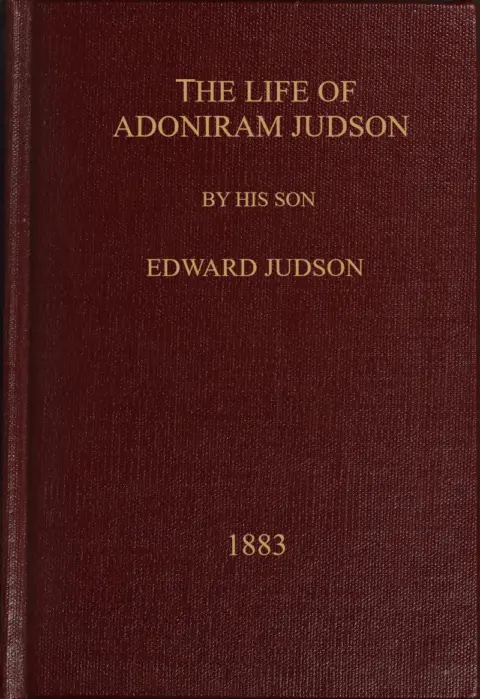
THE CLASSIC COLLECTION · 1883
"The Life of Adoniram Judson" by Edward Judson is a historical account written in the late 19th century. This biography chronicles the life and achievements of Adoniram Judson, a pioneering American missionary known for his extensive work in Burma (now Myanmar). The text explores Judson's early years, education, conversion to Christianity, and eventual dedication to missionary work, providing insight into his character and the significant impact he had on American foreign missionary endeavors. The opening of the biography presents a transcriber's note explaining the formatting of the text, followed by Edward Judson's dedication to the children of missionaries. In the initial chapters, the focus is on Adoniram Judson's early years, highlighting his precociousness, ambition, and formative familial relationships. The narrative recounts his academic achievements, struggles with skepticism, and eventual commitment to missionary work, influenced by a pivotal sermon he encountered during his studies. It sets the stage for Judson's eventual consecration to missionary life, foreshadowing his journey to the East and the trials he would face while spreading Christianity in Burma.
Introduction adapted from the source catalogue; source summaries may be automatically generated.
Free to read · English · 222,953 words · No account needed
MAKE TIME FOR A GOOD BOOK
On by default. Untick to stop anonymous reading totals. Each page counts after 10 seconds in view. How this works.
Anonymous counting is on unless you have switched it off.
“My last was dated Madras, May 28, 1818. At that place I remained, waiting for a conveyance to Rangoon, until the 20th of July, when I took passage on an English vessel, at one hundred and sixty-seven rupees. During my stay in Madras, I experienced great kindness and hospitality in the families of the Rev. Mr. Thompson, chaplain, and the Rev. Mr. Loveless, missionary; and received such proofs of Christian affection from many dear friends, as rendered parting with them very painful, though my detention in Madras had, in other respects, been almost insupportable. We anchored at the mouth of Rangoon River, on the 2d of August. The next morning, when the pilot came on board, I was overwhelmed with the intelligence that, on account of the dangerous situation of affairs, the mission had been broken up, and that Mr. Hough and family, and Mrs. Judson, had taken passage for Bengal. To my great relief, however, it was added, that, before the ship left the river, Mrs. Judson’s reluctance to leave the place had so increased as to force her back to the mission-house alone; and further, that the ship, being found unfit for sea, was still detained. On my arrival, I found that brother Hough was inclined to pursue his original plan. His reasons he will doubtless communicate to the Board. It is expected that the vessel will be ready for sea in about a fortnight.”
It is characteristic of Mr. Judson’s letters to the Board that he kept out of sight his own personal sufferings, touching only upon matters which seemed to him of general interest and importance. We are, therefore, indebted to Mrs. E. C. Judson for certain reminiscences of this horrible voyage, which she received from his own lips:
“They had sailed for Chittagong, a passage which should have been made in ten or twelve days, at farthest. He had, therefore, prepared himself for only a few weeks’ absence from home. When the vessel put in at Cheduba, the nervous affection of his head and eyes, occasioned at first by low diet, had so much increased by exhaustion and lack of food, that he was unable to go on shore. When they approached the Coromandel coast, and again encountered contrary winds, they were reduced to almost the last extremity, and the constitution of Mr. Judson sank under these accumulated hardships. The mouldy, broken rice, which they picked up from native vessels, and this in small quantities, with a limited supply of water, was their sole sustenance for three or four weeks. He was accustomed to look back on his sufferings at this time with a feeling of horror scarcely equalled by his reminiscences of Ava. Here he was alone, in a state of passive, monotonous suffering, with no one to share his sympathies, and nothing to arouse his energies. His scanty wardrobe, prepared for a trip of ten or twelve days, had been long since exhausted, and what with starvation, filth, pain, and discouragement, he became unable to leave his berth. At last he was attacked by a slow fever, and turning in disgust from his little mess of dirty rice, he begged continually for water! water! water! without ever obtaining enough to quench, even for a moment, his devouring thirst. At length the little vessel came to anchor in the mud of Masulipatam, some two or three miles from the low, uninviting beach, and the captain came to inquire if he would be taken on shore. The fact that they were near land seemed to him an incredible thing, a kind of dreamy illusion too fanciful to interest him. After some urging, however, he became sufficiently roused to pencil a note, which he addressed to ‘any English resident of Masulipatam,’ begging only for a place on shore to die. After a little while, one of the men came below, to tell him that a boat was approaching from the shore. He now succeeded in crawling to the window of his cabin, from which he plainly distinguished, in the rapidly moving boat, both the red coat of the military and the white jacket of the civilian. In the first thrill of joyful surprise, the sudden awakening of hope and pleasure, he threw himself on his knees and wept. Before his new friends were fairly on board, he had succeeded in gaining some little self-control; but he added, his voice faltering and his eyes filling with tears as he related the incident to Mrs. Judson, ‘The white face of an Englishman never looked to me so beautiful, so like my conception of what angel faces are, as when these strangers entered my cabin.’ They were very much shocked at his visible wretchedness: he was haggard, unshaven, dirty, and so weak that he could with difficulty support his own weight. Their earnest cordiality was peculiarly grateful to him. One of the officers took him to his own house, supplied him from his own wardrobe, procured a nurse, whom, however, he had occasion to employ but a short time, and displayed throughout a generous hospitality which Dr. Judson never forgot.”
Your reading position is saved on this browser. Take it to another device with a library code. Reading pages adapt to text, rather than matching a printed edition.
BEHIND THE BOOK
This eBook is for the use of anyone anywhere in the United States and most other parts of the world at no cost and with almost no restrictions whatsoever. You may copy it, give it away or re-use it under the terms of the Project Gutenberg License included with this eBook or online at www.gutenberg.org. If you are not located in the United States, you will have to check the laws of the country where you are located before using this eBook. Read the source licence.
The original source file, including credits and licence, is retained by this library. Request an original-format copy at no charge. Please include the book title and Project Gutenberg identifier #70894.
KEEP YOUR CURIOSITY GOING
Cécile Tormay

Moritz Busch
John L. Ransom
Frances Wright
Cécile Tormay

Mabel Potter Daggett