THE CLASSIC COLLECTION✦An outlaw’s diary: the CommuneCLASSIC FREE BOOKS
An outlaw’s diary: the Commune
Cécile Tormay
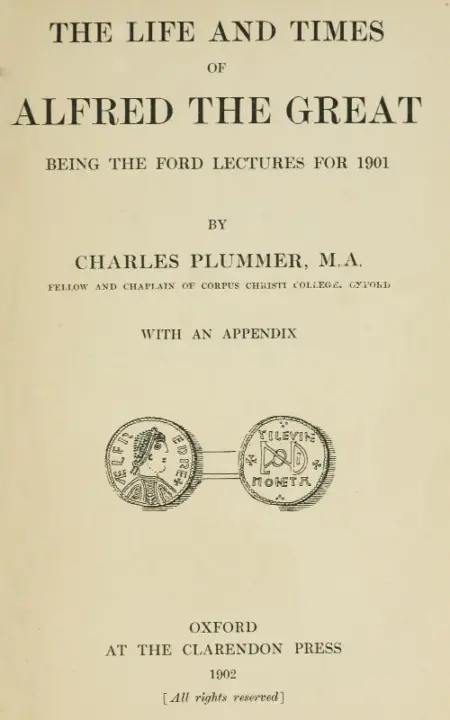
THE CLASSIC COLLECTION · 1902
"The Life and Times of Alfred the Great" by Charles Plummer is a historical account written in the early 20th century. This work presents a detailed examination of the life and legacy of King Alfred the Great, highlighting his contributions as a military leader, administrator, and promoter of education in a time of Viking invasions. Plummer’s account aims to clarify misconceptions about Alfred's character and actions while presenting a comprehensive view of his historical context. At the start of the text, the author introduces the lectures and expresses gratitude to historical figures who influenced his work. Plummer outlines his goal to address the existing confusions and oversimplifications surrounding King Alfred by critically surveying the sources available. He emphasizes the challenges historians face when interpreting the limited and often incomplete historical records about Alfred and remarks on the importance of a careful and nuanced understanding of this pivotal figure in English history. Through a methodical approach, Plummer sets the stage for a deep dive into Alfred's campaigns, governance, cultural contributions, and lasting impact on England.
Introduction adapted from the source catalogue; source summaries may be automatically generated.
Free to read · English · 77,156 words · No account needed
MAKE TIME FOR A GOOD BOOK
On by default. Untick to stop anonymous reading totals. Each page counts after 10 seconds in view. How this works.
Anonymous counting is on unless you have switched it off.
It was with a view to providing these necessary ‘tools,’ that Alfred seems to have established, probably after the example of Charles the Great[617], a Court school, for the education specially of the sons of the upper classes, in which books of both languages, Latin and Saxon, were read, especially the Psalms and Saxon poems, and writing also was taught; and to these studies the pupils applied themselves, till they were old enough to learn ‘hunting and other arts, befitting well-born men.’
This account of Asser[618] agrees well with the wish expressed by Alfred in the Preface to the Pastoral Care, ‘That all the freeborn youth of England who have sufficient means to devote themselves thereto, be set to learning so long as they are not strong enough for any other occupation, until such time as they can well read English writing. Let those be taught Latin whom it is proposed to educate further, and promote to higher office.’ This passage is most interesting; but we must not, on the strength of it, bring Alfred into court as an advocate either for or against classical education. On the one hand Alfred clearly wished that all who had the time and means should be taught Latin; on the other hand Latin was then, as it is not now, the sole vehicle of Western culture and science.
[Sidenote: Want of teachers supplied by Mercia, Wales, and the Frankish empire. John the Old Saxon. Grimbald. Letter of Archbishop Fulk to Alfred. Question of its genuineness.]
§ 88. But the great difficulty was to find teachers. Of England, the part which had suffered least from the ravages of the Danes was Western Mercia; moreover Offa had had a real desire to promote learning in his kingdom, as Alcuin’s letters show[619]; and from Mercia came Plegmund[620], whom Alfred ultimately made archbishop of Canterbury in succession to Æthelred, Werferth, the faithful bishop of Worcester, and two priests, Æthelstan and Werwulf, whom Alfred made his chaplains. The fact that Asser applies to these two last the term ‘sacerdotes,’ which, as I have elsewhere shown, is ambiguous in mediaeval Latin, sometimes meaning bishops, sometimes priests[621], has led Roger of Wendover not only to convert these priests into bishops, but to give them sees at Hereford and Leicester[622]; another illustration of the way in which myths arise. From Wales Alfred got Asser, as we have seen. But Britain alone could not supply Alfred’s needs; and the Frankish empire was now to repay to England some small portion of the debt which it owed for Boniface and Alcuin, in the persons of Grimbald and John the Old Saxon. Of the latter not much is known[623]. He was a monk of Corvey, and was made by Alfred abbot of his new monastery of Athelney. The story of his attempted murder there has been already alluded to[624]. The date of his coming to England is not known. The chronology of Grimbald’s life is also very obscure. Mabillon indeed was led to postulate two Grimbalds, who both came to England under Alfred. But his perplexity was largely caused by his acceptance of the Oxford interpolation in Asser as genuine; and his solution is quite incredible. Grimbald was a monk of St. Bertin’s in Flanders. He held various offices in that monastery, and in 892, on the death of Abbot Rudolf, the monks wished him to become their abbot; but with a view of protecting the monastery against the attacks of Count Baldwin of Flanders, Fulk, archbishop of Rheims, who had been abbot before Rudolf, was allowed to resume the abbacy, and hold it with his archbishopric[625]. If all this is true, Grimbald cannot have come to England much before 893, and as he is mentioned in the Preface to the Pastoral Care as one of Alfred’s helpers in that work (along with Plegmund, Asser, and John), it is obvious that this date for Grimbald’s arrival in England, if it be regarded as established, will have a very important bearing on the chronology of Alfred’s writings[626]. There is a letter extant[627] which purports to be Fulk of Rheims’ answer to Alfred’s application for Grimbald. Certainly, if Fulk was holding the abbacy of St. Bertin’s at this time, he would be the natural person to give permission to a monk of that house to leave his cloister[628], and Dr. Stubbs thought that the MSS. in which the letter is found were sufficiently ancient to exclude the suspicion of forgery. Its authenticity has however been doubted[629], and I confess it presents one very great difficulty to my mind. The letter throughout is written on the assumption that Grimbald is to be a bishop in England; he is to be placed over the care of pastoral rule, he is already a priest, and is worthy of pontifical honour; if Alfred will send Grimbald’s electors and certain leading men in Church and State, Fulk will then ordain him (i.e. as bishop, for he was already priest), and they can escort him to his proper see[630]. Alfred is represented as having stated in his application that, owing to the ravages of the Danes, the lapse of time, the carelessness of prelates, and the ignorance of the people, ecclesiastical order had much decayed in England[631], which is true enough, whoever wrote it. But there is no other evidence anywhere of any intention of making Grimbald a bishop. Dean Hook’s idea[632] that Alfred intended to make him archbishop of Canterbury, but finding the appointment of a foreigner unpopular, substituted Plegmund, has not a scrap of evidence to support it; while if Grimbald did not come to England till 893 the primacy had long been filled up. Ultimately Grimbald was made abbot of the New Minster at Winchester, where he died in 903, and became one of the tutelary saints of that foundation, winning a place in the English Calendar[633]. The tradition that Asser was one of the embassy sent to escort Grimbald to England has been already alluded to[634].
Your reading position is saved on this browser. Take it to another device with a library code. Reading pages adapt to text, rather than matching a printed edition.
BEHIND THE BOOK
This eBook is for the use of anyone anywhere in the United States and most other parts of the world at no cost and with almost no restrictions whatsoever. You may copy it, give it away or re-use it under the terms of the Project Gutenberg License included with this eBook or online at www.gutenberg.org. If you are not located in the United States, you will have to check the laws of the country where you are located before using this eBook. Read the source licence.
The original source file, including credits and licence, is retained by this library. Request an original-format copy at no charge. Please include the book title and Project Gutenberg identifier #56557.
KEEP YOUR CURIOSITY GOING
Cécile Tormay

Moritz Busch
John L. Ransom
Frances Wright
Cécile Tormay

Mabel Potter Daggett