THE CLASSIC COLLECTION✦An outlaw’s diary: the CommuneCLASSIC FREE BOOKS
An outlaw’s diary: the Commune
Cécile Tormay
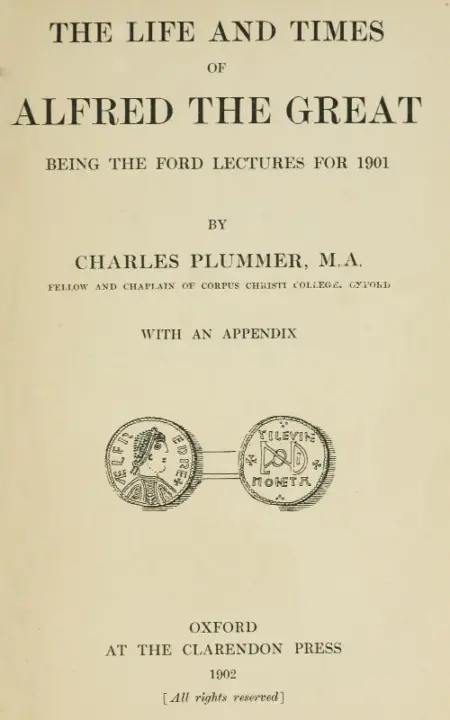
THE CLASSIC COLLECTION · 1902
"The Life and Times of Alfred the Great" by Charles Plummer is a historical account written in the early 20th century. This work presents a detailed examination of the life and legacy of King Alfred the Great, highlighting his contributions as a military leader, administrator, and promoter of education in a time of Viking invasions. Plummer’s account aims to clarify misconceptions about Alfred's character and actions while presenting a comprehensive view of his historical context. At the start of the text, the author introduces the lectures and expresses gratitude to historical figures who influenced his work. Plummer outlines his goal to address the existing confusions and oversimplifications surrounding King Alfred by critically surveying the sources available. He emphasizes the challenges historians face when interpreting the limited and often incomplete historical records about Alfred and remarks on the importance of a careful and nuanced understanding of this pivotal figure in English history. Through a methodical approach, Plummer sets the stage for a deep dive into Alfred's campaigns, governance, cultural contributions, and lasting impact on England.
Introduction adapted from the source catalogue; source summaries may be automatically generated.
Free to read · English · 77,156 words · No account needed
MAKE TIME FOR A GOOD BOOK
On by default. Untick to stop anonymous reading totals. Each page counts after 10 seconds in view. How this works.
Anonymous counting is on unless you have switched it off.
§ 5. When the electors to the Ford Lectureship did me the great honour of offering me the lectureship, coupled with the informal suggestion that the present set of lectures might appropriately be devoted to some subject connected with King Alfred, I warned them, in the letter in which I accepted both the offer and the suggestion, that it was unlikely that on such a well-worked period of English history I should be able to offer anything very new or original. That warning I must now repeat to you. If in the course of our labours I can remove some of the difficulties and confusions which have gathered round the subject, and put in a clearer light some points which have been imperfectly apprehended, that will be all that I can aspire to. For the rest I must be content to put in my own words, and arrange in my own way, what has been previously written by others or by myself; and these lectures may rank as Prolegomena, in the sense in which the late Master of Trinity College, Cambridge, remarked that Dean Alford seemed to have used that word in his edition of the Greek Testament, viz. ‘things that have been said before.’
[Sidenote: Prevalence of uncritical statements about Alfred.]
§ 6. But if I cannot tell you much that is very new, I hope that what I shall tell you may be approximately true. I shall not tell you, as a recent writer has done, that ‘by his invention of the shires [Alfred] anticipated the principles of the County Council legislation of ten centuries later[5].’ For, in the first place, Alfred did not ‘invent the shires’; and secondly, if I may quote a letter of my friend the Rev. C. S. Taylor, whose papers on Anglo-Saxon topography and archaeology[6] are well known to and appreciated by historical students, it ‘is surely a mistake to make Alfred, as some folks seem to do, into a kind of ninth century incarnation of a combined School Board and County Council.’ Yes, it is surely a mistake; and no less surely is it a mistake to make him into a nineteenth century radical with a touch of the nonconformist conscience[7]; or a Broad-Churchman with agnostic proclivities[8]. Nor shall I, with another recent writer, revive old Dr. Whitaker’s theory that St. Neot was an elder brother of Alfred, identical with the somewhat shadowy Athelstan who was under-king of Kent at any rate from 841 to 851[9]. For, firstly, it is very doubtful whether Athelstan was really Alfred’s brother, and not rather his uncle[10]; and secondly, as we shall see later on, St. Neot is an even more shadowy person than the under-king with whom Dr. Whitaker and Mr. Edward Conybeare would identify him; so shadowy indeed, as almost to justify an attitude of scepticism towards him as complete as that which Betsy Prig ultimately came to adopt towards the oft-quoted Mrs. Harris:—‘I don’t believe there never was no such person.’ I shall not repeat William of Malmesbury’s confusion of John the Old Saxon with John Scotus Erigena[11], and of Sighelm, Alfred’s messenger, with Sighelm, bishop of Sherborne in the following century[12]; or Henry of Huntingdon’s assertion[13] that Æthelwulf before his accession was bishop of Winchester. I shall not speak of an ‘Earl of Berkshire’ in the ninth century, nor tell you that Alfred’s Jewel is in the Bodleian[14], or that ‘the Danes made their first appearance on these shores in 832[15].’ Nor shall I tell you that ‘Alfred supplied chapter-headings and prefixed tables of contents to each of his authors, an improvement hitherto unheard of in literary work, which, simple as it seems now to us, betokened in its first conception no small literary genius[16]’; for I happen to have had better opportunities than most people of knowing that, in the case of Bede’s Ecclesiastical History, the chapter-headings were there long before Alfred undertook the work of translation. The same is true of Pope Gregory’s Dialogues, and of his Pastoral Care. The only works to which the above remarks could apply would be the Boethius and the Orosius translations; and even there we cannot be sure that the Latin MSS. used by Alfred had no chapter-headings; certainly the St. Gallen and Donaueschingen MSS. of Orosius have capitula[17], though, owing to the free way in which Alfred dealt with the Orosius, the Latin and Anglo-Saxon capitula do not correspond very closely. And the same is true of some Boethius MSS.[18] It is in truth a little disheartening to have all these old confusions and myths trotted out once more at this time of day as if they were genuine history. The fact is that there has been, if I may borrow a phrase from the Stock Exchange, a ‘boom’ in things Alfredian lately; and the literary speculator has rushed in to make his profit. Along with a few persons who are real authorities on the subjects with which they deal, eminent men in other departments of literature and life are engaged to play the parts which the ducal chairman and the aristocratic director play in the floatation of a company. They may not know very much about the business in hand, but their names look well on a prospectus. The result is not very creditable to English scholarship.
Your reading position is saved on this browser. Take it to another device with a library code. Reading pages adapt to text, rather than matching a printed edition.
BEHIND THE BOOK
This eBook is for the use of anyone anywhere in the United States and most other parts of the world at no cost and with almost no restrictions whatsoever. You may copy it, give it away or re-use it under the terms of the Project Gutenberg License included with this eBook or online at www.gutenberg.org. If you are not located in the United States, you will have to check the laws of the country where you are located before using this eBook. Read the source licence.
The original source file, including credits and licence, is retained by this library. Request an original-format copy at no charge. Please include the book title and Project Gutenberg identifier #56557.
KEEP YOUR CURIOSITY GOING
Cécile Tormay

Moritz Busch
John L. Ransom
Frances Wright
Cécile Tormay

Mabel Potter Daggett