THE CLASSIC COLLECTION✦An outlaw’s diary: the CommuneCLASSIC FREE BOOKS
An outlaw’s diary: the Commune
Cécile Tormay
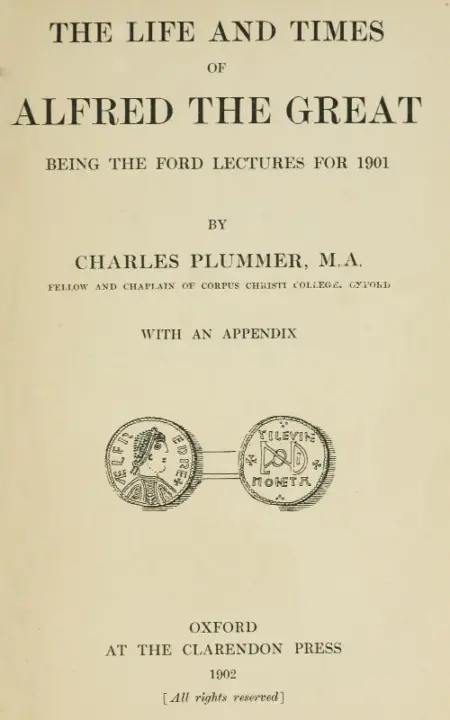
THE CLASSIC COLLECTION · 1902
"The Life and Times of Alfred the Great" by Charles Plummer is a historical account written in the early 20th century. This work presents a detailed examination of the life and legacy of King Alfred the Great, highlighting his contributions as a military leader, administrator, and promoter of education in a time of Viking invasions. Plummer’s account aims to clarify misconceptions about Alfred's character and actions while presenting a comprehensive view of his historical context. At the start of the text, the author introduces the lectures and expresses gratitude to historical figures who influenced his work. Plummer outlines his goal to address the existing confusions and oversimplifications surrounding King Alfred by critically surveying the sources available. He emphasizes the challenges historians face when interpreting the limited and often incomplete historical records about Alfred and remarks on the importance of a careful and nuanced understanding of this pivotal figure in English history. Through a methodical approach, Plummer sets the stage for a deep dive into Alfred's campaigns, governance, cultural contributions, and lasting impact on England.
Introduction adapted from the source catalogue; source summaries may be automatically generated.
Free to read · English · 77,156 words · No account needed
MAKE TIME FOR A GOOD BOOK
On by default. Untick to stop anonymous reading totals. Each page counts after 10 seconds in view. How this works.
Anonymous counting is on unless you have switched it off.
[927] ibid. i. 145; so in 838: ‘Imperator [Louis the Pious] filium suum Karolum armis uirilibus, i.e. ense cinxit, corona regali caput insigniuit,’ Theganus, Vita Hludouici, Pertz, ii. 643.
[928] See Chronicle, ii. 112-4; and add to the references there given, Ramsay, Foundations of England, i. 267; and an interesting little monograph on Alfred’s Boyhood and Death, by W. B. Wildman, Sherborne, 1898.
[929] Antony and Cleopatra, iv. 13. 67.
[930] ‘Pupillorum’; in Ps. ix. 34 (x. 16) ‘pupillo tu eris adiutor’ is paraphrased ‘þu eart fultumiend þara þe nabbað nawðer ne fæder ne modor.’ Cf. the elegy on the death of Charles the Great:—
‘Pater cunctorum orphanorum, omnium
Peregrinorum, uiduarum, uirginum.’
Printed at the end of Einhard’s Life (ed. Pertz, 1863), p. 41.
[931] i. 116.
[932] p. 519 A.
[933] Preface to Pastoral Care.
[934] Henry VI in 1441 did apply to Eugenius IV for Alfred’s canonisation, Bekynton’s Correspondence, i. 118, Rolls Series. I owe this reference to an interesting article in the London Quarterly for January 1902, which only came into my hands after the first three lectures were in type. The author, Mr. W. E. Collins, goes further than I can go in rejecting Asser, but his article is well worthy of attention.
[935] See Pauli, u. s. p. 126; cf. Essays, p. 13.
[936] Heb. xi. 33, 34.
[937] ‘Henry stands with Alfred, Canute, William the Conqueror, and Edward I, one of the conscious creators of English greatness.… If he had been a better man, his work would have been second to that of no character in history; had he been a weaker one than he was, England might have had to undergo for six hundred years the fate of France,’ Stubbs, Benedict of Peterborough, II. xxxiii, xxxvi.
[938] Sermon preached before the University on the Sunday following the death of Her late Majesty; now printed as an appendix to the present volume.
[939] Faust, Part I, Scene iv.
[940] Above, pp. 38, 120, 125-6, 129, 131, 135, 160, 191.
[941] Cf. Lord Rosebery’s inspiring address at Winchester (Humphreys’,
Piccadilly).
[942] Iliad, v. 303, 304.
[943] Cited by Ebert, ii. 151.
[944] ‘Usque ad quattuor milia quingenti traditi, et … in loco qui Ferdi [Verden] uocatur, iussu regis omnes una die decollati sunt,’ Einhardi Annales, sub anno 782.
[945] See above, p. 124.
[946] Tennyson, Guinevere.
[947] Above, p. 181.
[948] Hoveden, IV. lxxxi.
[949] Col. iv. 5; cf. 1 Thess. iv. 12.
[950] 1 Pet. ii. 12.
[951] 1 Cor. vii. 10-17.
[952] Matt. xiii. 33; Luke xiii. 21.
[953] John vi. 15.
[954] Luke xii. 14.
[955] Latham, Pastor Pastorum, pp. 403 ff.
[956] Gen. i. 27; Matt. xix. 4; Mark x. 6.
[957] Mark xii. 13 ff. and parallels.
[958] John xix. 11.
[959] Dante, Monarchia, Lib. i; cf. Purg. xxxii. 102:
‘Di quella Roma onde Cristo è Romano,’
though this is not the temporal, but the eternal Rome.
[960] Dante, Purg. x. 82 ff.; Parad. xx. 43 ff.
[961] 2 Cor. i. 4.
[962] 1 Tim. ii. 1, 2.
[963] c. lxi.
[964] Ad Philad. c. 6.
[The references are to the Pages.]
Abel, see Elias.
‘aedificia,’ special meaning of, in Asser, 46, 47.
Ælfheah, bishop of Winchester (934-51), 56 n.
Your reading position is saved on this browser. Take it to another device with a library code. Reading pages adapt to text, rather than matching a printed edition.
BEHIND THE BOOK
This eBook is for the use of anyone anywhere in the United States and most other parts of the world at no cost and with almost no restrictions whatsoever. You may copy it, give it away or re-use it under the terms of the Project Gutenberg License included with this eBook or online at www.gutenberg.org. If you are not located in the United States, you will have to check the laws of the country where you are located before using this eBook. Read the source licence.
The original source file, including credits and licence, is retained by this library. Request an original-format copy at no charge. Please include the book title and Project Gutenberg identifier #56557.
KEEP YOUR CURIOSITY GOING
Cécile Tormay

Moritz Busch
John L. Ransom
Frances Wright
Cécile Tormay

Mabel Potter Daggett