THE CLASSIC COLLECTION✦An outlaw’s diary: the CommuneCLASSIC FREE BOOKS
An outlaw’s diary: the Commune
Cécile Tormay
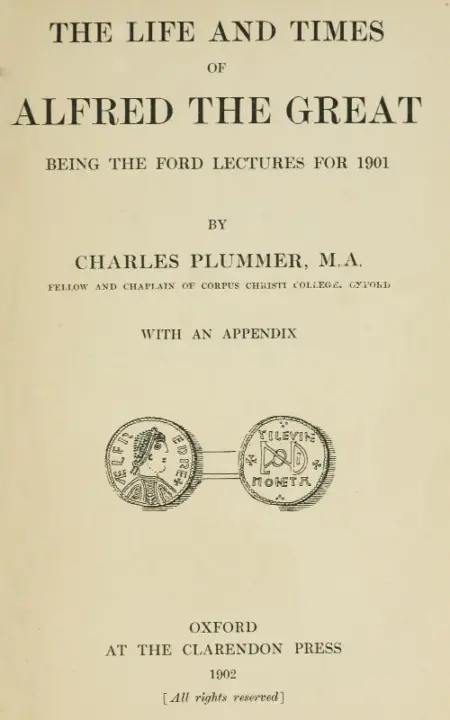
THE CLASSIC COLLECTION · 1902
"The Life and Times of Alfred the Great" by Charles Plummer is a historical account written in the early 20th century. This work presents a detailed examination of the life and legacy of King Alfred the Great, highlighting his contributions as a military leader, administrator, and promoter of education in a time of Viking invasions. Plummer’s account aims to clarify misconceptions about Alfred's character and actions while presenting a comprehensive view of his historical context. At the start of the text, the author introduces the lectures and expresses gratitude to historical figures who influenced his work. Plummer outlines his goal to address the existing confusions and oversimplifications surrounding King Alfred by critically surveying the sources available. He emphasizes the challenges historians face when interpreting the limited and often incomplete historical records about Alfred and remarks on the importance of a careful and nuanced understanding of this pivotal figure in English history. Through a methodical approach, Plummer sets the stage for a deep dive into Alfred's campaigns, governance, cultural contributions, and lasting impact on England.
Introduction adapted from the source catalogue; source summaries may be automatically generated.
Free to read · English · 77,156 words · No account needed
MAKE TIME FOR A GOOD BOOK
On by default. Untick to stop anonymous reading totals. Each page counts after 10 seconds in view. How this works.
Anonymous counting is on unless you have switched it off.
[834] See Stewart’s Boethius, p. 172; Moore, Dante Studies, i. 279-83; it may be noted that Augustine, Orosius, Gregory, Bede, and Boethius, all occur in Alcuin’s catalogue of the York Library, De Sanctis Ebor. vv. 1535 ff. Still more interesting is the fact that Augustine, Orosius, Boethius, Bede, are mentioned within a few lines of one another, Paradiso, x. 118-32.
[835] On Boethius generally, see Boethius, an essay by H. F. Stewart, 1891, a book from which I have learnt much. See also the article on Boethius in Dict. Christ. Biog.
[836] Stewart, p. 54.
[837] ibid., 78.
[838] Mr. Stewart, p. 106, puts it the other way; but I think the above statement does fuller justice to Boethius.
[839] Henry of Huntingdon and Petrarch among others wrote treatises De Contemptu Mundi. Boccaccio, as Mr. Archer reminds me, wrote a treatise De Casibus illustrium uirorum, on which Chaucer’s Monk’s Tale with the same title is founded.
[840] From a poem De Contemptu Mundi by Jacopone; Trench’s Sacred Latin Poetry, 3rd ed., p. 270. The Rhythm of Bernard of Morlaix, from which come ‘Jerusalem the Golden,’ ‘Brief life,’ &c., has the same title.
[841] Stewart, p. 203.
[842] ‘Misimi a leggere quello non conosciuto da molti libro di Boezio, nel quale, cattivo e discacciato, consolato s’ avea,’ Conv. ii. 13. This statement that the book was ‘not known by many’ is curious. On the use of Boethius by Dante, see Dr. Moore, u. s. pp. 282-8, 355, 356.
[843] I have not read this book myself; but More’s great-grandson Cresacre More describes it as ‘a most excellent book, full of spiritual and forcible motives, expressing lively Sir Thomas’ singular resolution to apply all those wholesome medicines to himself,’ Life of Sir T. More, ch. x. ad init.
[844] c. viii, Sedgefield, p. 20; cf. c. vii. § 2, p. 15.
[845] In Memoriam, vi.
[846] Matthew Arnold, Geist’s Grave.
‘Sunt lacrimae rerum, et mentem mortalia tangunt.’
[847] On the strength of this, Boethius obtained the honours of saintship, Moore, u. s. p. 282. Dante places Boethius in heaven, but among the theologians in the Sun, Paradiso, x. 124 ff., not among the warriors and martyrs of the Cross in Mars; though he says of his soul—
‘Ed essa da martiro
E da esilio venne a questa pace.’
[848] Stewart, p. 33.
[849] Stewart, pp. 1 ff.
[850] ibid., pp. 108 ff.
[851] ‘Uti in Timaeo Platoni nostro placet, in minimis quoque rebus diuinum praesidium debet inplorari,’ Lib. III, Prosa ix.
Your reading position is saved on this browser. Take it to another device with a library code. Reading pages adapt to text, rather than matching a printed edition.
BEHIND THE BOOK
This eBook is for the use of anyone anywhere in the United States and most other parts of the world at no cost and with almost no restrictions whatsoever. You may copy it, give it away or re-use it under the terms of the Project Gutenberg License included with this eBook or online at www.gutenberg.org. If you are not located in the United States, you will have to check the laws of the country where you are located before using this eBook. Read the source licence.
The original source file, including credits and licence, is retained by this library. Request an original-format copy at no charge. Please include the book title and Project Gutenberg identifier #56557.
KEEP YOUR CURIOSITY GOING
Cécile Tormay

Moritz Busch
John L. Ransom
Frances Wright
Cécile Tormay

Mabel Potter Daggett