THE CLASSIC COLLECTION✦An outlaw’s diary: the CommuneCLASSIC FREE BOOKS
An outlaw’s diary: the Commune
Cécile Tormay
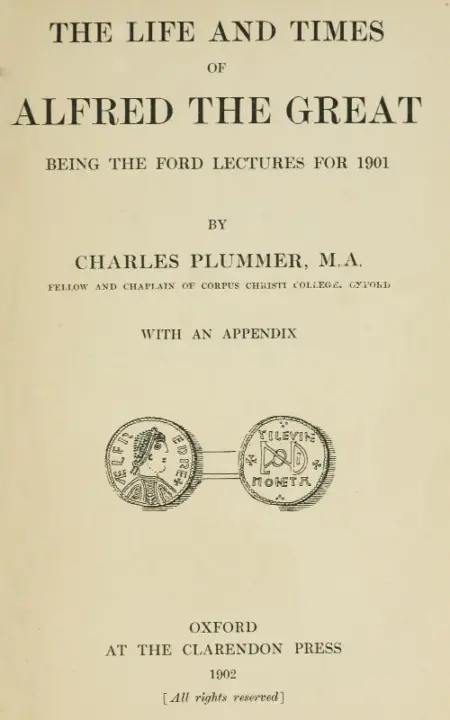
THE CLASSIC COLLECTION · 1902
"The Life and Times of Alfred the Great" by Charles Plummer is a historical account written in the early 20th century. This work presents a detailed examination of the life and legacy of King Alfred the Great, highlighting his contributions as a military leader, administrator, and promoter of education in a time of Viking invasions. Plummer’s account aims to clarify misconceptions about Alfred's character and actions while presenting a comprehensive view of his historical context. At the start of the text, the author introduces the lectures and expresses gratitude to historical figures who influenced his work. Plummer outlines his goal to address the existing confusions and oversimplifications surrounding King Alfred by critically surveying the sources available. He emphasizes the challenges historians face when interpreting the limited and often incomplete historical records about Alfred and remarks on the importance of a careful and nuanced understanding of this pivotal figure in English history. Through a methodical approach, Plummer sets the stage for a deep dive into Alfred's campaigns, governance, cultural contributions, and lasting impact on England.
Introduction adapted from the source catalogue; source summaries may be automatically generated.
Free to read · English · 77,156 words · No account needed
MAKE TIME FOR A GOOD BOOK
On by default. Untick to stop anonymous reading totals. Each page counts after 10 seconds in view. How this works.
Anonymous counting is on unless you have switched it off.
[652] ‘Die Verehrung der Reliquien und der Glaube an ihre Wunderkräfte war kaum zu irgend einer Zeit grösser,’ Ebert, u. s. ii. 99. 334 ff., iii. 208 ff.; Gregorovius, iii. 72 ff.; Bede, ii. 157 f.
[653] The MS. of the revised version, Hatton 76, is mutilated near the end of ii. 35, and has also several lacunae earlier in the work, Hecht, p. ix.
[654] See H. Johnson, Gab es zwei … altenglische Uebersetzungen der Dialoge Gregors? Berlin, 1884.
[655] e.g. 4, 14; 5, 1; 9, 19; 15, 9; 30, 21. Occasionally, though rarely, the later version is the longer, e.g. 36, 20; 37, 27; 42, 28. The references are to the pages and lines of Hecht’s edition, where the two texts are very conveniently printed in parallel columns.
[656] e.g. 17, 1 ff.; 31, 28 ff.; 41, 24 ff.; 43, 7 f.; 46, 14 ff.; 62, 9 ff.; 67, 1; 81, 30 ff.; 108, 2; 126, 19; 127, 20 ff.; 128, 2; 133, 12; 136, 7; 139, 16; 140, 3; 141, 21; 163, 10.
[657] 35, 17 æmtignesse C = otio, ingange H = ostio; 89, 30 mid oþrum C = cum aliis, mid fiðerum H = cum alis; at 145, 17 C is more correct than H, unless this too rests on a difference of reading, molesta for modesta; the latter is certainly right. (C = unrevised, H = revised text.)
[658] I give a few examples of changes frequently made, with the number of instances which I have noticed: ongitan altered to oncnawan (14 times; in three cases ongitan is retained); gangan to stæppan (7); tid to tima (8; in four cases tid is retained); cniht to cnapa (19; in three cases cniht is retained); wise to þing (17); semninga to færinga (8); hwæt, as exclamation, inserted (9). There are probably other instances of these changes which I have overlooked. But these are sufficient to show that they were systematically made. And the list could be easily enlarged.
[659] See above, pp. 34, 35.
[660] For this account of the Anglo-Saxon Chronicle I may refer generally to the Introduction to vol. ii of my edition, especially §§ 62, 68, 83, 89, 93, 100-8.
[661] For the body of scribes maintained by Alfred see the little verse Proem to the Pastoral Care; (the book itself is represented as speaking) ‘Ælfred kyning … me his writerum sende suð ⁊ norð; heht him swelcra ma brengan bi ðære bisene,’ pp. 8-9.
[662] Below, § 99.
[663] ‘Psalterium transferre aggressus, uix prima parte explicata, uiuendi finem fecit,’ G. R. i. 132. On Alfred’s fondness for the psalms see above, pp. 16, 140; below, p. 153. It is worth notice that in Boeth. xxxix. § 10 (p. 133), Alfred substitutes a quotation from the psalms, for the Greek quotation of the original.
[664] See Bede, ii. 137; so in Anglo-Saxon we have ‘let him sing one fifty,’ ‘two fifties,’ &c., ibid. 138; and add to the references there given, Thorpe, Ancient Laws, ii. 286.
[665] The MS. was edited by Mr. Thorpe for the Clarendon Press in 1835.
[666] See Wichmann in Anglia, xi. 41.
[667] Grundriss, p. 436.
[668] Anglia, xi. 39 ff.
Your reading position is saved on this browser. Take it to another device with a library code. Reading pages adapt to text, rather than matching a printed edition.
BEHIND THE BOOK
This eBook is for the use of anyone anywhere in the United States and most other parts of the world at no cost and with almost no restrictions whatsoever. You may copy it, give it away or re-use it under the terms of the Project Gutenberg License included with this eBook or online at www.gutenberg.org. If you are not located in the United States, you will have to check the laws of the country where you are located before using this eBook. Read the source licence.
The original source file, including credits and licence, is retained by this library. Request an original-format copy at no charge. Please include the book title and Project Gutenberg identifier #56557.
KEEP YOUR CURIOSITY GOING
Cécile Tormay

Moritz Busch
John L. Ransom
Frances Wright
Cécile Tormay

Mabel Potter Daggett