THE CLASSIC COLLECTION✦An outlaw’s diary: the CommuneCLASSIC FREE BOOKS
An outlaw’s diary: the Commune
Cécile Tormay
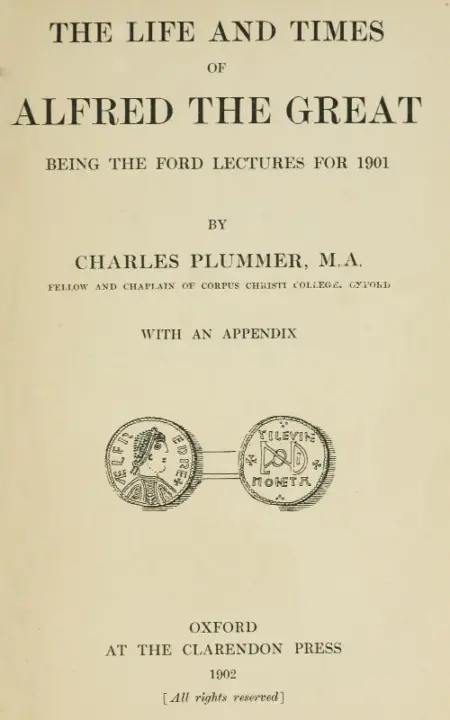
THE CLASSIC COLLECTION · 1902
"The Life and Times of Alfred the Great" by Charles Plummer is a historical account written in the early 20th century. This work presents a detailed examination of the life and legacy of King Alfred the Great, highlighting his contributions as a military leader, administrator, and promoter of education in a time of Viking invasions. Plummer’s account aims to clarify misconceptions about Alfred's character and actions while presenting a comprehensive view of his historical context. At the start of the text, the author introduces the lectures and expresses gratitude to historical figures who influenced his work. Plummer outlines his goal to address the existing confusions and oversimplifications surrounding King Alfred by critically surveying the sources available. He emphasizes the challenges historians face when interpreting the limited and often incomplete historical records about Alfred and remarks on the importance of a careful and nuanced understanding of this pivotal figure in English history. Through a methodical approach, Plummer sets the stage for a deep dive into Alfred's campaigns, governance, cultural contributions, and lasting impact on England.
Introduction adapted from the source catalogue; source summaries may be automatically generated.
Free to read · English · 77,156 words · No account needed
MAKE TIME FOR A GOOD BOOK
On by default. Untick to stop anonymous reading totals. Each page counts after 10 seconds in view. How this works.
Anonymous counting is on unless you have switched it off.
[612] St. Willibald in the preceding century (circa 720), took a very different route. I give the principal stages only: The Seine, Rouen, Gorthonicum(?), Lucca, Rome, Naples, Syracuse, Monemvasia, Cos, Samos, Ephesus, Miletus, Cape Chelidonium, Cyprus, Emesa, Damascus, Jerusalem. This also is printed in Tobler, u. s.
[615] Lib. ii. Prosa vii.
[616] Anglo-Saxon Version, ch. xvii; ed. Sedgefield, p. 40; the translation which follows is taken mainly from Mr. Sedgefield’s handy rendering of Alfred’s version into modern English, in which the passages added by Alfred to his original are very conveniently indicated by italics, p. 41.
[617] For Charles’ Court school cf. Weber, v. 392 ff.
[619] Writing to Offa Alcuin says: ‘ualde mihi placet quod tantam habetis intentionem lectionis, ut lumen sapientiae luceat in regno uestro, quod multis modo extinguitur in locis. Vos estis decus Britanniae, tuba praedicationis, gladius contra hostes, scutum contra inimicos,’ Monumenta Alcuiniana, p. 265.
[620] ‘Pleimundus … magister Elfredi regis,’ G. P. p. 20.
[621] Bede, ii. 55, 56. To avoid this ambiguity Lupus of Ferrières uses the expression ‘sacerdos secundi ordinis,’ Vita S. Wigberti, c. 5.
[622] R. W. i. 324; he alters Werwulf’s name into Werebert, probably because there was a bishop of Leicester of that name early in the ninth century. There was an Athelstan bishop of Hereford early in the eleventh century. This may give us an idea of Wendover’s critical skill.
[623] See Stubbs, W. M. II. xlviii.
[624] Above, p. 129.
[625] W. M. II. xliv ff.
[626] Johannes Longus, a later chronicler of St. Bertin’s, says that Grimbald came to England in consequence of the murder of Fulk, archbishop of Rheims, Pertz, xxv. 769; as the date of this was 900, the date of Grimbald’s arrival would be thrown to the very end of Alfred’s reign. The Liber de Hyda, p. 30, says that Grimbald was sent for by advice of Archbishop Æthelred. This would make the invitation at least as early as 889. And the same authority, p. 35, places his arrival in 885. But I do not attach much weight to any of these statements.
[627] Printed in Wise’s edition of Asser, pp. 123 ff., Birch, ii. 190
ff., and elsewhere.
[628] ‘nostrum est uobis illum canonice concedere,’ Wise, p. 128.
[629] e.g. by Pauli, u. s. p. 195; AA. SS. July, ii. 652.
[630] Wise, pp. 127, 128.
[631] Wise, p. 124.
[632] Lives of the Archbishops of Canterbury, i. 322.
[633] St. Grimbald’s mass day (July 8) is mentioned in the Chron. 1075 D ad init. See Chron. ii. 122, 123.
[634] Above, p. 18.
[635] ‘inde perplures instituere studuit,’ Asser, 592 A [56].
Your reading position is saved on this browser. Take it to another device with a library code. Reading pages adapt to text, rather than matching a printed edition.
BEHIND THE BOOK
This eBook is for the use of anyone anywhere in the United States and most other parts of the world at no cost and with almost no restrictions whatsoever. You may copy it, give it away or re-use it under the terms of the Project Gutenberg License included with this eBook or online at www.gutenberg.org. If you are not located in the United States, you will have to check the laws of the country where you are located before using this eBook. Read the source licence.
The original source file, including credits and licence, is retained by this library. Request an original-format copy at no charge. Please include the book title and Project Gutenberg identifier #56557.
KEEP YOUR CURIOSITY GOING
Cécile Tormay

Moritz Busch
John L. Ransom
Frances Wright
Cécile Tormay

Mabel Potter Daggett