THE CLASSIC COLLECTION✦An outlaw’s diary: the CommuneCLASSIC FREE BOOKS
An outlaw’s diary: the Commune
Cécile Tormay
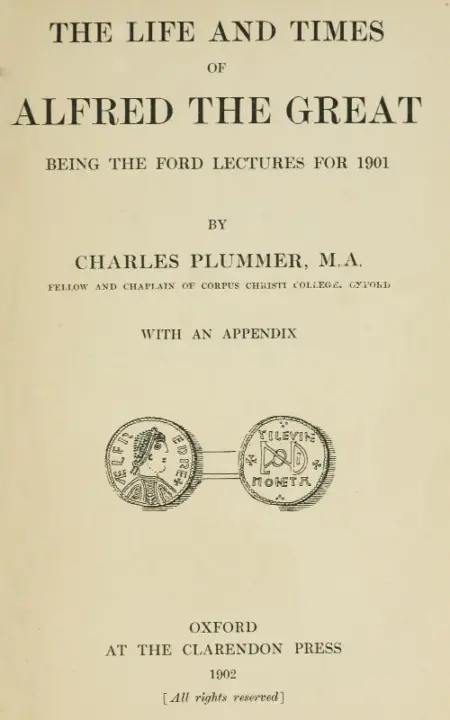
THE CLASSIC COLLECTION · 1902
"The Life and Times of Alfred the Great" by Charles Plummer is a historical account written in the early 20th century. This work presents a detailed examination of the life and legacy of King Alfred the Great, highlighting his contributions as a military leader, administrator, and promoter of education in a time of Viking invasions. Plummer’s account aims to clarify misconceptions about Alfred's character and actions while presenting a comprehensive view of his historical context. At the start of the text, the author introduces the lectures and expresses gratitude to historical figures who influenced his work. Plummer outlines his goal to address the existing confusions and oversimplifications surrounding King Alfred by critically surveying the sources available. He emphasizes the challenges historians face when interpreting the limited and often incomplete historical records about Alfred and remarks on the importance of a careful and nuanced understanding of this pivotal figure in English history. Through a methodical approach, Plummer sets the stage for a deep dive into Alfred's campaigns, governance, cultural contributions, and lasting impact on England.
Introduction adapted from the source catalogue; source summaries may be automatically generated.
Free to read · English · 77,156 words · No account needed
MAKE TIME FOR A GOOD BOOK
On by default. Untick to stop anonymous reading totals. Each page counts after 10 seconds in view. How this works.
Anonymous counting is on unless you have switched it off.
[494] The details are mostly from Asser, u. s. He gives the number of slain as 1200; i.e. CↃCC for IↃCCC. Ethelwerd, p. 515 E, says that the Danes were finally victorious; but it is hard to reconcile this with the Chronicle, and still more with Asser.
[495] The Chronicle puts this under 879; but, seeing that the battle of Ethandun was fought in May, it almost certainly belongs to the same year 878. It is this mistake which throws the chronology of the Chronicle a year wrong from this point up to 897 (= 896).
[496] No document exists embodying the terms of the agreement of 878. ‘Alfred and Guthrum’s peace,’ often confused with the treaty of Wedmore, belongs to 886.
[497] Chron. ii. 114.
[498] Idylls of the King, The Coming of Arthur.
[499] Chron. u. s. chiefly from Green, Conq. Engl. pp. 111 ff.
[500] p. 515 D.
[501] Cf. what is said in the Soliloquies, p. 182: ‘gyf þonne æfre gebyreð þ þu … hæfst ealle þine freond myd þe … on þam ilcan weorce, ⁊ on þam ilcan willan ðe ðe best lyst don’; cf. Boeth. xxix. § 1 (p. 66): ‘cyningas ne magon nænne weorðscipe forðbrengan buton hiora þegna fultume.’
[502] ‘urne ealra freond,’ Birch, No. 582; K. C. D. No. 327. I do not mean to assert that Werferth was at Athelney or Edington, though he may have been. But he and Æthelnoth were working for a common end, and his district benefited largely by Alfred’s victory.
[503] ‘They were the first European warriors who realised the value of quick movement in war,’ Green, C. E. p. 89.
[504] ‘þæer gehorsude wurdon,’ 866; ‘se gehorsoda here,’ 876, 877; ‘þa wearþ se here gehorsod æfter þæm gefeohte,’ 881. Conversely after a defeat: ‘his wurdon þær behorsude,’ 885. Asser, describing this last incident, says: ‘equis, quos de Francia secum adduxerant, derelictis,’ 483 C [37]; ‘hie asettan him … ofer [sc. to England] mid horsum,’ 893; cf. Flor. Wig. i. 111.
[505] Note the use of ‘bestelan’ for the movements of the invaders, 865,
876 (bis), 878.
[506] Earlier in the annal Alfred ‘rides’ to Brixton.
[507] ‘Ælfred æfter þam gehorsudan here mid fierde rad.’
[508] Sir Walter Besant, Essays, p. 17.
[509] For purely English events we have not, as a rule, the help of the foreign Chronicles, and cannot therefore be sure whether they also are dated a year in advance; but probably in most cases they are.
[510] That this and not 885 is the true date is proved by the Annales Vedastini, and the Chronicon Reginonis, Pertz, i. 521, 594.
[511] Asser, 483 B, C [37].
[512] This comes at the end of the annal in the Chronicle, but almost certainly refers to an earlier period of the year.
[513] ‘de Cantio,’ Asser, u. s.
[514] See above, § 50.
[515] Chron. ii. 99 f.
Your reading position is saved on this browser. Take it to another device with a library code. Reading pages adapt to text, rather than matching a printed edition.
BEHIND THE BOOK
This eBook is for the use of anyone anywhere in the United States and most other parts of the world at no cost and with almost no restrictions whatsoever. You may copy it, give it away or re-use it under the terms of the Project Gutenberg License included with this eBook or online at www.gutenberg.org. If you are not located in the United States, you will have to check the laws of the country where you are located before using this eBook. Read the source licence.
The original source file, including credits and licence, is retained by this library. Request an original-format copy at no charge. Please include the book title and Project Gutenberg identifier #56557.
KEEP YOUR CURIOSITY GOING
Cécile Tormay

Moritz Busch
John L. Ransom
Frances Wright
Cécile Tormay

Mabel Potter Daggett