THE CLASSIC COLLECTION✦An outlaw’s diary: the CommuneCLASSIC FREE BOOKS
An outlaw’s diary: the Commune
Cécile Tormay
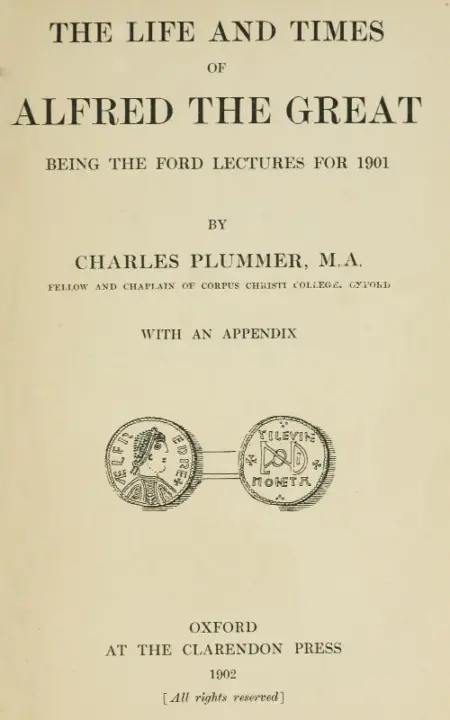
THE CLASSIC COLLECTION · 1902
"The Life and Times of Alfred the Great" by Charles Plummer is a historical account written in the early 20th century. This work presents a detailed examination of the life and legacy of King Alfred the Great, highlighting his contributions as a military leader, administrator, and promoter of education in a time of Viking invasions. Plummer’s account aims to clarify misconceptions about Alfred's character and actions while presenting a comprehensive view of his historical context. At the start of the text, the author introduces the lectures and expresses gratitude to historical figures who influenced his work. Plummer outlines his goal to address the existing confusions and oversimplifications surrounding King Alfred by critically surveying the sources available. He emphasizes the challenges historians face when interpreting the limited and often incomplete historical records about Alfred and remarks on the importance of a careful and nuanced understanding of this pivotal figure in English history. Through a methodical approach, Plummer sets the stage for a deep dive into Alfred's campaigns, governance, cultural contributions, and lasting impact on England.
Introduction adapted from the source catalogue; source summaries may be automatically generated.
Free to read · English · 77,156 words · No account needed
MAKE TIME FOR A GOOD BOOK
On by default. Untick to stop anonymous reading totals. Each page counts after 10 seconds in view. How this works.
Anonymous counting is on unless you have switched it off.
[224] Above, p. 44. Other good additions will be found under 853, 871. (I do not include under this head the story of Æthelred and his mass.) But the fact that Asser was occasionally able to make authentic additions no more disproves the greater originality of the Chron. than similar additions in Ethelwerd, who, while following in the main the Chron., evidently had other good sources now lost. On the type of Chron. used by Asser, see Chron. II. lxxxiv.
[225] 492 C [58]: ‘ad quadragesimum quintum [annum] quem nunc agit.’
[226] 496 A [67], from Cura Past. iii. c. 20. [Anglo-Saxon Version, cap.
xliv.]
[227] Alfred says that he translated sometimes ‘word be worde,’ word by word, sometimes ‘andgit of andgite,’ ‘sensum ex sensu.’ The exact correspondence is curious.
[228] See above, §§ 24, 25.
[229] u. s. p. 356.
[230] Rev. C. S. Taylor, The Danes in Gloucestershire, pp. 7-9.
[232] Ed. Coxe, i. 331, 332.
[233] pp. 339 ff.
[234] ‘Saxones Anglicos Zephyri sub uento morantes,’ p. 350.
[235] AA. SS. July vii. 314 ff.
[236] ‘Priusquam Anglia … Nortmannorum subiugaretur ditioni,’ p. 320ᵇ.
[237] p. 320ᵃ.
[238] Imitatio, i. 3; Eng. Transl. ed. 1863.
[239] p. 320ᵇ.
[240] pp. 317 ff.
[241] Whitaker, u. s. p. 367.
[242] pp. 256 ff.
[243] In the Shrine, pp. 12 ff.
[244] Anglia, iii. 104 ff.
[245] Catalogue of British History, i. 539.
[246] Two Saxon Chronicles, pp. 351 ff.
[247] See below, p. 56, note 4.
[248] Grundriss … der angelsächsischen Litteratur, p. 494.
[249] Gorham, pp. 256, 257.
[250] ibid. 258.
[251] AA. SS. u. s. p. 321ᵃ; Whitaker, pp. 318, 367.
[252] AA. SS. ibid.; Whitaker, p. 367. The Metrical Life seems to make him king of Kent only, ibid. 318.
[253] Whitaker, p. 318.
[254] AA. SS. p. 321ᵇ; Whitaker, pp. 320, 367.
[255] AA. SS. ibid.; Whitaker, p. 321.
[256] Whitaker, p. 343; Gorham, p. 257: ‘on Sc͠es Ælfeges dagen þæs halgen biscopes.’ The absurdity is hardly less if we suppose the earlier Ælfheah to be meant, 934-951. But the title of ‘Saint’ seems to show that the later one is intended. If so, the life cannot at any rate be earlier than 1012. And this alone would be fatal to Ælfric’s authorship, as he was himself a personal friend of this later Ælfheah, and could not possibly have made such a confusion; cf. Wülker, Grundriss, p. 455.
[257] AA. SS. pp. 322ᵇ, 323ᵃ; Whitaker, pp. 328, 346, 368; Gorham, p. 257.
[258] AA. SS. p. 323ᵇ; Whitaker, pp. 329, 346, 368.
[259] AA. SS. p. 325ᵃ; Whitaker, pp. 333 ff., 347 ff., 370 ff.; Gorham,
p. 258.
[260] AA. SS. p. 325ᵇ; Whitaker, pp. 335, 349, 372; Gorham, pp. 258, 259.
[261] AA. SS. p. 327ᵃ: ‘panes … quos nonnulli liridas appellant’; Whitaker, pp. 351 ff.; Gorham, p. 259.
[262] AA. SS. pp. 327ᵇ-328ᵇ; Whitaker, pp. 355 ff., 371 ff.; Gorham, p.
260.
[264] Bede, ii. 48, 168, 175, 243, 371.
[265] Ebert, u. s. ii. 229.
[266] AA. SS. pp. 323ᵃ, 325ᵇ; Whitaker, pp. 328, 348, 368, 370; Gorham,
p. 258.
[267] Gregorovius, Gesch. der Stadt Rom, iii. 206, 207. The Saxon Chronicle dates his pontificate 883-885, another indication that it is a year in advance of the true chronology.
[268] AA. SS. p. 325ᵇ; Whitaker, pp. 335, 349, 372; Gorham, p. 259.
[269] Chron. 885.
[270] ibid. 883; omitted in MS. ‘A’ only. According to Malmesbury, Alfred gave this relic to Glastonbury, Antiq. Eccl. Glast. p. 316 (ed. Gale).
Your reading position is saved on this browser. Take it to another device with a library code. Reading pages adapt to text, rather than matching a printed edition.
BEHIND THE BOOK
This eBook is for the use of anyone anywhere in the United States and most other parts of the world at no cost and with almost no restrictions whatsoever. You may copy it, give it away or re-use it under the terms of the Project Gutenberg License included with this eBook or online at www.gutenberg.org. If you are not located in the United States, you will have to check the laws of the country where you are located before using this eBook. Read the source licence.
The original source file, including credits and licence, is retained by this library. Request an original-format copy at no charge. Please include the book title and Project Gutenberg identifier #56557.
KEEP YOUR CURIOSITY GOING
Cécile Tormay

Moritz Busch
John L. Ransom
Frances Wright
Cécile Tormay

Mabel Potter Daggett