THE CLASSIC COLLECTION✦An outlaw’s diary: the CommuneCLASSIC FREE BOOKS
An outlaw’s diary: the Commune
Cécile Tormay
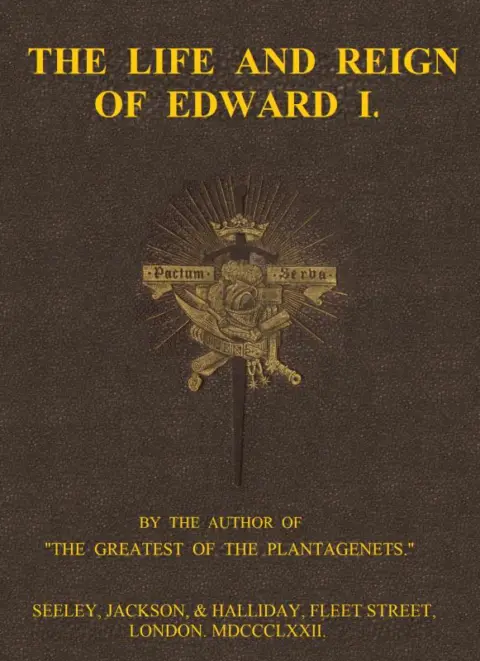
THE CLASSIC COLLECTION · 1872
"The Life and Reign of Edward I." by Robert Benton Seeley is a historical account written in the late 19th century. The work focuses on the life and governance of Edward I of England, tracing his personal and political development against the backdrop of significant events during his reign. The author aims to present a comprehensive picture of Edward's character, emphasizing his contributions to English law and society. The opening of the text provides insight into Edward's early life, beginning with his birth in 1239 and the joys surrounding it in England's capital. It highlights the historical context of his time, particularly the transition from Norman rule to a sense of English identity. The narrative illustrates the affectionate relationship Edward had with his father, Henry III, while also hinting at the challenges he would face as a ruler. The opening sets the stage for exploring Edward's maturation into a principled monarch who sought to improve the state of England through effective governance, ultimately laying the groundwork for future discussions on his reign's impact on legal and social frameworks.
Introduction adapted from the source catalogue; source summaries may be automatically generated.
Free to read · English · 110,512 words · No account needed
MAKE TIME FOR A GOOD BOOK
On by default. Untick to stop anonymous reading totals. Each page counts after 10 seconds in view. How this works.
Anonymous counting is on unless you have switched it off.
[82] That the name was, in his own day, William Walays, is a fact concerning which there is no room for doubt. The Scalachronica (recently printed by the Maitland Club of Glasgow), was written by one who personally knew the Insurgent leader, and he always writes the name Walays. Hemingford and Langtoft, two of the best English historians of that day, always write it Walays. In the “Wallace Documents,” printed by the Maitland Club, a Charter is given, granted by the Insurgent leader himself, and there the name stands Walays. A century later, Andrew Wyntoun, one of the earliest and best of the Scottish historians, writing about A.D. 1420, always speaks of Walays. Other writers, following the sound only, write of Walais, or Waleis. But when many other names suffered change—Botteville into Botfield, and De Moleyns into Mullins—Walays also was corrupted into “Wallace.” So entirely has this corruption rooted itself in our English literature, that we shall feel compelled to yield to it, and shall use, in the following pages, the customary name of “Wallace.”
[83] Lewis on “Roman History,” p. 16.
[84] Hemingford, Trivet, Matthew of Westminster, Wykes, Rishanger, Langtoft, Knighton, the Chronicles of Lanercost, Rochester, St. Alban’s, Abingdon, etc.
[85] Tytler’s History of Scotland, vol. i., p. 134.
[86] History of Scotland, vol. i., pp. 126, 127.
[87] Tytler’s Scottish Worthies, pp. 172, 184.
[88] Tytler’s Scottish Worthies, p. 186.
[89] “Wallace Documents,” p. 30.
[90] Chalmers’ Caledonia, vol. i., p. 659.
[91] Macfarlane’s History of England, vol. iv., p. 54.
[92] History of Scotland, vol. i., p. 72.
[93] Hist. of Scotland, vol. i., p. 142.
[94] A recent writer, Mr. Pearson, expresses a doubt whether these acts of unusual cruelty are sufficiently established by evidence. This incredulity is hardly reasonable. Several English writers who lived at the time assert the facts; all Scottish historians, Fordun, Wyntoun, Boece, and Blind Harry, confirm the statement,—some in general, others in specific terms; and the charges deliberately read to the prisoner in Westminster Hall, with the sentence passed, surely may be regarded as leaving no room for doubt.
[95] Tytler, Hist. Scotl., vol. i., p. 143.
[96] Ibid, p. 146.
[97] Selkirkshire, at the present, has about 9,800 people in the whole county. In 1298 it probably had not 2,000.
[98] Cronykyl, viii. 13.
[99] Tytler, vol. i., p. 142-147.
[100] Tytler, vol. i., p. 163.
[101] Hume, chap. xiii.
Your reading position is saved on this browser. Take it to another device with a library code. Reading pages adapt to text, rather than matching a printed edition.
BEHIND THE BOOK
This eBook is for the use of anyone anywhere in the United States and most other parts of the world at no cost and with almost no restrictions whatsoever. You may copy it, give it away or re-use it under the terms of the Project Gutenberg License included with this eBook or online at www.gutenberg.org. If you are not located in the United States, you will have to check the laws of the country where you are located before using this eBook. Read the source licence.
The original source file, including credits and licence, is retained by this library. Request an original-format copy at no charge. Please include the book title and Project Gutenberg identifier #50866.
KEEP YOUR CURIOSITY GOING
Cécile Tormay

Moritz Busch
John L. Ransom
Frances Wright
Cécile Tormay

Mabel Potter Daggett