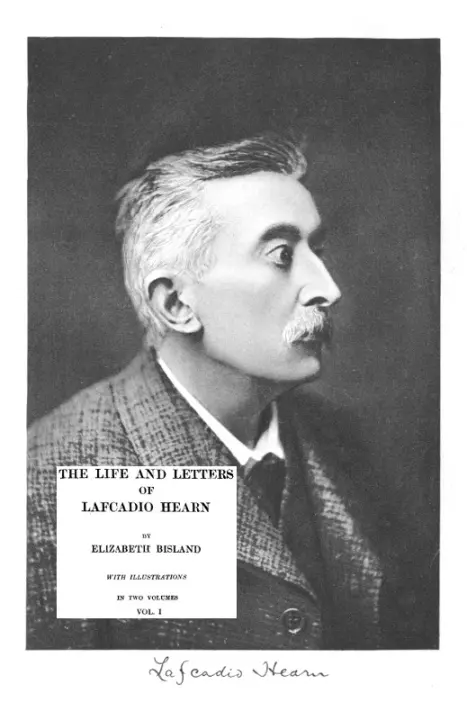
The Life and Letters of Lafcadio Hearn, Volume 1
Elizabeth Bisland
THE CLASSIC COLLECTION · 1906
"The Life and Letters of Lafcadio Hearn, Volume 2" by Elizabeth Bisland is a collection of correspondence written in the early 20th century. This volume delves into the experiences and reflections of Lafcadio Hearn, a notable writer and translator renowned for his writings on Japan. The letters provide insight into his life, thoughts on Japanese culture, and his deep admiration for the country and its people. At the start of the volume, the reader is introduced to Hearn's expressive and passionate writing style through various letters addressed to friends and colleagues. He shares his feelings about Japan's beauty and cultural nuances, discussing the spirituality of its nature and simplicity of its people. Hearn confides his struggles with finding employment, his dedication to studying Buddhism, and his deep desire to immerse himself in Japanese life through teaching and cultural exploration. Together, these letters reveal both his personal challenges and his heartfelt connection to Japan, setting the tone for a rich exploration of his literary journey.
Introduction adapted from the source catalogue; source summaries may be automatically generated.
Free to read · English · 144,751 words · No account needed
MAKE TIME FOR A GOOD BOOK
On by default. Untick to stop anonymous reading totals. Each page counts after 10 seconds in view. How this works.
Anonymous counting is on unless you have switched it off.
Mountains, sadness produced by sight of, II: 151.
Mud-dauber, I: 89.
Muir, John, I: 388.
Müller, Friedrich Max, his Sacred Books of the East, I: 327.
Muezzin, call of the. See Azan.
Mukden, Manchuria, I: 106.
Mulock, Dinah, her John Halifax used as a reading-book in Kumamoto,
II: 79.
Murderer, Hearn's description of a, I: 322, 323.
Murger, Henri, philosophy of his Bohemianism, I: 242.
Murray, John, guide-book published by, II: 37, 43.
Music, infinity of, I: 179;
demands of, 180;
opportunities for studying, 182;
antique, 211, 213;
in the Talmud, 287;
Spencer's essay of musical origination, 325;
mathematics of, 385.
See also Brittany, Creoles, Cuba, Eskimo, Finland, Griots, Havana,
Japan, Mexico, Negro, Scandinavia, Timbuctoo, Wales, West
Indies.
Musical instruments, I: 165-167, 211-213, 311, 353. See also Bagpipe, Chalumeau, Egypt, Flute, Greece, Harps, Judæa, Marimba, Negro, Sistrum, Syrinx.
Musset, Alfred de, I: 254, 255.
Mystic number, Japanese, II: 80.
Nakamura, Mr., II: 68.
Nala, story of, I: 402.
Names, of Japanese women, Hearn's article on, II: 445, 446, 447.
Nanji-umi, II: 30.
Naples, museum of, I: 213.
Napoleon I, II: 160, 173.
Natural selection, only one factor of evolution, II: 235.
Naturalism, in art and literature, I: 228.
Nature, in Japan, II: 3;
attitudes toward, in East and West, 123-125, 131, 425, 426;
immorality of, 189.
Negro, vocal chords of, I: 313, 339, 356;
West Coast races and, 332;
their talent for improvisation, 353;
temperature of blood of, 356;
music of the American, 358;
musical instruments played by, in West Indies, 411.
Neith, Egyptian divinity, I: 315.
Neptune, festival of, I: 386.
Nerval, Gérard de, pseud. See Labrunie, Gérard.
Nervous system, weight of, II: 245.
New Orleans, La., Hearn removes to, I: 65, 66, 67;
conditions in, after the war, 68, 69;
yellow fever in, 69, 185, 186, 195;
Hearn leaves, 97;
description of an old Creole house in, 172-174;
a Chinese restaurant in, 203, 204;
maladministration in, 215; Hearn's disappointment in, 224, 225.
See also Métairie.
New York City, Hearn goes to, I: 39, 40, 101, 102; his dislike of, 288, 405, 425, 443, 444; II: 182, 476, 484.
Newts, tradition regarding, at Sakusa, Japan, II: 26.
Nichiren, followers of, II: 27;
prevalence of, at Yabase, 47;
temple of, at Yabase, 55.
Nidānakathā, I: 287.
Nietzsche, Friedrich Wilhelm, II: 325, 514.
Nishida, Sentarō, I: 116, 122; II: 9, 23, 33;
letters from Hearn to, II: 18, 19, 54, 55, 65-69, 72-76, 95-98,
101-106, 118, 119, 141-145, 153-160, 165-167, 180-182,
191-193, 274-276, 278-280, 291, 292, 296-299, 303-305,
327-332;
his knowledge of English, 101;
his ballad of Shuntoku-maru, 130.
Nishinomiya, Japan, II: 8.
Noguchi, Yone, I: 159.
Nordau, Max, false theories of, II: 277;
his Degeneration, 456.
North, stimulus to literary production in, I: 194;
conceptions of beauty in, 211;
intellectual vigour of, 423;
struggle for life in, 424.
Nude, the, in art, I: 30, 31.
Numi, a Japanese friend of Hearn, II: 465.
Occident, possible future domination of, by Orient, II: 29;
indifference in, to stories of the real life of the Orient, 362,
363.
Ochiai, T. See Inomata, Teizaburō.
O'Connor, William D., Hearn's letters to, I: 73;
his first acquaintance with, 80;
text of the letters, 268-275, 290-292, 315-320, 326-329, 340, 341,
348-351, 364-367, 380-384;
Hearn's advice regarding an illness, 365-367;
his death, II: 432.
Odd, Hearn's pursuit of the, I: 290, 291, 294, 328, 329.
Odin, the Hávamál of, II: 428.
Œdipus, II: 168.
Your reading position is saved on this browser. Take it to another device with a library code. Reading pages adapt to text, rather than matching a printed edition.
BEHIND THE BOOK
This eBook is for the use of anyone anywhere in the United States and most other parts of the world at no cost and with almost no restrictions whatsoever. You may copy it, give it away or re-use it under the terms of the Project Gutenberg License included with this eBook or online at www.gutenberg.org. If you are not located in the United States, you will have to check the laws of the country where you are located before using this eBook. Read the source licence.
The original source file, including credits and licence, is retained by this library. Request an original-format copy at no charge. Please include the book title and Project Gutenberg identifier #42313.
KEEP YOUR CURIOSITY GOING

David Patterson (Spirit) Hatch

David Patterson (Spirit) Hatch

David Patterson (Spirit) Hatch
John L. Ransom

Ralph Waldo Emerson

Maurice Baring