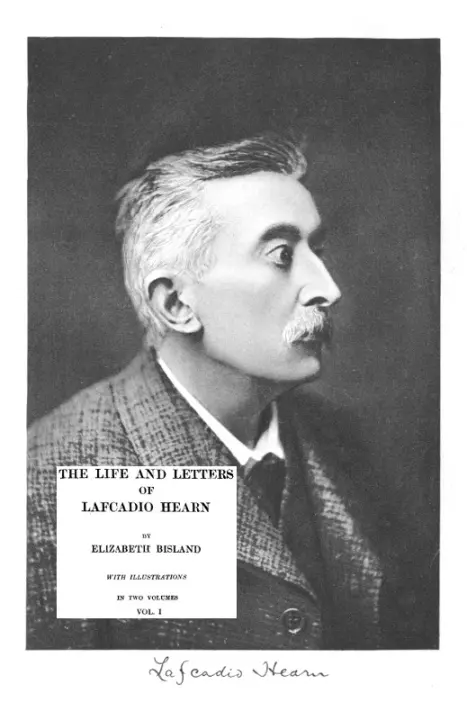
The Life and Letters of Lafcadio Hearn, Volume 1
Elizabeth Bisland
THE CLASSIC COLLECTION · 1906
"The Life and Letters of Lafcadio Hearn, Volume 2" by Elizabeth Bisland is a collection of correspondence written in the early 20th century. This volume delves into the experiences and reflections of Lafcadio Hearn, a notable writer and translator renowned for his writings on Japan. The letters provide insight into his life, thoughts on Japanese culture, and his deep admiration for the country and its people. At the start of the volume, the reader is introduced to Hearn's expressive and passionate writing style through various letters addressed to friends and colleagues. He shares his feelings about Japan's beauty and cultural nuances, discussing the spirituality of its nature and simplicity of its people. Hearn confides his struggles with finding employment, his dedication to studying Buddhism, and his deep desire to immerse himself in Japanese life through teaching and cultural exploration. Together, these letters reveal both his personal challenges and his heartfelt connection to Japan, setting the tone for a rich exploration of his literary journey.
Introduction adapted from the source catalogue; source summaries may be automatically generated.
Free to read · English · 144,751 words · No account needed
MAKE TIME FOR A GOOD BOOK
On by default. Untick to stop anonymous reading totals. Each page counts after 10 seconds in view. How this works.
Anonymous counting is on unless you have switched it off.
That was an age in which it was the fashion to keep all emotion suppressed. But Pope is a useful study for English classes in England, because of what English students can take from it through the mere study of form, of compact and powerful expression with very few words. Here, the situation is exactly converse. The value of foreign poetry to you cannot be in the direction of form. Foreign form cannot be reproduced in Japanese any more than French can be produced into English. The value of foreign poetry is in what makes the soul, the heart, the heart of all poetry:--feeling and imagination. Foreign feeling and foreign imagination may help to add something to the beauty and the best quality of future Japanese poetry. There I think the worth of study may be very great. But when foreign poetry means nothing but correct verse, you might as well waste no time upon it; as there is much great poetry which has good form as well as strong feeling.
Adulteration, in food and morals, II: 139-141.
Æsthetics, Y. Hirn's study of, II: 20, 21.
Africa, musical aptitudes of races of, I: 284, 353; transplantation of melodies of, to America, 356, 380, 411.
Ahriman, the Persian Spirit of Darkness, II: 118, 126.
Akizuki, teacher of Chinese at Kumamoto, I: 125; II: 66, 67, 73, 119,
177.
Albee, John, I: 83;
letters from Hearn to, I: 276,277; II: 358-361;
his Prose Idyls, 360.
Albee, Mrs. John, I: 358, 359, 360.
Alden, Henry Mills, I: 286, 378, 405, 428.
Alexander the Great, I: 161.
Allen, Grant, Hearn's comment on, I: 394.
Allen, James Lane, II: 377.
Allingham, William, II: 522;
a verse by, 521.
Amaron, lyrics of, I: 368.
Ama-terasu-Omi-Kami, II: 25.
Amenomori, Nobushige, I: 128, 139, 159; II: 217, 346, 353, 380, 390,
391, 392, 394;
photograph of, 376.
Amicis, Edmondo de, his Cuore, I: 456; II: 102.
Amiel, Henri Frédéric, his Journal Intime, II: 400.
Ancestors, worship of, II: 28.
Andersen, Hans, Hearn's comment on, II: 251.
Angelinus, I: 256.
Anglo-American alliance, II: 384.
Anglo-Saxon race, future of, II: 137.
Antæus, II: 454.
Antilles. See West Indies.
Apes, treatment of, on board ship, I: 413, 414.
Apollo, Temple of, at Levkas, I: 3.
Apollonius of Tyana, I: 321, 322.
Arabia, hero-stories of, I: 234, 237.
Aristocracies, value of, II: 248.
Arnold, Edwin, I: 282, 335, 454;
his Light of Asia, 291;
Hearn's opinion of, 319;
his translation of the story of Nala, 402.
Arnold, Matthew, Hearn's comments on, I: 318, 319.
Arnoux, ----, I: 465, 466; II: 347.
Arrows, used in Japanese rice-fields, II: 6.
Arrows of prayer, II: 6.
Art, nature of antique, I: 211;
standards of, 216-218;
sacrifices and rewards of, 237-239, 242, 243;
return to antique, 254;
money considerations should not enter into, 336;
ghostliness of, II: 19, 20;
use of the distorted in, 125-127
secret of literary, 345, 346.
Asai, Mr., II: 298, 299.
Assyria, ghost-stories of, II: 251.
Aston, William George, II: 484.
Atlantic City, N. J., I: 451.
Atlantic Monthly, I: 293, 317, 321, 397.
Aubryet, Xavier, I: 340.
Augustin, Jean, I: 70, 71, 363; II: 294.
Austin, Alfred, II: 302.
Azan, the muezzin's call, I: 280, 281, 283, 309, 317, 321.
Azukizawa, one of Hearn's pupils, II: 68.
Your reading position is saved on this browser. Take it to another device with a library code. Reading pages adapt to text, rather than matching a printed edition.
BEHIND THE BOOK
This eBook is for the use of anyone anywhere in the United States and most other parts of the world at no cost and with almost no restrictions whatsoever. You may copy it, give it away or re-use it under the terms of the Project Gutenberg License included with this eBook or online at www.gutenberg.org. If you are not located in the United States, you will have to check the laws of the country where you are located before using this eBook. Read the source licence.
The original source file, including credits and licence, is retained by this library. Request an original-format copy at no charge. Please include the book title and Project Gutenberg identifier #42313.
KEEP YOUR CURIOSITY GOING

David Patterson (Spirit) Hatch

David Patterson (Spirit) Hatch

David Patterson (Spirit) Hatch
John L. Ransom

Ralph Waldo Emerson

Maurice Baring